


Last month I wrote about a wind turbine for Princetown, the highest built-up area in England and Wales, and more of you read it than anything I have written about my own village. Many of the replies asked the same thing, some politely: what about the prison?
It is the question nobody here can avoid. HMP Dartmoor sits at the top of the village. It is the reason the village exists, and it has been empty for more than two years. This post is my attempt to take that question seriously. I'm going to suggest a data centre, and I know how that sounds.
The sound of music
Ask most communities how they would feel about a data centre and you will get a version of the same answer. In the US the answer has become a movement. Data Center Watch, which tracks local opposition, counted $68bn of projects blocked or delayed in the second quarter of this year alone, after $130bn in the first. It now counts 843 local groups opposing data centres, in every state except Hawaii. Eighteen months ago it counted 142.
The fights are getting bigger, and they are getting won:
Prince William County, Virginia. A $25bn, 2,100-acre campus next to the Manassas battlefield. A judge voided the rezoning and the appeals court agreed in March. The county gave up in April, after spending $1.7m of taxpayers' money defending it.
Saline Township, Michigan. A 1.4 GW OpenAI and Oracle campus on farmland. The township said no, the developer sued, and the township settled for about $14m of "community benefits", more than ten times its annual budget. Residents are now trying to recall the board.
Indiana. Indianapolis voted 23 to 1 for a moratorium in August. By one count, 25 of the state's 92 counties now have one.
In Georgia, power bills and data centres helped end 20 years of one-party control of the state's utility regulator.
The complaints are not cranky. Most of them are reasonable:
Bills. In the biggest US power market, data centres are more than 90% of the new demand expected by 2030, and capacity prices have hit their cap three years running.
Water. Evaporative cooling uses roughly 2 to 4 litres of water for every kWh.
Noise. Fans, chillers and diesel generators that are tested every month.
Land. Most are new sheds on fields, often farmland or green belt.
Jobs. Hundreds during construction, then very few. A recent analysis of new UK campuses found about 1.2 permanent jobs per megawatt, against the industry's claim of 8.5.
Secrecy. Projects arrive under code names, behind non-disclosure agreements.
Britain is heading the same way. The government made data centres Critical National Infrastructure in 2024, and since January developers can skip the local council and go through the national infrastructure planning route. Ministers overturned local refusals on green-belt land at Abbots Langley and at Iver. At Iver the government later admitted a "serious logical error". In Scotland one scheme at Larbert drew almost 7,000 objections. And as I wrote last month about Loughton, around London they are running out of grid.
I'm not going to argue those concerns away. If you live next to a field that is about to become a 200 MW shed, I'd be worried too. My question is narrower. If Britain is going to build data centres anyway, where would one do the least harm and the most good? I think the answer looks a lot like the building at the top of my village.
Two years going on three
HMP Dartmoor was built in 1809 for French prisoners of war, on land leased from the Duchy of Cornwall. In July 2024 it was emptied, because of radon.
Radon is a radioactive gas that seeps out of granite. Employers must act above an annual average of 300 becquerels per cubic metre. A 2020 survey of the prison found 2,988 in the kitchen, nearly ten times the limit. The Health and Safety Executive concluded that prisoners and staff had been exposed "significantly above the specified dose limits for a prolonged period of time", and in May this year it issued a Crown Censure, the most it can do to a Crown body.
Since then:
Staff went from 275.6 full-time equivalents in March 2024 to 1.0 in June 2026. That is the Ministry of Justice's own payroll data. It was the largest employer in the village by a distance. What the high street lost was hundreds of customers a day.
The Prison Service is locked into the lease until December 2033, at £1.5m a year in rent and about £4m a year all-in, with around £68m of building obligations. The Public Accounts Committee called it a failure "to negotiate a good deal".
£1.2m was spent on radon works. When the Public Accounts Committee reported in January 2026, nothing more was being spent. The ministry has said reopening depends on "the viability of the site, the effectiveness of works to reduce levels of radon, and value for money". It has given no date.
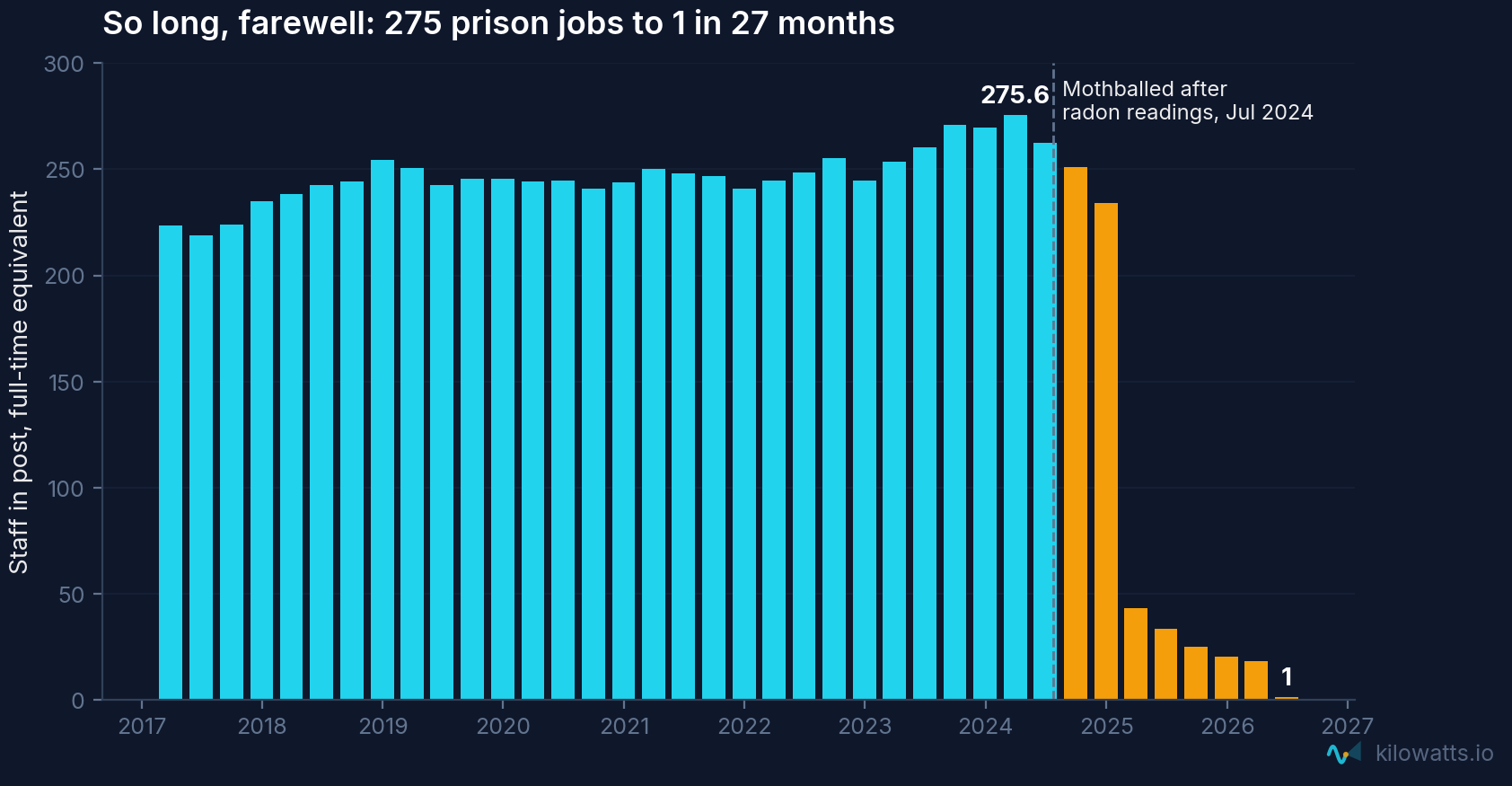
HMP Dartmoor payroll staff in post, full-time equivalent, every quarter from March 2017 to June 2026. Staff were redeployed to other prisons rather than made redundant, but they no longer work, or shop, in Princetown. Source: Ministry of Justice, HMPPS workforce statistics, June 2026.
When it was running, the prison spent £16m to £21m a year, and most of that stayed in the area. The biggest part was wages for about 250 staff, who lived in Princetown, Tavistock and Plymouth and spent them there. Add the families visiting 600 prisoners, the suppliers and the trade on the high street, and Tim Jones, chairman of the South West Observatory, told the BBC the closure could leave "a £30m hole in the local economy". Now the staff work, and spend, wherever they were redeployed. Meanwhile the bill for the empty building keeps running. At about £4m a year for rent, rates, utilities and security, the empty prison has cost about £10m since it closed, and it will cost nearly £40m by the end of 2033 if nothing changes.
Not all of that is lost to the village. £1.5m a year of it is rent to the Duchy of Cornwall, the prison's landlord. In June the Duchy said that from 2026-27 it would hand that rent back to Princetown and Dartmoor, starting with a £250,000 community fund. That is a generous answer to a bad deal, and it means up to £11m could come back to the area by 2033. The taxpayer still pays it, though, and the other £2.5m a year buys nothing but an empty building.
The £1.2m spent on radon works is the saddest part. Radon works only pay off if someone uses the building. Left empty, that money has been wasted as surely as the rates and the security bill.
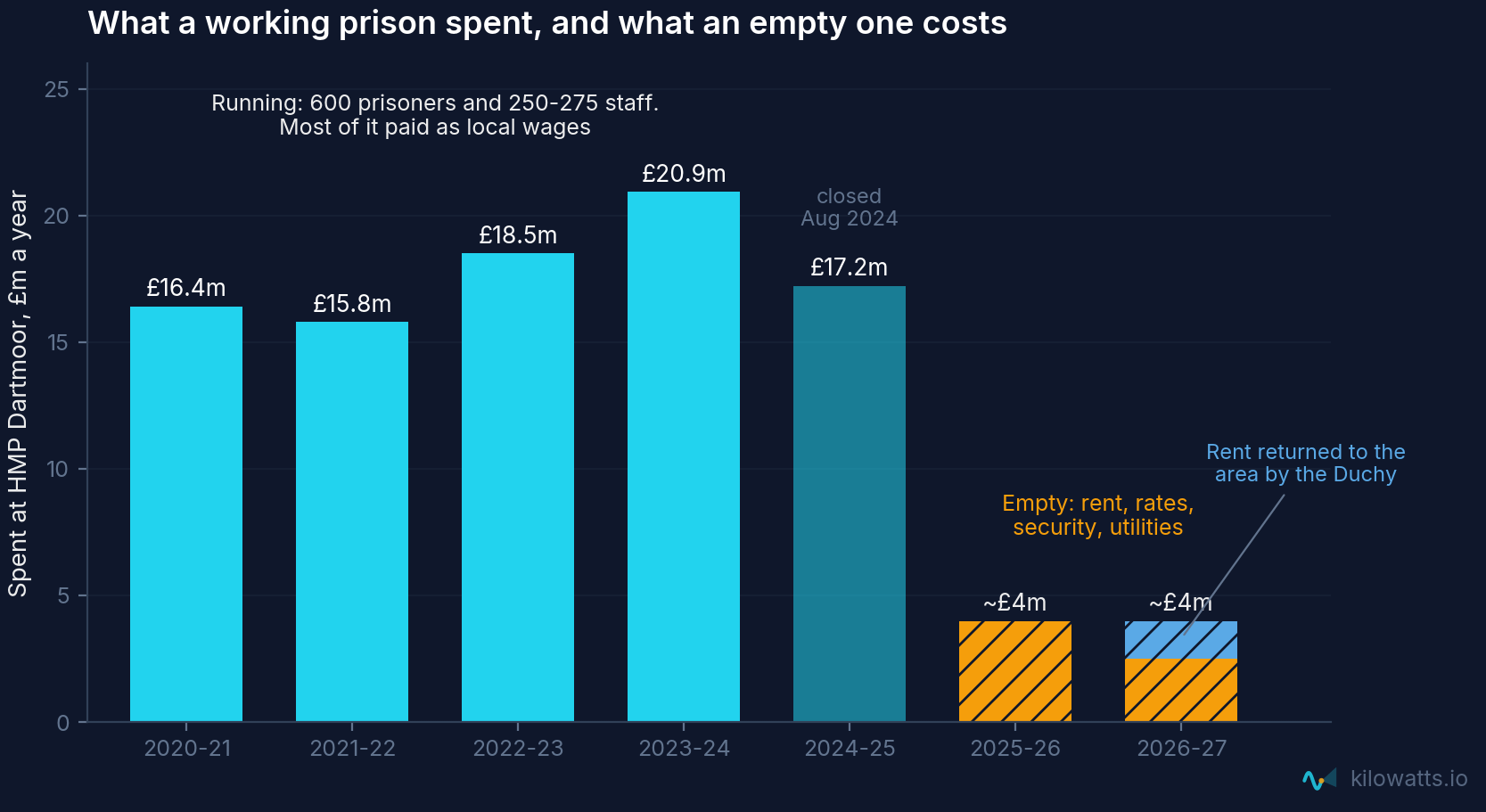
Spending at HMP Dartmoor by financial year. 2020-21 to 2024-25: the prison's direct spending, mostly staff, from the Ministry of Justice's costs by individual prison. 2024-25 is high because staff stayed on Dartmoor's books for months after it closed. 2025-26 and 2026-27: the Public Accounts Committee's estimate of about £4m a year to keep it empty; from 2026-27 the Duchy of Cornwall returns the £1.5m rent to the area.
The prison is also listed, heavily. Historic England has 17 Grade II entries covering it, including all seven cell wings, the gateways, the perimeter wall and the reservoir, plus two registered cemeteries for French and American prisoners of war. Clearing the site would need listed building consent in a national park. Nobody I've spoken to thinks that is plausible. So the building will be there, in some form, whatever happens.
One detail in the listings matters more than the rest. They exclude the modern buildings inside the wall: the late 20th-century gym, the modern kitchen block, the covered walkways and later workshops. Those need ordinary planning permission, not listed building consent. The kitchen is where the radon reading of 2,988 was taken.
That is the first thing that makes Princetown unusual. Most data centres are new buildings on open ground. Here there is an existing building, already connected to power, gas and water, that the state is paying £4m a year to keep empty. The question is not whether to build on a field. It is what goes inside a shell that is staying anyway.
Climb every tor
The second unusual thing is what is around the prison. I've put it on a map.
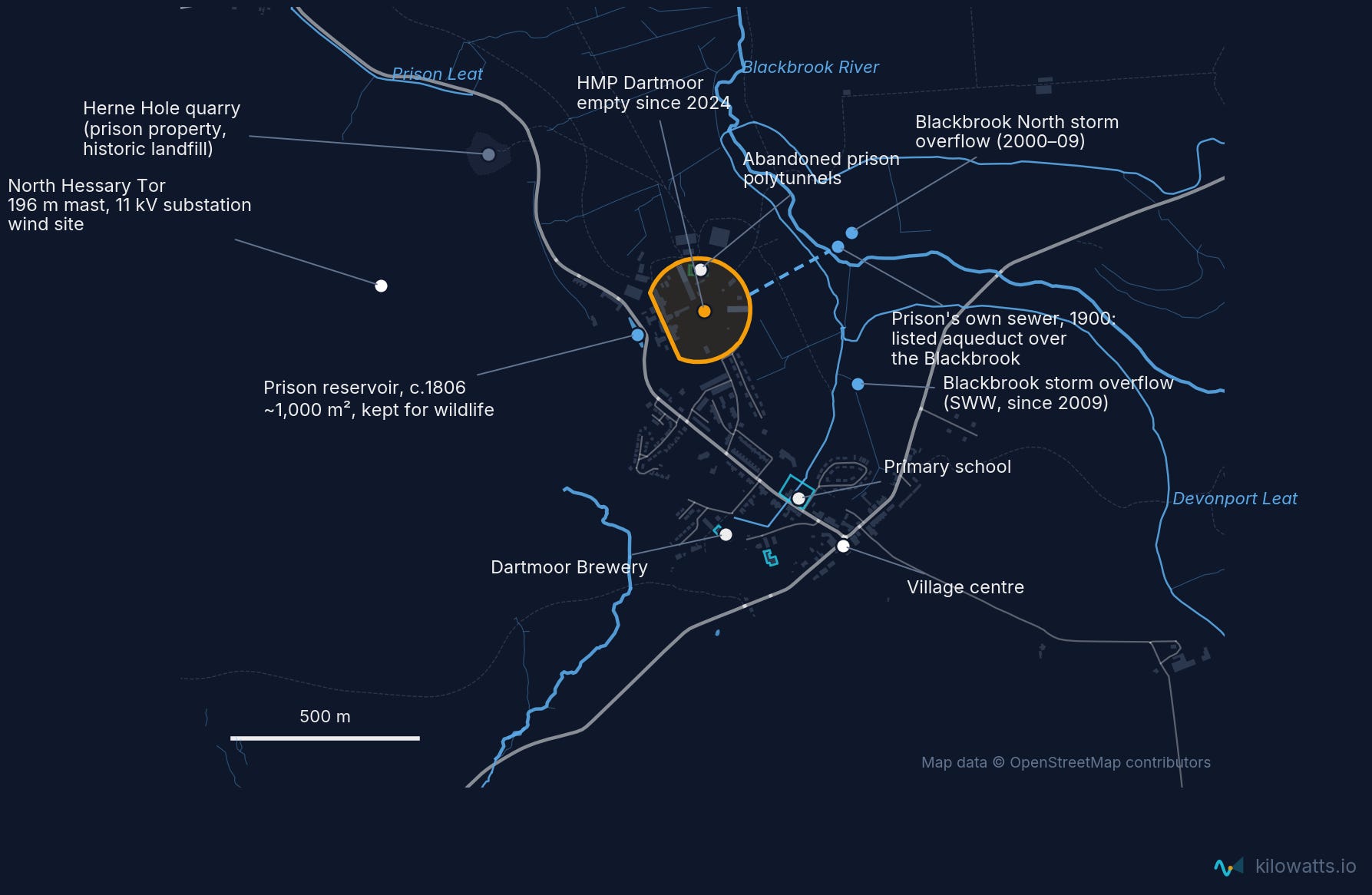
HMP Dartmoor and its surroundings. Sources: OpenStreetMap, NGED, Historic England, Environment Agency. The prison sewer's route is drawn schematically: only the aqueduct and the overflows are mapped.
Cold. Princetown's average temperature is 9.5 °C, about the same as Aberdeen's. In five years of hourly data it rose above 25 °C for about 11 hours a year. Data centres spend a lot of energy getting rid of heat. Here, outside air would do almost all of it, almost all the time, without evaporating water. The world's data centres use, on average, 1.54 units of electricity for every unit their computers use. A site here could plausibly get that down to 1.1–1.2, my estimate.
Wind. The prison sits under North Hessary Tor, where a 196 m broadcast mast stands about 900 m away. The Global Wind Atlas puts the average wind at 100 m on the summit at 10.8 m/s; I use 9 to be safe. That is where I have been modelling a community turbine, and an 11 kV substation is already up there. I don't yet know what fibre reaches the mast or the prison.
Water, though less than I hoped. Just outside the gate is the prison's own reservoir, built with the prison around 1806–9 and fed by the Prison Leat, a granite channel that brought water about 6 km from the River Walkham. South West Water took over the prison's supply in the 1990s, and the leat has been breached and largely dry for years. Prisoners restored the reservoir in 2013, and it is now kept for wildlife.
I'd wondered whether it could take a data centre's summer heat. It can't. It covers about 1,000 m² and probably holds 1,000–2,000 m³. A 2 MW load would warm it by about a degree an hour, and its surface can lose only a fraction of that. Dry coolers, fans blowing moorland air over radiators, would do the job instead. The tors would be alive with the sound of server fans, which is just what neighbours in Virginia complain about, so the coolers would need to sit on the side of the prison away from the houses. The quarries don't obviously help either. Herne Hole, the prison's own quarry, is still prison property and closed to the public, and was once used as a landfill. The flooded one at Foggintor is 2 km away.
Its own sewer. In 1900 the prison built an aqueduct of 11 granite arches, now listed, "to carry waste away from the prison across the Blackabrook River to new sewage works". Before that its foul water ran in an open leat to fields near Tor Royal. Today South West Water has a storm overflow on the Blackbrook here, separate from the village's main sewage works further east. Until 2009 one sat right beside the aqueduct; its replacement is about 400 m to the south. In heavy rain, that is where untreated sewage goes straight into the river. A data hall cooled by dry coolers would add almost nothing to any of it. I mention it because it shows how much of the village's infrastructure was built by and for the prison.
A grid connection. The prison had its own high-voltage supply. Before it closed it used around 2.8 GWh of electricity a year (its 2015 energy certificate), about 0.3 MW on average.
And a gas pipe. Which deserves a section of its own.
I have confidence
Princetown's gas arrives along a single medium-pressure main, about six miles across the moor, run by an independent gas transporter called GTC. As far as I can tell from GTC and the meter records, gas first flowed around 2004. The prison was the anchor customer. On its 2015 certificate it burned 3.7 GWh of gas a year, which I estimate was more than half the gas on the network.
The pipe itself will last. Polyethylene main laid in 2004 has a design life of 50 years and probably far more. What will not last is the business case. A network whose biggest customer was the prison now serves about 226 homes and a few businesses. I asked Ofgem what it knew about the network. It told me it holds no correspondence about Princetown since 2023, nothing about the prison closing, and no figures on the network's size or use.
My guess, and it is only a guess, is that the network's future gets decided in the mid-2030s, when the village's boilers come up for replacement again and national policy on running down the gas grid gets serious.
Here is the uncomfortable bit. A data centre needs firm power: electricity that is there every hour, whatever the wind does. In the Loughton story, that is exactly what the grid could not offer. A wind turbine cannot offer it either. The prison's gas connection could, through engines on site that only run when the wind and the grid fall short.
I modelled this roughly. Take a data centre drawing 1 MW for its computers, about 1.4 MW in all once cooling and heat recovery are included. A 2.3 MW turbine on North Hessary would supply about half of that, hour by hour. If gas engines covered everything else, they would burn about 15 GWh of gas a year, four times what the prison used. That is too much. It would be a gas-fired data centre with a wind turbine attached.
So gas only makes sense as backup: for the cold, still weeks of winter and the hours when the grid is stretched, with the grid doing the rest. Used that way, it gives the old pipe a job for another decade or two, and the waste heat from the engines could be used too. It also keeps a fossil fuel in the picture longer than a pure heat-pump future would. I don't think that should be hidden.
Something good
Now the part that got me interested.
Princetown is cold, and its houses are hard to heat. On the same weather data it needs about as much heating as Glasgow. It is sunnier than Glasgow, but even allowing for the sun, homes here need heating on about 215 days a year, two months more than in London, and need about 50% more heat over the year than London and twice as much as Plymouth, twelve miles away. 58% of homes fail the Decent Homes standard, among the worst 1.4% of areas in England. Fuel poverty is 16%, against 10% nationally.
Most of the housing was built for the prison. There are Victorian granite terraces for warders, in a conservation area where external insulation is unlikely. There are about 120 post-war Cornish Unit semis, precast concrete houses that were designated defective in 1984. On their energy certificates, 134 homes have uninsulated walls. About a third of homes are off the gas grid, mostly on oil or storage heaters.
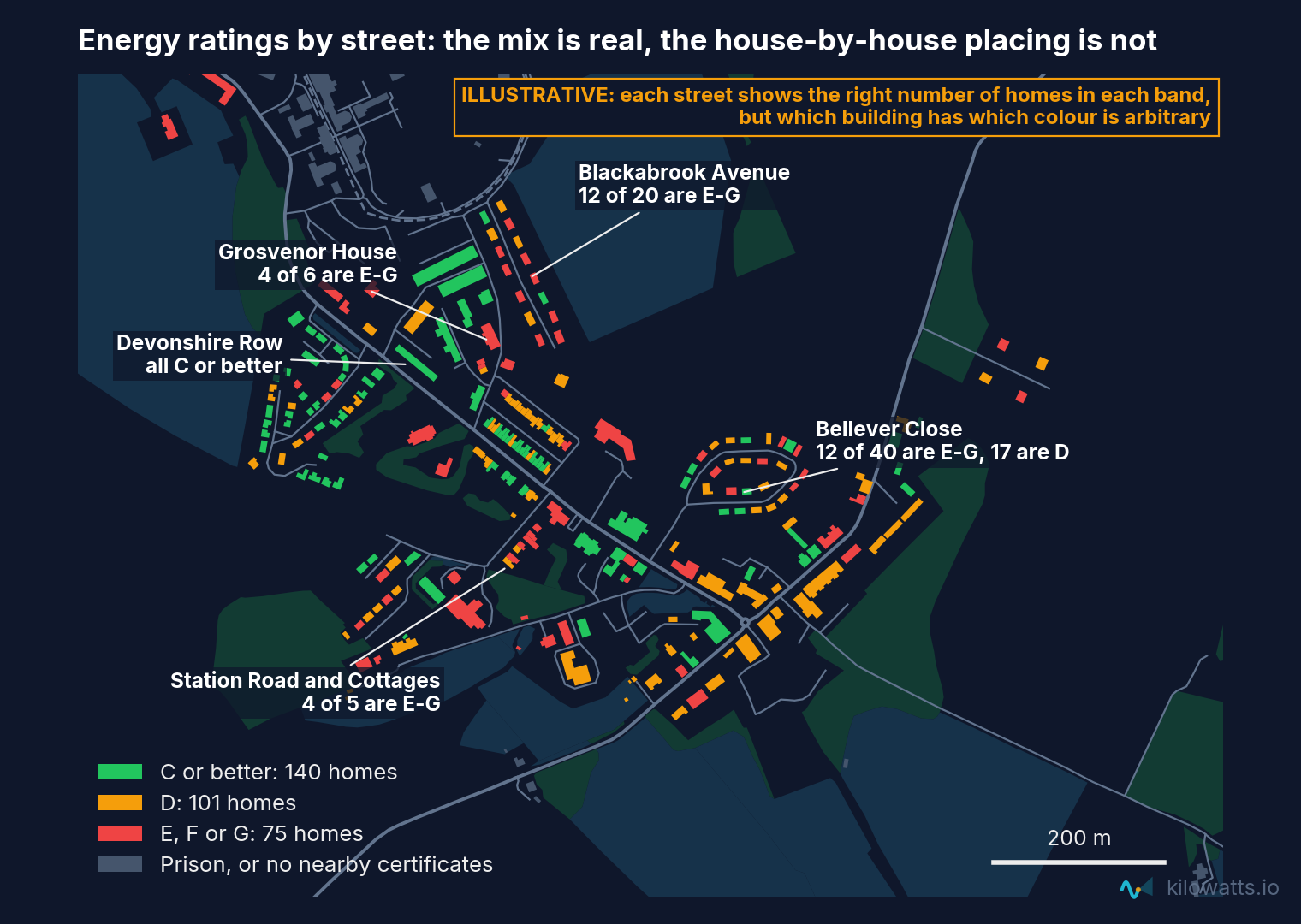
Energy ratings from the latest certificate for each home (316 of 368 homes have one). Each street shows the right number of homes in each band, but which house gets which colour is shuffled, so no single home can be identified. Source: EPC register, October 2026; OpenStreetMap.
Between them, the village's 368 homes and 31 businesses spend about £519,000 a year on heating. Homes on gas pay about £900. Homes off gas pay about £1,330. As I wrote in October, energy and fuel take 9–12% of a rural wage, against 4% in London.
A few of my favourite things
The homes are not the biggest heat users, though. Aside from the prison others are beer, whisky: a few of my favourite things, if not everyone's. Put the village's heat on one chart and two things stand out: the prison used about as much heat as every home in Princetown put together, and the distillery, if it ever ran at full capacity, would use three or four times as much as either.
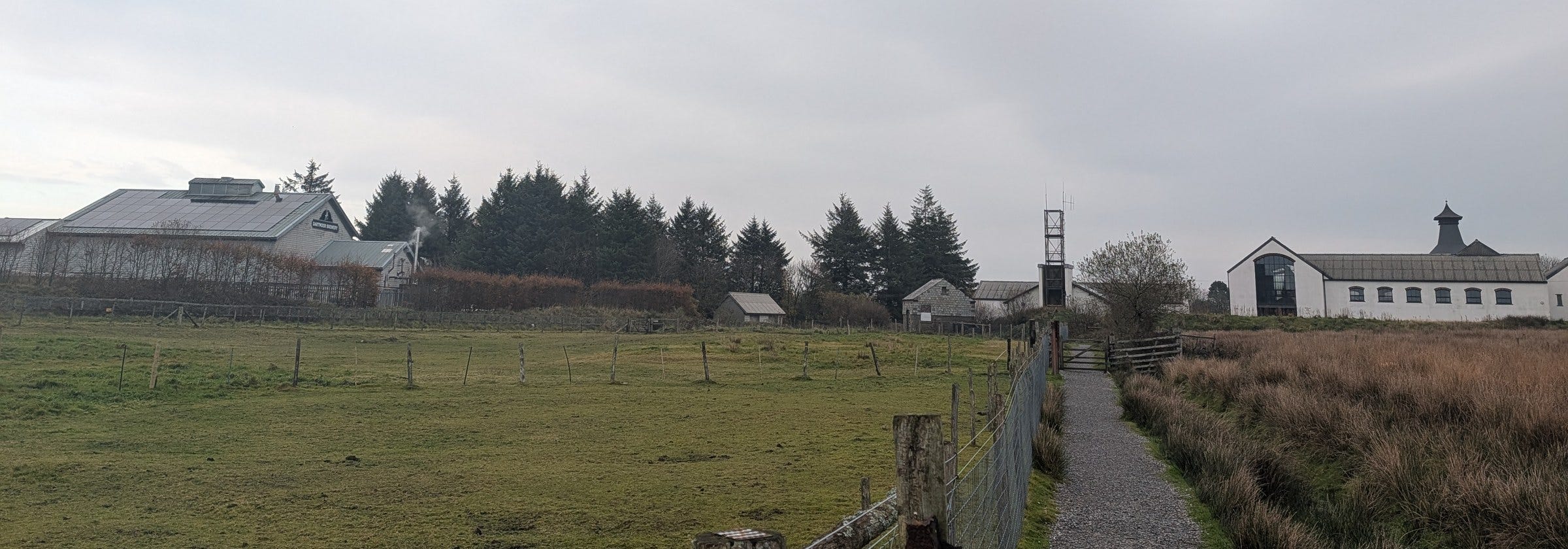
Dartmoor Brewery (left, steam rising from the brewhouse) and the distillery (right, with its pagoda roof), a field apart on the edge of Princetown. The sourdough bakery is missing. Photo: Ben Watts, November 2026.
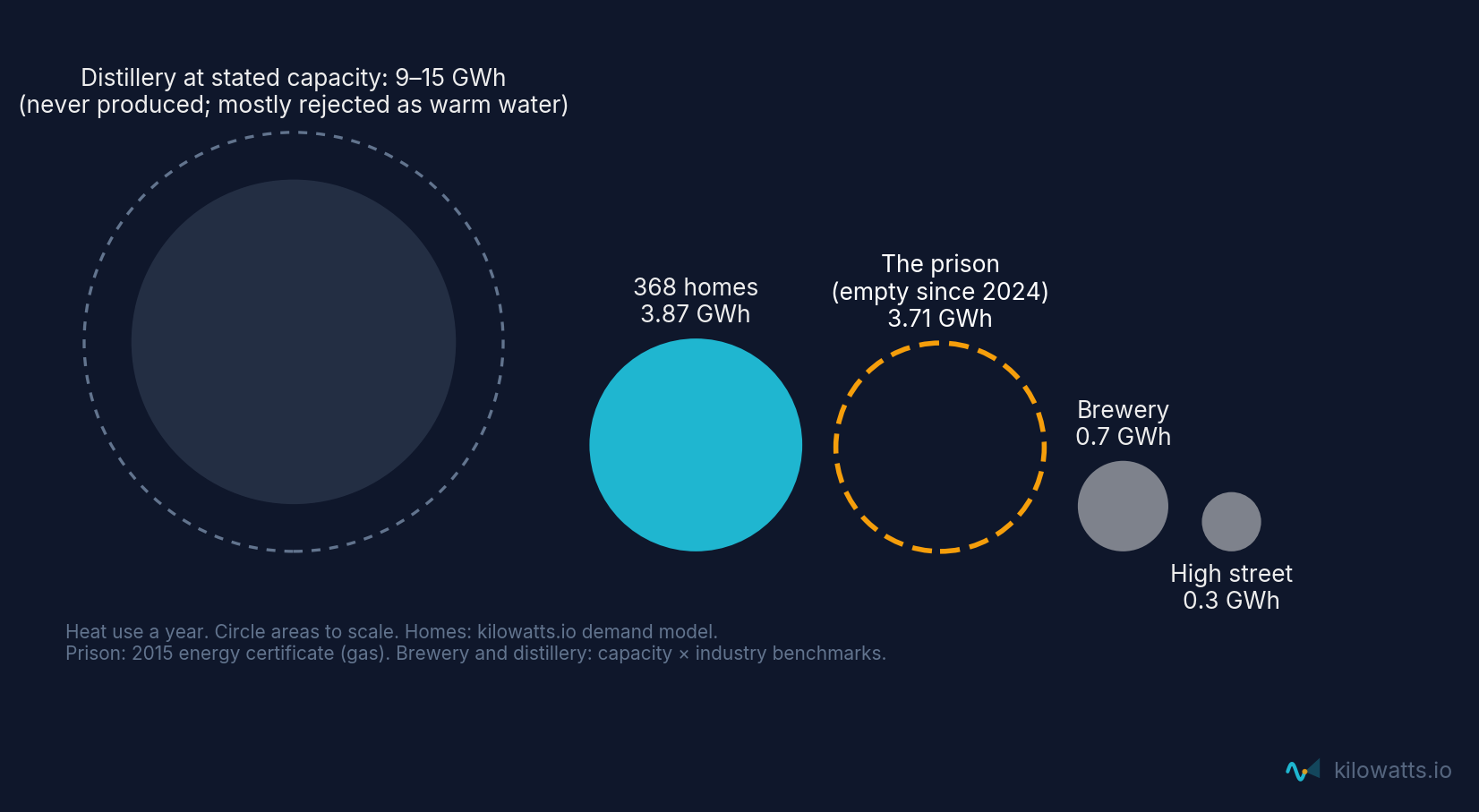
Heat use a year, circle areas to scale. The prison's circle is empty because the prison is. The distillery has never produced. It is shown at its stated capacity of 1.5 million litres of alcohol a year, at 6–10 kWh of heat per litre, typical of working Scotch malt distilleries. Sources: kilowatts.io demand model; HMP Dartmoor 2015 energy certificate; brewery and distillery from capacity and industry benchmarks.
Two maps of the same village
Nesta has just published a local heat planning map for councils, and it is well worth a look. It groups homes into clusters and suggests a kind of low- carbon heat for each, from open data. For almost all of Princetown it recommends a heat pump in each home, which is also what our own numbers say when there is no cheap source of heat.
Putting the two side by side is instructive:
Homes. The seven clusters that cover the village on Nesta's map hold 296 properties. We count 368 homes, from energy certificates and meter counts.
Off the gas grid. Nesta counts 15. The energy certificates say about 120, a third of the village. My guess is that an isolated village gas network makes postcodes look connected when many homes in them are not.
Gaps. Nesta has no energy rating for 36% of the properties and no tenure for 38%. It says itself that the data is preliminary.
The prison. Nesta's method counts "jail and prison" as an anchor load, a big building a shared heat network could start from. It picks anchors by type of building, not by how much heat they use, so it can't know this one is empty.
None of that is a criticism. A national map built from open data will miss things a village knows. The last point is the problem in a sentence: the biggest heat load in the village has gone, and only something new in that building can bring it back.
What a data centre would add
Our demand model puts the village's heat need at about 4.6 GWh a year, peaking at about 2.6 MW on the coldest mornings and averaging about 0.5 MW. Even in summer it averages about 0.2 MW, mostly hot water.
A 1 MW data centre makes about 1 MW of heat, all day, every day. If most of that is captured and lifted by a heat pump to the temperature a heat network needs, and you allow for 20% lost in the pipes, I get:
About 87% of the village's heat over a year could come from the data centre.
About 80% in December to February, when it matters most. Boilers or heat pumps cover the coldest peaks.
About half of the data centre's heat would still be surplus, mostly in summer.
A 0.5 MW data centre would cover about 62%, and use three-quarters of its own heat.
The climate is what makes that work. I moved the same 368 homes, on the same hourly model, to the weather at Heathrow, where data centres actually cluster. Next to a 0.5 MW data centre, Princetown would waste about a quarter of its heat. The same village near Slough would waste about 42%, and near Plymouth 43%. So Princetown puts about a quarter more of the same heat to use, and that is before counting that many homes here are heated less than they need to be. Heated to the standard their certificates assume, they would waste about 23%.
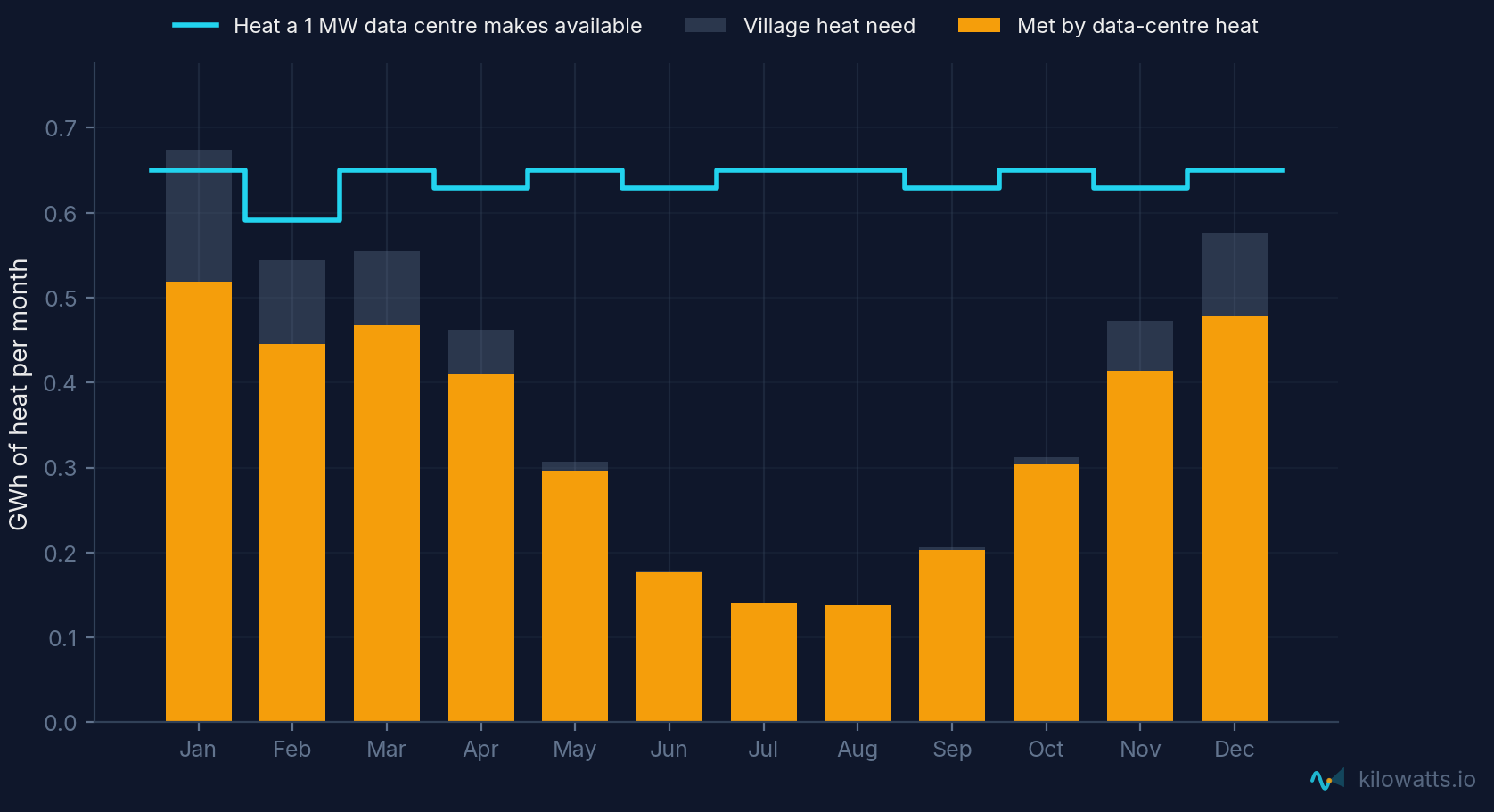
Princetown's heat need by month (homes and businesses, average of 2021–25) and the share a 1 MW data centre could meet hour by hour. Even in January the month's total is close to what the data centre makes. The shortfall is the cold mornings, when need peaks above what a steady source can give. Source: kilowatts.io demand model; assumptions in the notes.
I know this can feel less green than the obvious answer, which is a heat pump in every home running on grid electricity, which moves Britain's biggest energy demand onto the wires. The heat is coming from computers, and the computers might be backed up by gas. But those computers will run somewhere. Today they mostly run around London and Slough, where data centres have already added 148 MW of demand. On the same weather data, London needs about 30% less heating than Princetown (1,581 heating degree days a year against 2,269). There, the heat mostly goes out of a roof into the sky, and the grid has to be reinforced to carry the power in. Moving a small slice of that work to a place with a long heating season, wind on the hill and a building that already exists seems to me a better use of the same electricity. Betjeman wanted friendly bombs to fall on Slough. I would settle for a few friendly servers falling on Princetown.
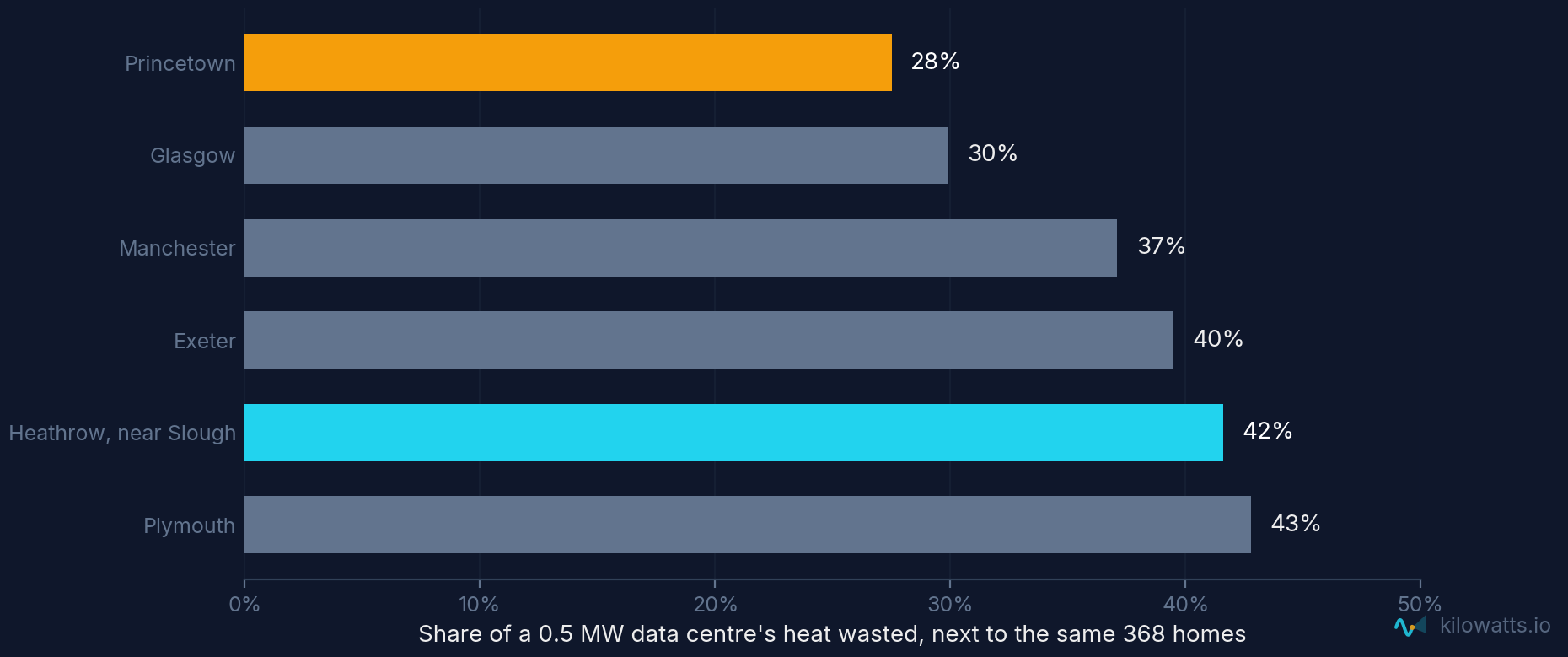
Share of a 0.5 MW data centre's heat that would go to waste next to the same 368 homes, on each place's hourly weather, 2023–26. Princetown's homes stay the same in every case; only the climate changes. Source: kilowatts.io demand model, Open-Meteo.
The pipes are the catch
The heat is almost free. The pipes are not. When I costed a conventional hot-water heat network for Princetown, the pipework and connections alone came to about £6.9m, roughly £17,000 per building. A heat pump for a home costs £12,000 to £14,000, before a grant that is about to shrink. Without a cheap source of heat, the network lost to a heat pump in every building.
Last month I looked at a different design for the village: a shared ground loop. A cool pipe runs under the street and links boreholes in the granite, and each home has a small heat pump drawing on it. The obvious first loop is Blackabrook Avenue, Heather Terrace and Grosvenor House: 44 homes just below the prison. 95% of them are off gas, they have the worst energy ratings in the village, and they pay the most for heat. The weak point of that design was the summer. Take heat out of the granite all winter and, unless something puts heat back, the ground cools year after year.
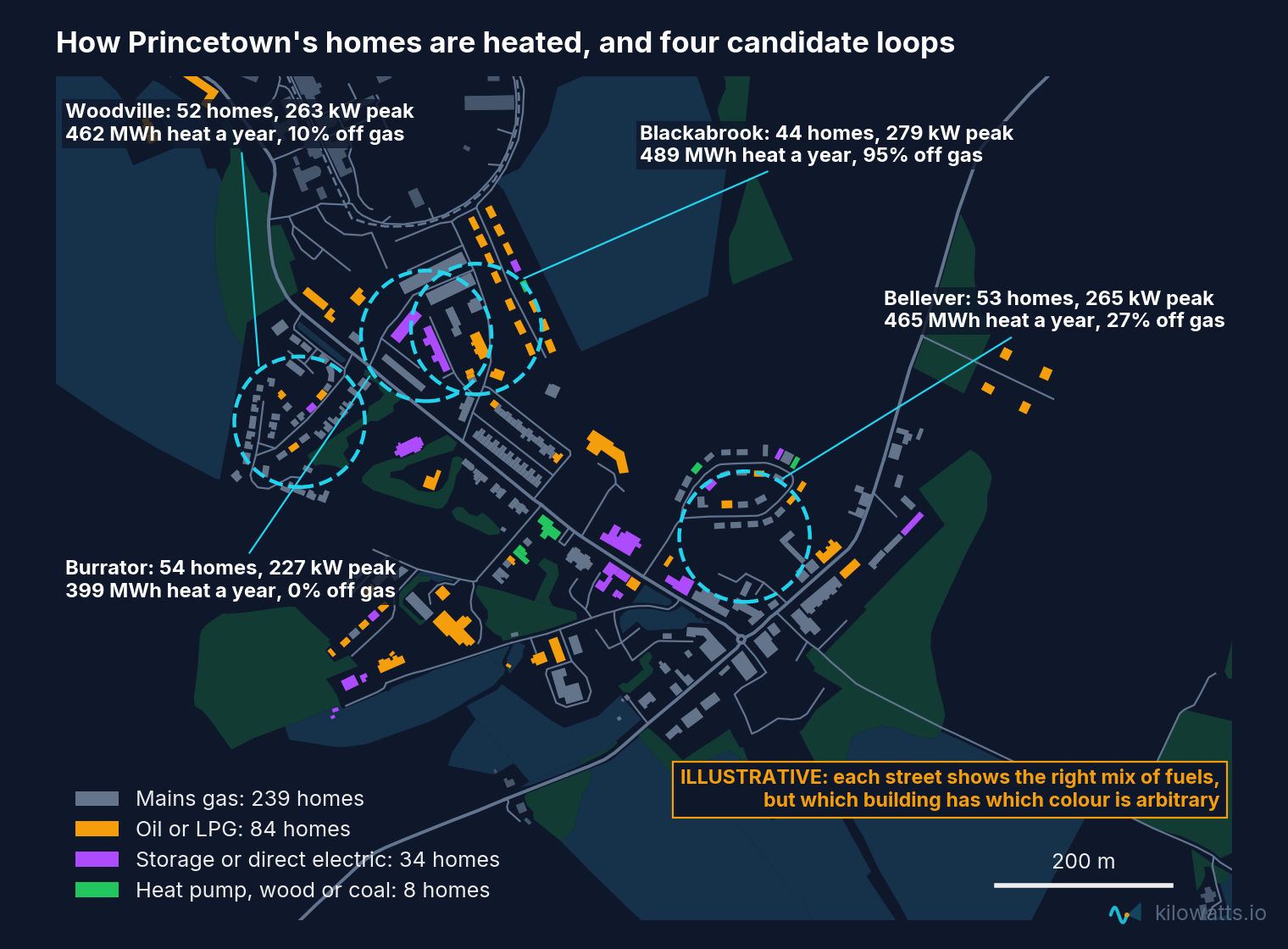
Main heating fuel by street, from energy certificates, with the four clusters of 44–54 homes that could each share a loop. Blackabrook, next to the prison, is almost entirely off gas. As on the ratings map, the mix on each street is right but the house-by-house colours are shuffled. Source: EPC register; kilowatts.io demand model.
A data centre is that something. Its winter heat would feed the loop, and its summer surplus, the part the homes can't use, would recharge the boreholes for the next winter.
This is not my idea. It is close to what is being planned near Cambridge. The Melbourn Energy Superloop, backed by Octopus, would put a 10 MW data centre next to a village of about 5,000 people, with a cool loop under the streets, a heat pump in every home and boreholes to store summer heat. Fibre goes in the same trench. The developer claims savings of 25–40% against gas. It is still in planning, Natural England has questions about nearby protected sites, and it still has diesel generators, tested monthly.
The data centre there is run by Deep Green, which started in Devon. Since 2023 it has run servers sunk in oil at Exmouth Leisure Centre. Deep Green pays for the electricity, and the pool gets about 62% of its heat for free. It now heats a leisure centre in Manchester and won planning in May for a 5.6 MW site feeding Bradford's heat network.
The brewery could use some of the summer heat, too. It brews all year round, so in summer, when the homes need least, it would still be taking heat. About half of its heat goes on hot water for mashing and cleaning, at 65–80 °C, which a second heat pump could reach from the network. (The boil, at 100 °C, needs more.) On my numbers that would take about 250 MWh a year off its gas bill, worth very roughly £20,000. That cuts the data centre's waste by only about three percentage points, and the brewery is about 600 m down the road, so it is a bonus, not a reason to build.
Two other things could use it. Just north of the prison wall are its old polytunnels, abandoned since it closed. The prison once farmed about 1,600 acres of moor, and warm greenhouses are a classic use for low-grade heat: Windcloud, a wind-powered data centre in northern Germany, grows algae on its 36 °C server heat. And if the village's distillery ever runs at full capacity, its cooling water would be another heat source, bigger than the whole village's demand.
Do-Re-Mi
So far this has been about heat. The money is in the power, and that is where the "community" in a community data centre comes from.
A data centre buying all its electricity from the grid pays about £99 for every megawatt-hour on top of the wholesale price: the Renewables Obligation, the other policy levies, the Climate Change Levy, and charges for the networks and for balancing the system. Power from its own turbine, over a private wire that never touches the public grid, pays almost none of that. Only the fixed charge for its grid connection stays. I worked these numbers up for a talk on keeping industry in Britain at Montel's UK Energy Day last week, and the gap is the same for a factory as for a data hall.
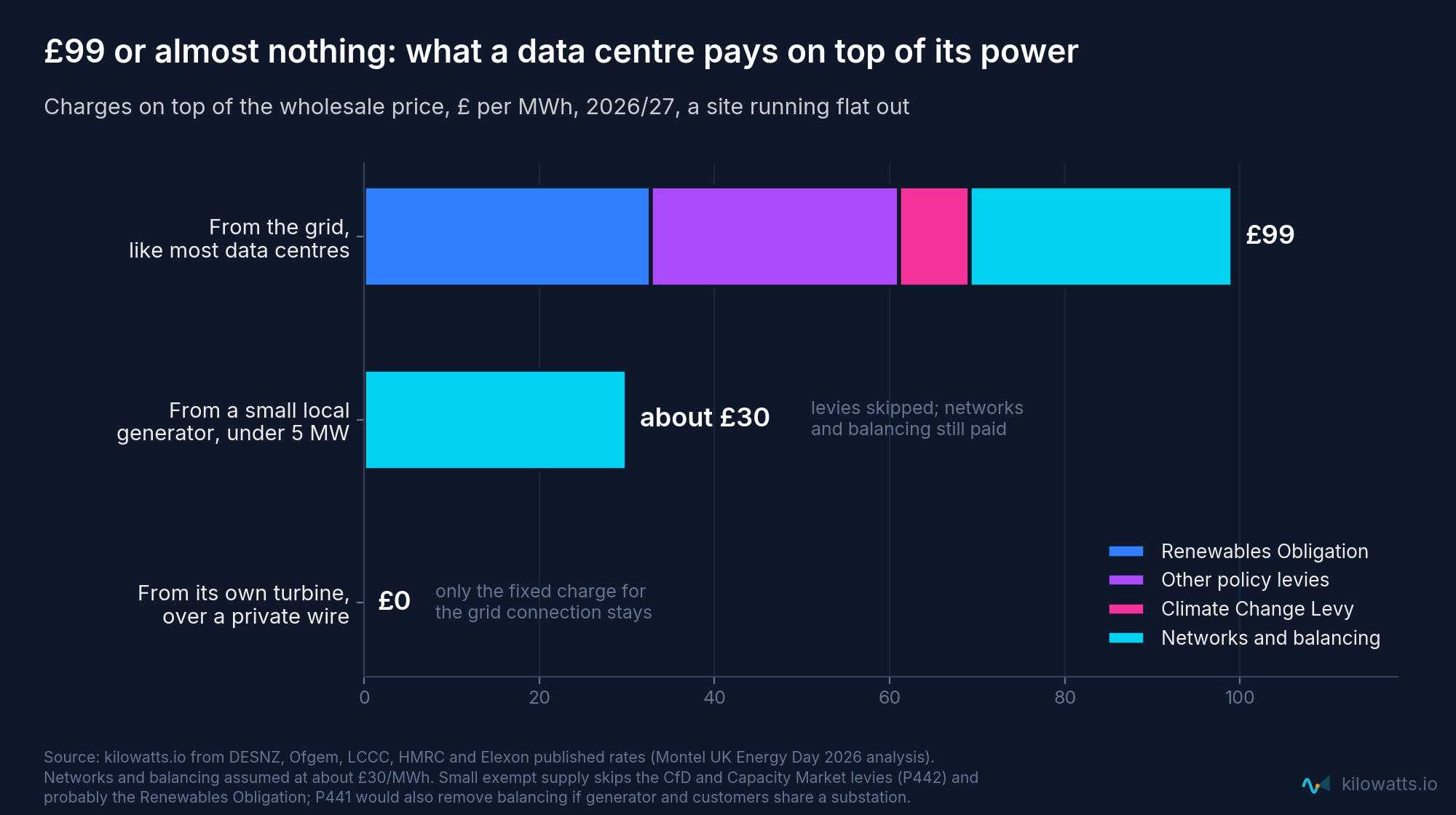
Charges on top of the wholesale price for a site running flat out, 2026/27. A small generator selling to customers nearby, under 5 MW, skips the levies but still pays to use the wires. Source: kilowatts.io from published DESNZ, Ofgem, LCCC, HMRC and Elexon rates.
For a 0.5 MW data centre, the turbine on North Hessary would supply about 63% of its power, hour by hour. That is about 3.8 GWh a year that pays none of those charges, worth roughly £350,000 to £380,000 a year, depending on whether the operator has a climate change agreement. That is the strongest commercial argument for putting the computers next to the wind rather than near Slough.
I should be clear about what that saving is. It isn't a saving for the country. The levies pay for things already built, and every megawatt-hour that escapes them is paid for by other bill payers, just as they pay for the discounts energy-intensive industry gets. What does cut the total is using power where and when it is made, without new wires to carry it.
The turbine would also make more than the data hall can use: about 3.4 GWh a year, mostly on windy nights. Sold to the village by a small licence-exempt supplier, under 5 MW, it would skip the CfD and Capacity Market levies and probably the Renewables Obligation, though it would still pay for the local wires and for balancing. A rule change called P441 would drop the balancing charge too, where the generator and its customers sit under the same substation. The industry panel that runs the market rules backed it unanimously; Ofgem sent it back in August to line up the timetable, not on its merits.
That is where the village comes in. P441 stops at 5 MW, and rules change. What doesn't change is a pipe under Blackabrook Avenue, a cable to a turbine on the hill, and the prison's connection to the grid, which is already built and so needs no new place in the queue. If the village owns a stake in the turbine and the heat network, the data centre stops being a shed it has to put up with. It becomes the customer that makes the village's own heat and power cheaper. That is what I mean by a community data centre: an operator rents the hall, and the village owns the things that outlast any lease.
It is also the best answer I know to the 843 groups in the US. They are fighting data centres that take power, water and land and give back a few jobs. A data centre that heats local buildings and pays a dividend to the village it sits in is a different proposition.
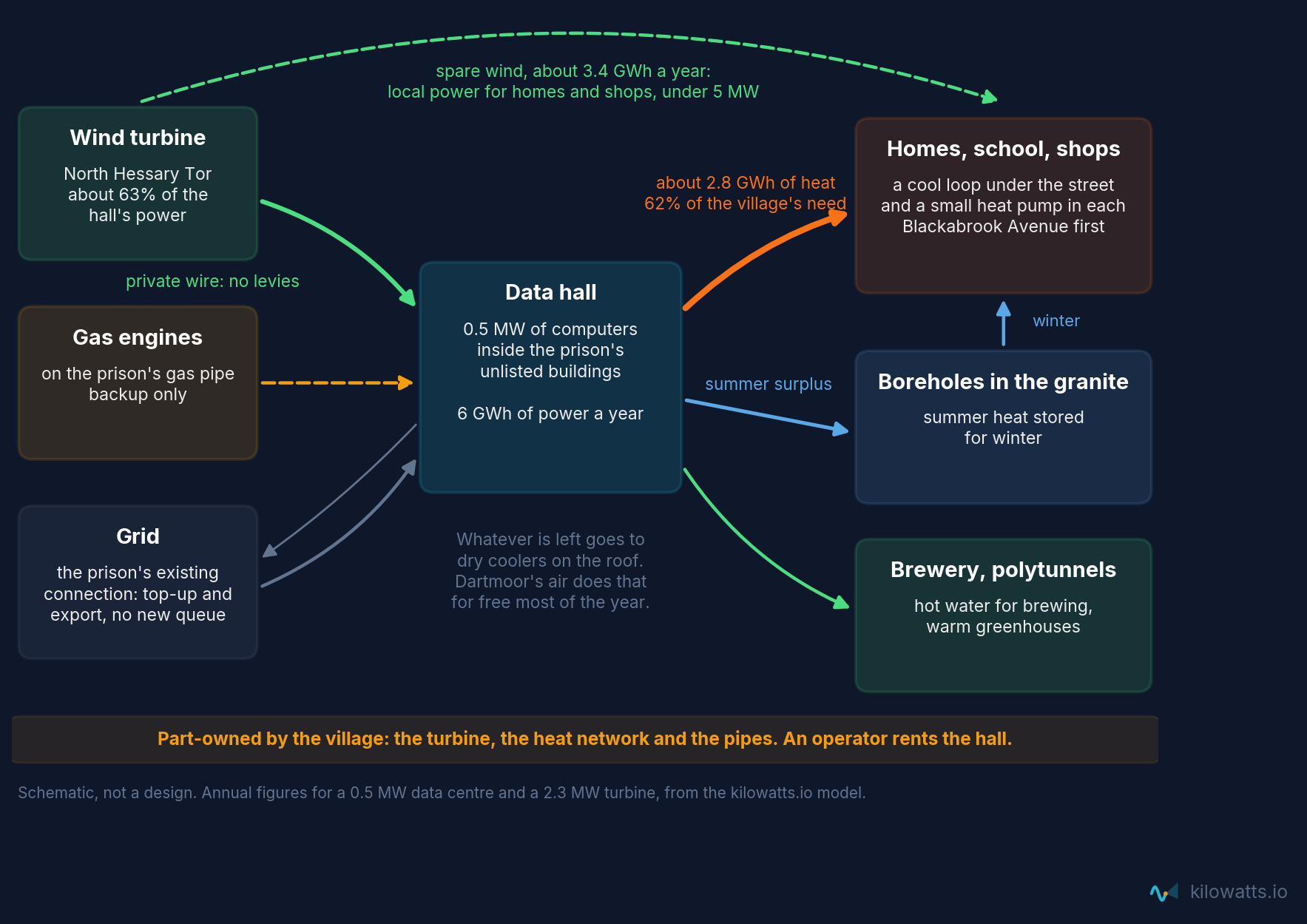
How it could fit together: a schematic, not a design. Annual figures for a 0.5 MW data centre and a 2.3 MW turbine on North Hessary Tor. Source: kilowatts.io model.
So long, farewell?
I want to be clear about what would make this fail. There is a lot.
It might be too small. An industry contact suggested that operators of small "edge" data centres, such as nLighten, look for more than about 3 MW. I don't know the prison's connection capacity. Its old electricity use, about 0.3 MW on average and perhaps 0.8 MW at peak, suggests something nearer 1 MW. A 1 MW data centre is small by today's standards. It might suit the village's heat demand and still not suit anyone's business.
Firm power is the hard part. Data centres hate connections that can be switched off. Gas engines can fill the gap, but winning support for new gas generation is usually hard, and it should be.
New demand, not moved demand. If this is extra computing, it adds to the country's electricity use rather than moving it. The honest version of the argument is about where, not whether.
Jobs. A small data hall employs a handful of people. It would not replace 275 prison staff. The construction, the heat network and any engineering work on site would matter more.
Radon. It doesn't harm servers: its alpha particles can't get through the packaging of a chip. But people still have to work there. A sealed, lightly staffed data hall would cut the time anyone spends inside, and pressurised air tends to keep radon out. The workplace rules still apply, and any offices or workshops would still need fixing. HSE's review of those rules, which the ministry has been waiting on, has not reported.
A listed building in a national park. Getting servers, cooling and engines into a 200-year-old granite cell wing may be expensive, or impossible. The unlisted modern kitchen block or gym, rebuilt inside the walls, is the more realistic place to start.
Connectivity. I don't yet know what fibre reaches the site. But the nearby TV and radio mast bodes well.
Who decides. The Ministry of Justice holds the lease, the Duchy owns the land, the National Park is the planning authority and GTC runs the gas. None of them has said what it wants for the site in the long run.
No help from policy. Devon is not an AI Growth Zone, so there would be no power discount. Britain has no rule that data centres use their heat, and Germany is watering down its own. Heat network zones are for towns, not 370-home villages.
Opposition doesn't stop at big sheds. Deep Green withdrew a heat-reuse project in Lansing, Michigan, this year after local pushback. Being small and useful is not a guarantee.
The questions I can't answer
As last time, here is what I don't know and would like to be told:
Is there a small operator, or a research or public-sector user, for whom 1 to 3 MW in a cold, windy place with spare heat is a good fit?
What fibre reaches HMP Dartmoor?
How much gas could the prison's connection actually deliver at peak? And how much power could its grid connection take and export?
Would the village want it, and a stake in it? I would rather hear that before anyone draws a plan.
Would the Ministry of Justice, the Duchy or the National Park even want this conversation?
How do you solve a problem like a prison? I'm not sure you do. But a building that can't be knocked down, in a village that needs heat, under a hill that has wind, seems a better place to start than a field.
Notes on the numbers. These are screening sums, not a design. Village heat need comes from our demand model of 369 homes and 31 businesses (energy certificates, calibrated to metered gas), hour by hour for 2021–25. The data centre runs flat out at 1 MW of IT load, with a PUE of 1.15. 85% of its heat is captured at about 40 °C and lifted to network temperature by a heat pump with a COP of 4.5, and 20% is lost in the pipes. Turbine output is the base case from my North Hessary modelling, using 2019–21 weather, so the wind and heat years differ and only annual shares are compared. Gas engines are assumed 40% efficient.
The hall you model needs no new place in the grid queue, and at the small end it would not have had much company. The table Ofgem, the energy regulator, published in July 2026 counts 315 data centre projects, and 11 of them are 10 megawatts or under. Those 11 hold 76 megawatts between them, 0.1% of the megawatts in the table. Did your industry contact say why operators of small data centres look for more than about 3 megawatts?
How to catch the Cloud, and pin it down