


In rural Britain, energy and fuel take 9 to 12% of a typical full-time wage. In central London they take 4%. The difference isn't the price cap, which is the same everywhere. It's bigger, older homes heated by oil and LPG, a car for every journey, and lower pay. And when oil, gas and diesel spike together, as they have this autumn, the countryside pays first and most.
Many of those same places sit under some of the best wind in Europe. Yet the turbines on their hills do nothing for their bills: the power is sold into one national market, charged the same levies as everything else, and often sent hundreds of miles away or paid to switch off. This piece is about changing that, and about onshore wind as a way to cut the cost of living in rural Britain. It starts with a wind farm I own a tiny piece of.
I own 2.5 kW of a wind farm in South Ayrshire, on a hill whose name is Scots for church. ("Kirk" is church; the village below it, Kirkoswald, is named after St Oswald's.)
Not a turbine, not a blade — a sliver of eight Enercon E92 turbines, bought through Ripple Energy's 2022 share offer alongside about 5,600 other people. Kirk Hill is 18.8 MW, and my bit is 2.5 / 18,800 of it.
The hill looks down to the Ayrshire coast and, about three miles away, to Trump Turnberry. The man who spent years fighting an offshore wind farm he could see from his Aberdeenshire course now has 5,600 small co-operative owners' turbines on the skyline above his other one. The trade press couldn't resist: "Co-op a look, Donald!"
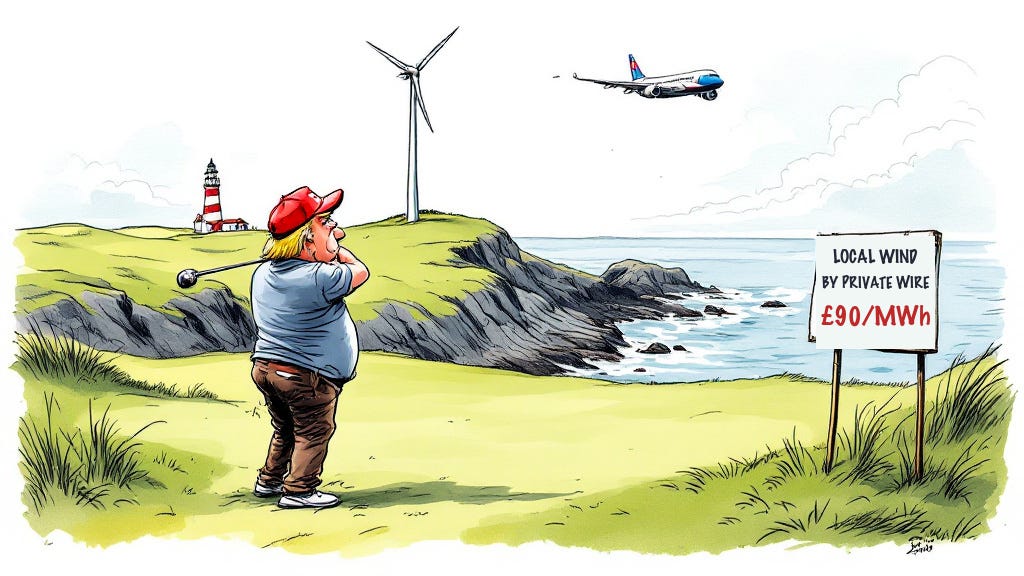
Illustration generated with AI (fal.ai Flux) and lettered by hand. The price is illustrative, and so is the plane.
It also turns out to be one of the few investments I own where I can check every half-hour of its performance in public data. Every wind farm registered in the Balancing Mechanism gets its metered output settled by Elexon, and the settlement files (P114, flow S0142) are downloadable if you have a portal key. Kirk Hill is BM unit E_KHLLW-1. So here is my share, half-hour by half-hour, since the first blade turned on 29 April 2024:
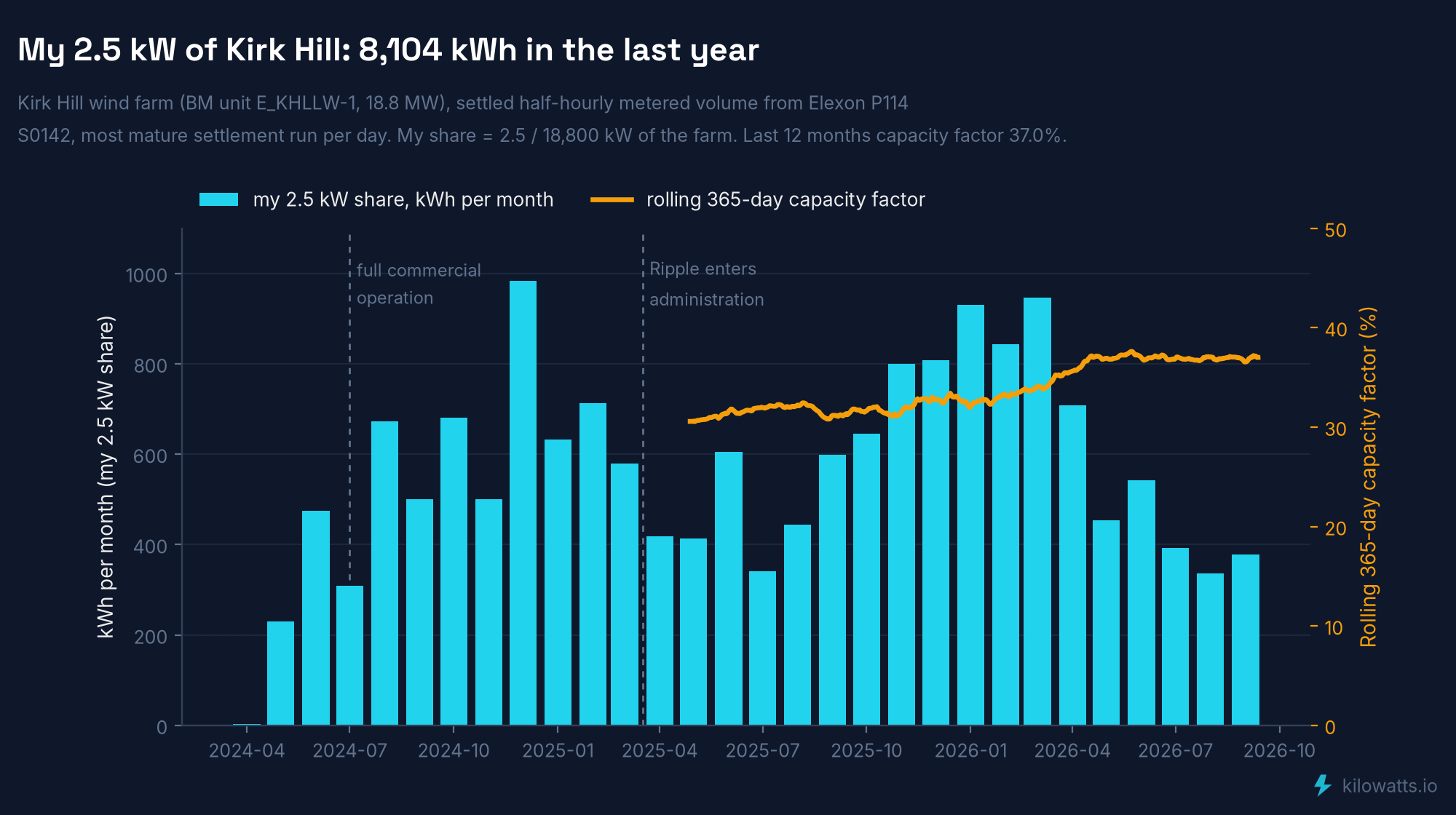
8,104 kWh in the last twelve months, from something I have never seen.
A few things stand out:
The first year was poor, the second year was good. From August 2024 to July 2025 — the first full year after commercial operation — Kirk Hill ran at a 32.1% capacity factor. The last twelve months ran at 37.0%, or 60,940 MWh. The share offer's central (P50) estimate was 60,266 MWh. So after a slow start it is running almost exactly as promised.
The winter of 2025/26 was a belter. January to March 2026 all ran at around 50%. The best day in the settlement data is 27 January 2026 at 444 MWh, a whisker behind the co-op's own record of 21 December 2024.
The data agrees with the co-op. The co-op's website says it had passed 125,776 MWh by 2 September 2026. Settlement data says 124,486 MWh — about 1% lower, which is what you would expect from metering at the grid connection rather than at the turbines. December 2024: 7,436 MWh on the co-op's site, 7,400 in settlement.
A word on why I'm the one writing this. I've been on both sides of community energy. I've been a member-owner of a community wind co-op since 2022, through its builder's collapse and its rescue. I've spent the last few months doing the sums on what it would take for a community-owned turbine to pay its way. And I write about how Britain's electricity system works, and who pays for it, for a living. This piece puts those together: what owning a share of a wind farm 600 km away has taught me, what the same wind could do for the people who live next to it, and where in Britain local wind would cut bills the most.
1. A wind farm I've never seen
How it used to pay me
Ripple's model was clever, and it was also the problem.
You did not get a dividend. The wind farm sold its power to a partner supplier at roughly its operating cost, about 2p/kWh, and the supplier knocked the difference between that and the wholesale price off your bill. The 2022 offer assumed 6.3p wholesale, so 4.3p/kWh of "savings", worth around £125 a year on average for a typical stake. Part of each credit counted as a return of your share capital, part as "trading benefit".
The catch was that the credit only worked if you were with a supplier that had signed up. At the start that meant Co-op Energy or Octopus; the list grew over time, but it was always a list. If you wanted a particular tariff — say, one built around an EV or a home battery — you had to hope its supplier was on the list. Owning a wind farm meant choosing your supplier from a short menu.
How it pays me now
Ripple Energy went into administration on 17 March 2025, after finding what the administrators called a "significant level of accounting discrepancies". The customer database and supplier contracts were sold to 1st Energy a fortnight later.
The wind farms were not part of the insolvency: each one belongs to its own co-operative. But Ripple was the thing that ran the co-ops — the admin, the member records, the supplier deals, the money flows. When it fell over, Kirk Hill's co-op was left owning an 18.8 MW wind farm, 5,600 members, and no operating company.
What happened next deserves more credit than it has had. A volunteer board — unpaid, and a good few of them people who work in the energy sector and know exactly how much there was to go wrong — took the co-op out of Ripple's wreckage. They cut ties with Ripple by April 2025, suspended the bill credits rather than let the money get stuck, let the income build up in the wind farm company's account, surveyed members on what they wanted, renamed the society Kirk Hill Coop, and went and found a new manager (Communities for Renewables) and a new registrar (Ethex). That is many hundreds of hours of work — contracts, auditors, banks, member communications — done in evenings and weekends for people most of them will never meet. I am one of those people. Thank you.
The members said they wanted to be paid directly, and that is what is happening. Instead of a credit on a partner supplier's bill, my share now arrives through the Ethex platform as a dividend-style payment, paid straight to a bank account once every 12 months.
That is a better arrangement. I can be with whichever supplier I like. And it is honest about what this always was: an investment in a wind farm, which sells its power and pays its owners.
The furore
This month GB Energy appointed Ripple's founder and former chief executive, Sarah Merrick, as its Managing Director for Local Energy, to lead the team delivering the Local Power Plan. It did not go down well: the news was "met with some surprise given the way that Ripple Energy's bankruptcy and failure played out".
It is worth being precise about why. The main anger comes from members of Ripple Coop 4 — Whitelaw Brae, a 57 MW project in the Scottish Borders that was never built. About 7,000 people put in £10.4 million; the administrators' figures leave around £4 million unaccounted for, and the project itself was sold to Thrive Renewables, which says it received no money from Ripple or Coop 4. That is a real loss to real people and they are entitled to be angry.
It is not Kirk Hill. Kirk Hill is built, generating, and — as the chart above shows — doing roughly what it said it would. The two stories keep getting merged, and they shouldn't be.
Why I think Ripple failed
Here is where I stop reporting and give you my opinion.
I have been spending a lot of time recently on community energy: what a village could actually own, and how it would get paid. And the more I look at it, the more I think Ripple's problem was not the accounting. It was the business model underneath.
Ripple's pitch was own your own wind farm: the power is yours, so you should pay less for it. But electricity from a wind farm in Ayrshire, delivered to a house 600 km away in England, still travels through the whole system — and on the way it picks up the full load of policy levies: the Renewables Obligation, Contracts for Difference, the Capacity Market, Feed-in Tariffs. Those are charged on every kWh a licensed supplier sells, however virtuous its origin. So the only margin Ripple had to play with was the gap between wholesale price and the farm's running cost. That is a thin margin to pay for a supply-chain of partner suppliers, a platform, a member base, and a growth ambition.
What would have made the model work was a levy exemption: the ability to say this power is ours, it never really went to market, so don't charge levies on it as if it had. In effect, it would have put my 2.5 kW of Scottish wind on the same footing as solar panels on my own roof. Power a home or business generates behind its own meter never passes through a supplier, so it never pays a penny of levies. Ripple was trying to put its members' wind farm behind their meters from 600 km away. That exemption exists, just about, for licence-exempt supply. But the small-supplier exemption (Class A) caps you at 5 MW, and 2.5 MW to households, and the generator has to be the supplier. An 18.8 MW wind farm with 5,600 owners scattered across Britain is nowhere near that. In my view Ripple needed the exemption, didn't get it, and had no business model without it.
I should say now where I stand on levies, because it runs through the rest of this piece. I don't think charging them per kWh is a good idea at all. But while they are charged that way, avoiding them is what makes local energy pay, and someone else picks up what you avoid. I come back to that below.
2. Why rural Britain pays more
The problem: same price cap, very different bills
When people talk about energy bills, they usually quote the price cap, about £1,720 a year for a typical home this winter, as if it were what everyone pays. And when prices rise, they talk about a percentage, as if it lands evenly. It doesn't.
I modelled what a typical household spends in every council in Great Britain, on home energy and on fuel for the cars its residents actually own, at today's prices: electricity and gas at the cap, oil, LPG and solid fuel for homes off the gas grid, and petrol and diesel at last week's record pump prices. Then I set it against what people there earn.
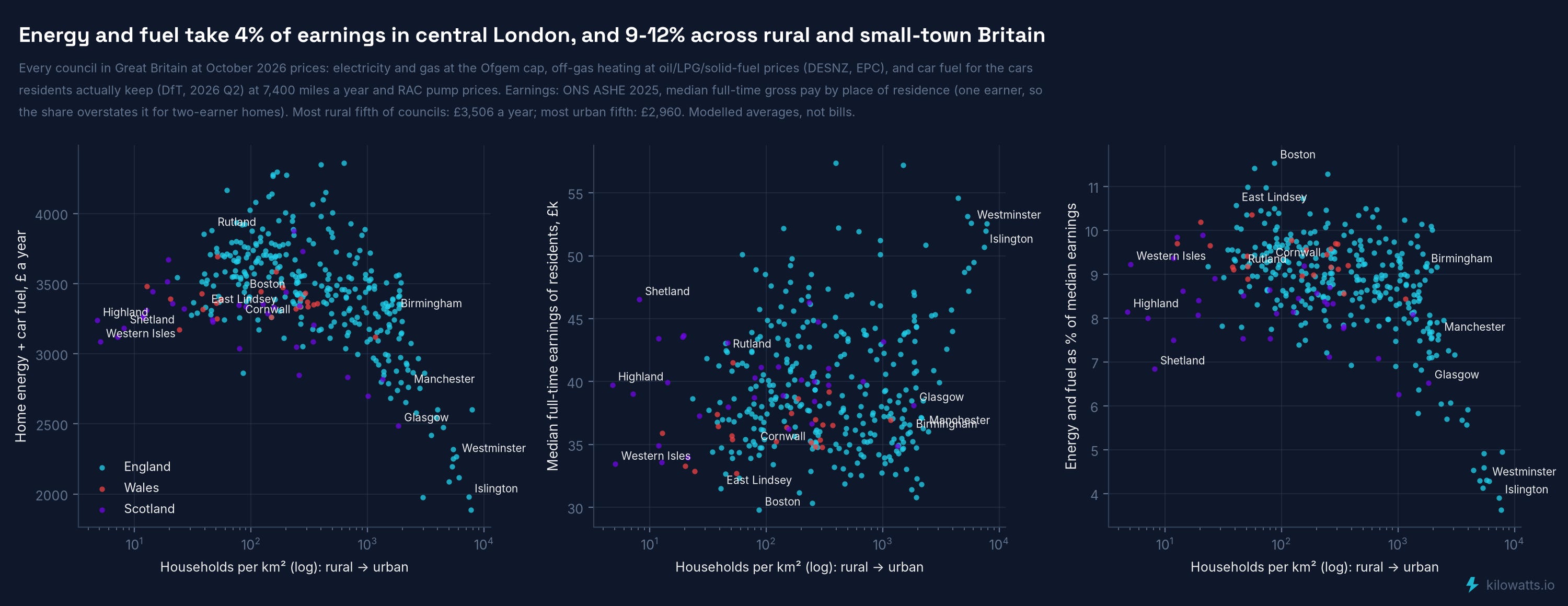
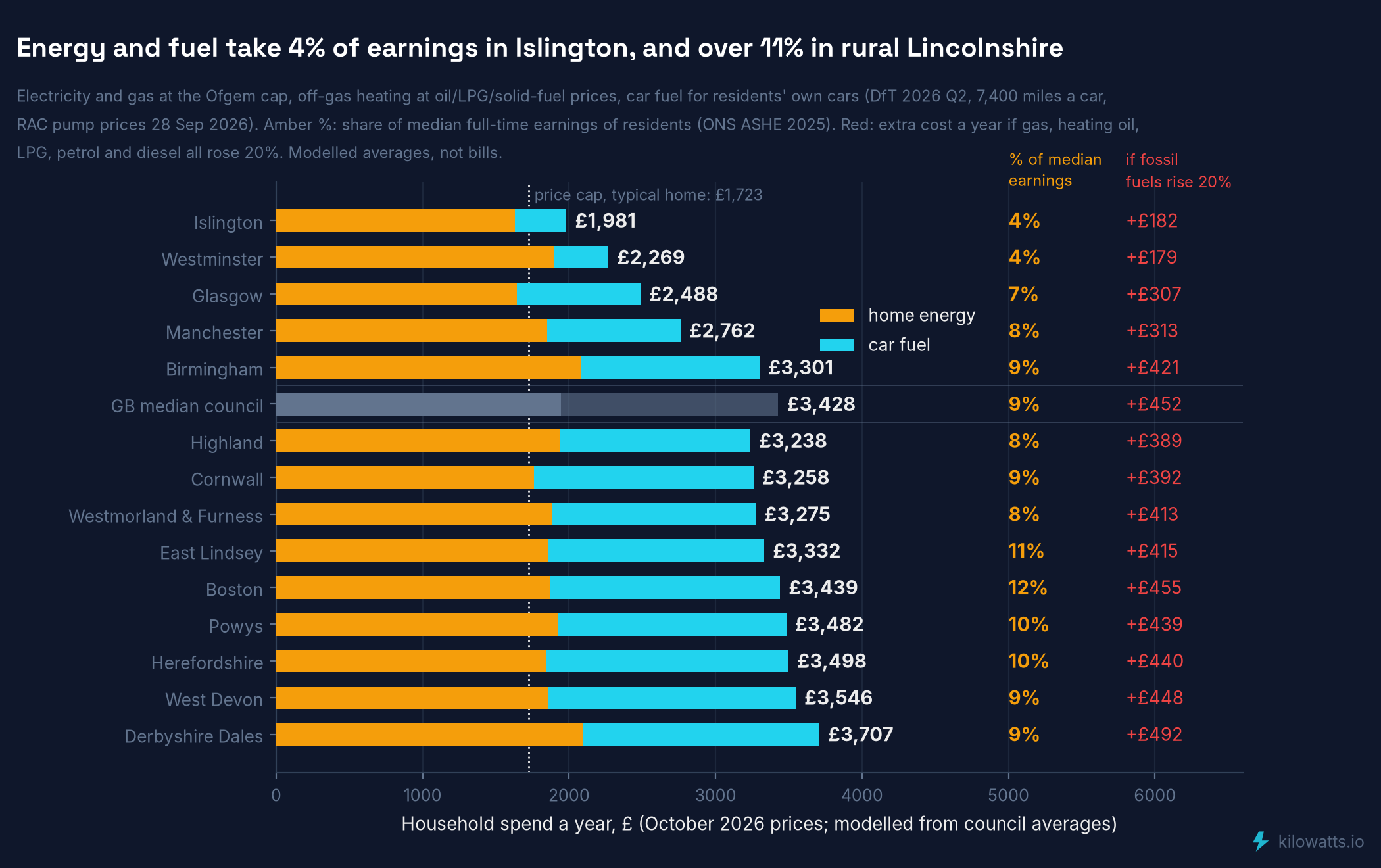
Rural households spend more. The most rural fifth of councils spend about £3,500 a year on energy and fuel; the most urban fifth about £2,960. Most of the gap is the car: an Islington household keeps a quarter of a car on average, a rural one more than one. In West Devon, a typical household runs 1.2 cars and spends about £3,550 a year, nearly double Islington's £1,980.
And they earn less. Median full-time pay is £50,000 or more in central London, and nearer £30,000 in the Fens and much of rural Wales and Lincolnshire.
So the burden is three times as heavy. Energy and fuel take about 4% of median earnings in Islington and Westminster, and 9–12% across rural and small-town Britain, with Boston and East Lindsey at the top.
A price shock is regressive by geography. The same 20% rise in gas, oil, LPG, petrol and diesel costs an Islington household about £180 a year, and a West Devon one about £450, out of a smaller pay packet. And fuel shocks rarely come alone: this autumn's oil spike has pushed diesel to a record 199p a litre at the same time as heating oil.
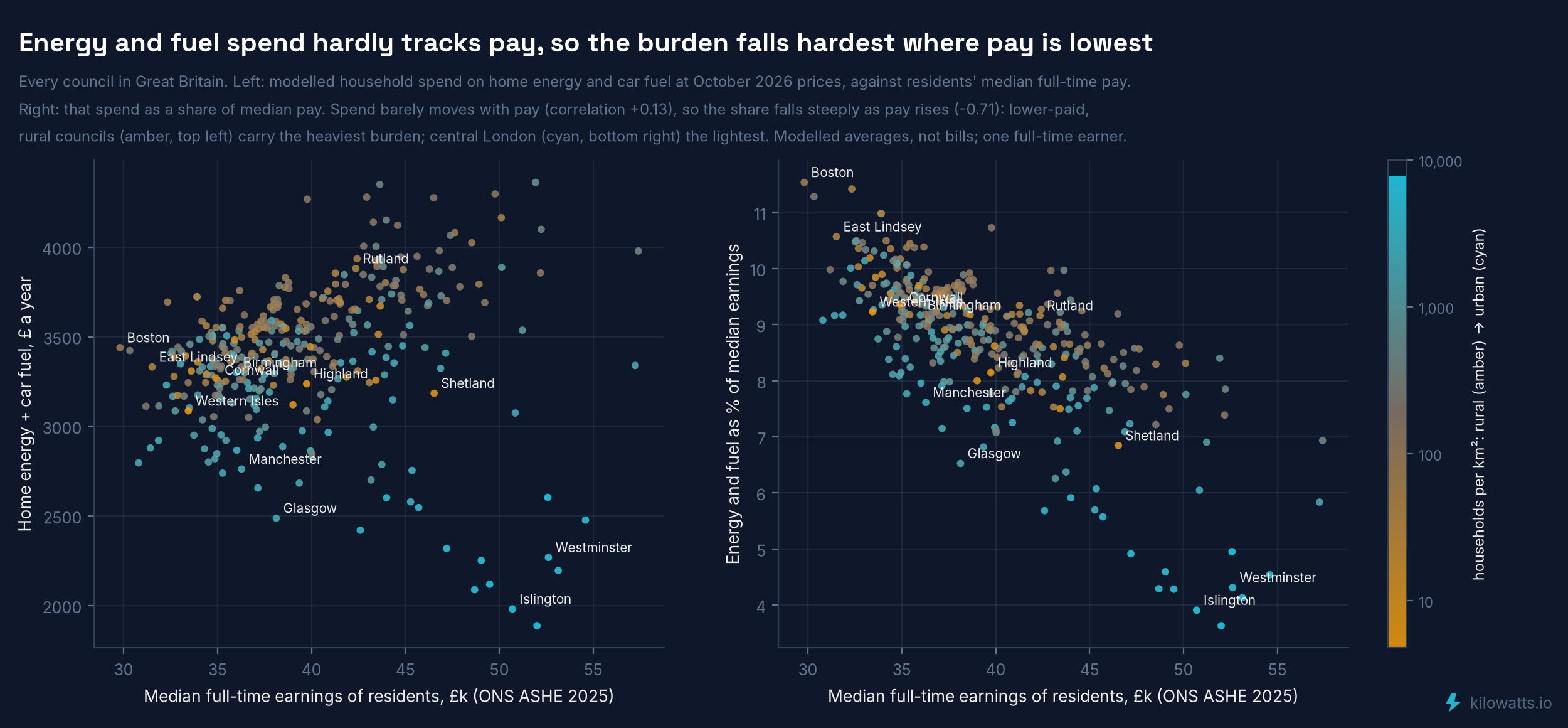
Plot it against pay instead of density and the pattern is stark. What a household spends on energy and fuel hardly rises with what it earns, so the share of pay it takes falls steeply as pay rises.
The point isn't that city dwellers are virtuous. They live in smaller homes, often flats that share walls, and they can take a bus or a train, so they simply use less energy, and they tend to earn more. Rural households have fewer of those options: bigger, older, detached homes, more of them off the gas grid, and no alternative to the car. They're the ones most exposed to fossil-fuel prices, and the ones with the most to gain from heating and driving on electricity that's made next door.
(Modelled from official averages, not bills: car fuel assumes the national average 7,400 miles a car, which understates rural mileage; earnings are one full-time earner, which overstates the share for two-earner homes; and a council average understates the coldest, most remote homes within it.)
And here's the part that matters for this piece. I checked whether the burden is higher where the wind is stronger. On its own, it barely is: once you allow for how rural a place is, wind speed makes no difference. What's striking is the coincidence. The places with the best wind are already the places where energy takes the biggest bite out of people's pay: rural, lower-paid, car-dependent, often off the gas grid. The resource and the need sit in the same places, and the way Britain prices power keeps them apart. One national price, levies charged on every kWh, and the wind sent away rather than used next door. The rest of this piece is about why that happens and how it could change.
"It's just another tax"
Talk to people in rural areas about energy and you often hear the same thing: it feels like a tax. That isn't far wrong. Much of what they pay is set or imposed by government:
At the pump, nearly half the price is tax. At last week's prices, fuel duty (52.95p a litre) plus VAT came to about 82p of a 174p litre of petrol (47%) and 86p of a 199p litre of diesel (43%). A household driving twice as far pays twice the tax, with no bus to switch to.
On electricity, policy levies are charged on every kWh (about 4p of a household's 26p unit rate this year, even after the Treasury took over most of the Renewables Obligation), on top of network charges set through Ofgem. The heavier your use, the more you pay towards schemes that were never about you. Mains gas, by contrast, carries almost none of those levies, and it's the option rural homes are least likely to have: in the most rural fifth of councils, 32% of homes are off the gas grid, twice the British average of 16% and nearly four times the 8–9% in suburban and small-town areas. (City centres are higher again, around 17%, but that's mostly electrically heated flats, which share the same problem.)
Standing charges are flat. A small flat and a large farmhouse pay the same daily charge, and many rural homes effectively pay twice: once for electricity, and again in the delivery charges on the oil or LPG they buy by the tank. In West Devon, more than four homes in ten aren't on the gas grid at all.
So in that sense it's a regressive tax by geography: the places that drive further, heat bigger homes and earn less pay the most of it.
The fair counterpoint is that rural households use more energy partly because of how they live. Bigger houses with gardens are a choice as well as a necessity, and in much of rural and small-town Britain, housing costs a fraction of what it does in London or Bristol. Measured against total living costs rather than earnings, the gap would narrow. And plenty of rural places, the Cotswolds among them, are anything but poor.
But I don't think that settles it. Housing can't be traded for heating oil, and you can't move your job closer to a bus route. What stands out to me is narrower: rural Britain is paying a large, centrally set bill for energy, while the one energy resource it has in abundance, wind, is the one it isn't allowed to use to bring that bill down.
3. Why the wind on their hills doesn't help
Whose wind is it?
Rural communities have always lived off local resources. On English and Welsh commons, the law still recognises old fuel rights: estovers, the right to take wood for the fire, and turbary, the right to cut peat for the hearth. Plenty of rural households still keep warm on logs from a neighbour's woodland at a price no city dweller could get. The resource is local, so the benefit is local.
Wind doesn't work like that. The land a turbine stands on is usually leased by a landowner to a developer, the turbine is owned by a utility or an investment fund, often based a long way away, and the power is sold into the national market. The village gets the view, the construction traffic and, in Scotland, a community benefit fund that government guidance pegs at £5,000 per megawatt a year, which many wind farms don't even reach. It doesn't get cheaper electricity, and it doesn't own any of the turbine.
Community ownership is still rare. Across all technologies, Scotland had about 1,150 MW of community and locally owned renewable capacity at the end of 2025, still well short of its 2 GW target (Energy Saving Trust). Wind is only part of that, a few percent of Scotland's onshore wind fleet, and much of "locally owned" means a farm or an estate rather than the village.
That, I think, is the root of the planning fights. People are being asked to host a resource that is theirs in every sense except the ones that matter: who owns it, and what it does to their bills. If a turbine on the hill worked like the woodland behind the village, cheaper fuel for the people who live next to it, many of those fights would look different. The rest of this part is about why it currently can't.
The border problem
The first reason is physical, and Kirk Hill shows it well. Between Kirk Hill and most of Britain's demand sits B6, the transmission boundary between Scotland and England. NESO publishes a day-ahead forecast of the flow across it (SCOTEX) and the limit on it, every half-hour.
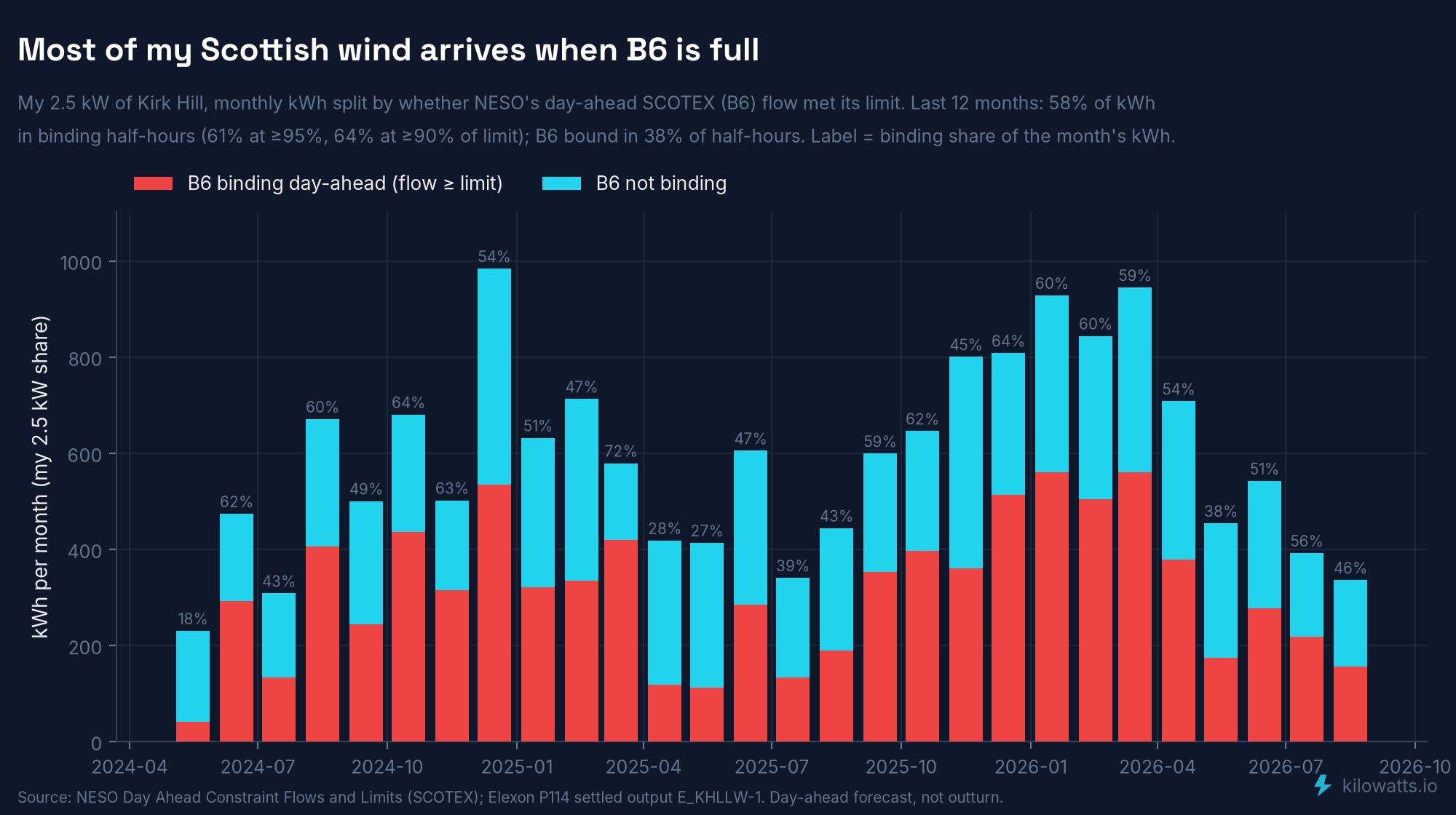
Over the last twelve months, B6 was forecast to be full in 38% of half-hours. But 58% of my share of Kirk Hill's output (4,514 kWh) was generated in those half-hours. That rises to 61% at 95% of the limit, and 64% at 90%. The reason is simple: B6 fills up when it's windy in Scotland, and that's exactly when Kirk Hill runs hardest. It averages 56% of capacity when B6 binds, against 25% when it doesn't.
To be precise about what this means: Kirk Hill itself was never turned down. It is a small embedded unit outside the Balancing Mechanism, with no bid-offer acceptances in the whole period. When B6 is full, its output is used in Scotland, and other Scottish generation gets paid to switch off. So "inaccessible to England" is a marginal idea, not a physical one; electrons don't carry return addresses. But it's another way of seeing why selling Ayrshire wind to households in southern England never made much sense. More than half the time, the extra Scottish megawatt-hour had nowhere south to go. And this counts only B6: the boundaries further south between Ayrshire and the south of England would add to it.
When does that change? The big fixes are two subsea cables down the east coast. Eastern Green Link 1, Torness to County Durham, is now expected in 2030. Eastern Green Link 2, Peterhead to Drax, is expected in 2029. They were first proposed in 2009 and 2012, and the National Audit Office's report this month notes both will arrive "several years later than originally planned". Two more links follow in 2033–34.
In the meantime it's getting worse, not better. B6's average day-ahead limit has fallen by about a fifth since 2023, while the flow trying to cross it has doubled, partly because lines have to be taken out of service to build the upgrades. And on my own analysis of the constraint data, EGL1 on its own would remove only 5–9% of today's Scottish curtailment. It's the pair together, with EGL2 running all the way from Aberdeenshire to Yorkshire and bypassing the bottlenecks further north, that removes around three-quarters. So for the rest of this decade, Kirk Hill's best customers are the ones it can see.
Kirk Hill's next chapter: sell to the neighbours
The volunteer board's rescue was stage one: get out of Ripple's wreckage, sell the power wholesale, and pay members directly once a year. That was the right thing to do, and it was hard. But it leaves Kirk Hill as a price-taker: a Scottish wind farm selling into a wholesale market that pays it least when it's windiest, behind a border that is full more than half the time it generates.
Stage two could be to stop sending the power south at all, and sell it next door.
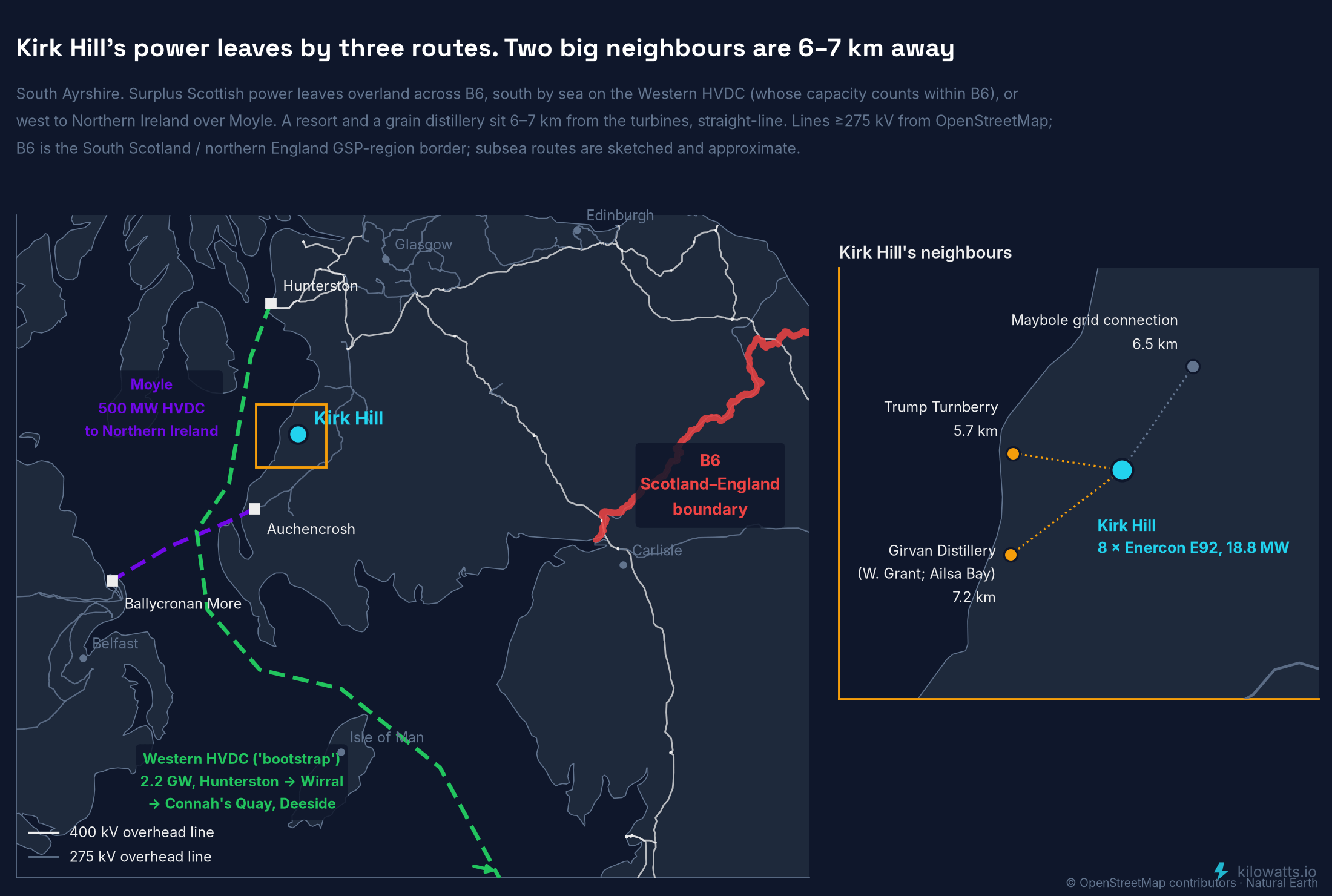
Look at who lives within 7 km of the turbines. On the coast, 5.7 km away, is Trump Turnberry: a five-star hotel, spa and championship golf resort with kitchens, laundries and a lot of heated hospitality. And 7.2 km south, near Girvan, is William Grant & Sons' Girvan distillery. It is one of Scotland's big grain distilleries and shares its site with the Ailsa Bay malt distillery. Distilling means heat and power around the clock, which is the kind of steady demand a wind farm dreams of.
There are two ways to reach them:
A private wire. A cable of Kirk Hill's own, supplying under the licence exemption for on-site and private-wire supply (up to 100 MW, of which no more than 1 MW to households). It avoids network charges and policy levies entirely, but it means several kilometres of cable, wayleaves and a lot of engineering.
P441-style local supply over the existing wires, if the sites share a primary substation. I haven't checked whether they do. The small-supplier exemption also caps it at 5 MW, a quarter of Kirk Hill.
Both buyers are businesses, and as the levy maths below shows, businesses are the best customers for local power: they still pay the full Renewables Obligation, so they save about 8p for every kWh they take locally.
I'm not proposing anything. The board has done enough unpaid work, and a private wire is a serious project. But it is a nice thought: the best-paying local customer for a community wind farm might be the man who hates wind farms most, or a whisky distillery.
Why this could be a game changer in Scotland
Kirk Hill is not unusual. Scotland has most of Britain's onshore wind, and a lot of it sits in places like Ayrshire, the Borders, Dumfries and Galloway and the Highlands, where people live within sight of the turbines and pay the same bills as everyone else, or more, because so many homes are off the gas grid.
What makes local power interesting there is that, for once, the grid argues for it. Scotland's grid is pretty saturated: new wind farms wait years for a connection, and when it's windy the boundaries to the south fill up. B6 was full in 38% of half-hours over the last year, and the curtailment bill for paying Scottish wind farms to switch off keeps growing. Every extra turbine north of the border makes that worse, unless the power is used close to where it's made.
So the opportunity is a community that can consume its own wind at a meaningful discount, and own a share of the turbine too. That's something no supplier can offer, because no supplier owns the wind farm next door. The catch is the same grid. A new community turbine in Scotland faces the same connection queue as everyone else, and if its neighbours don't use the power, it joins the queue to be curtailed. A local scheme only helps if the demand is genuinely local: electric heating, heat pumps, EV charging, a distillery or a water works under the same substation.
That makes Scotland the place where local supply is both most valuable and hardest to connect. And it points to what the opportunity in Scotland actually is: not more turbines, which the grid can't take, but using the wind that's already there. Kirk Hill selling to its neighbours, and heat pumps in Scottish towns soaking up power that would otherwise be paid to switch off. New community turbines make most sense somewhere else, where the grid is still dirty, which I come back to below.
4. Letting neighbours use their own wind
P441, and why geography matters
Which brings me to P441.
P441 is a change to the Balancing and Settlement Code — the rulebook for how electricity is metered and paid for — that creates "Complex Site Classes". The one that matters here is Class 5: it lets a licence-exempt supplier net the power its generators export against the power its customers import, across different meters, and settle only the difference. In plain English, it lets a local generator sell directly to its neighbours, with the shared kWh treated as never having gone to the wider market.
The Panel recommended it unanimously in March 2026 and sent it to Ofgem. On 27 August Ofgem sent it back — not a rejection, but so it can be decided alongside the matching distribution-charging change (DCP424) and a retail code change. It is sitting in the queue. My bet is that it comes in, probably in 2027.
The crucial detail is the catchment: every meter in a Class 5 site must sit under the same primary substation. That is typically a town, or a few villages. For most of the country, that makes the obvious technology rooftop and field solar plus batteries — it's what you can get planning for inside a town's footprint.
But there are places where that is the wrong answer. Remote, high, windy places — the Scottish uplands, the Highlands and islands, parts of mid-Wales — where the local resource is wind, and the local grid is thin. And these are exactly the places where wind has the hardest time: long new tracks across the moor to bring in the cranes and blades, then keep them serviced for thirty years, for power that is shipped off somewhere else. That is the heart of the NIMBY problem. P441 offers the neighbours the power. A turbine whose output is sold, at a discount, to the houses that can see it is a completely different planning conversation from one whose output disappears into the grid.
And wind is a much better match for how households use electricity than solar is:
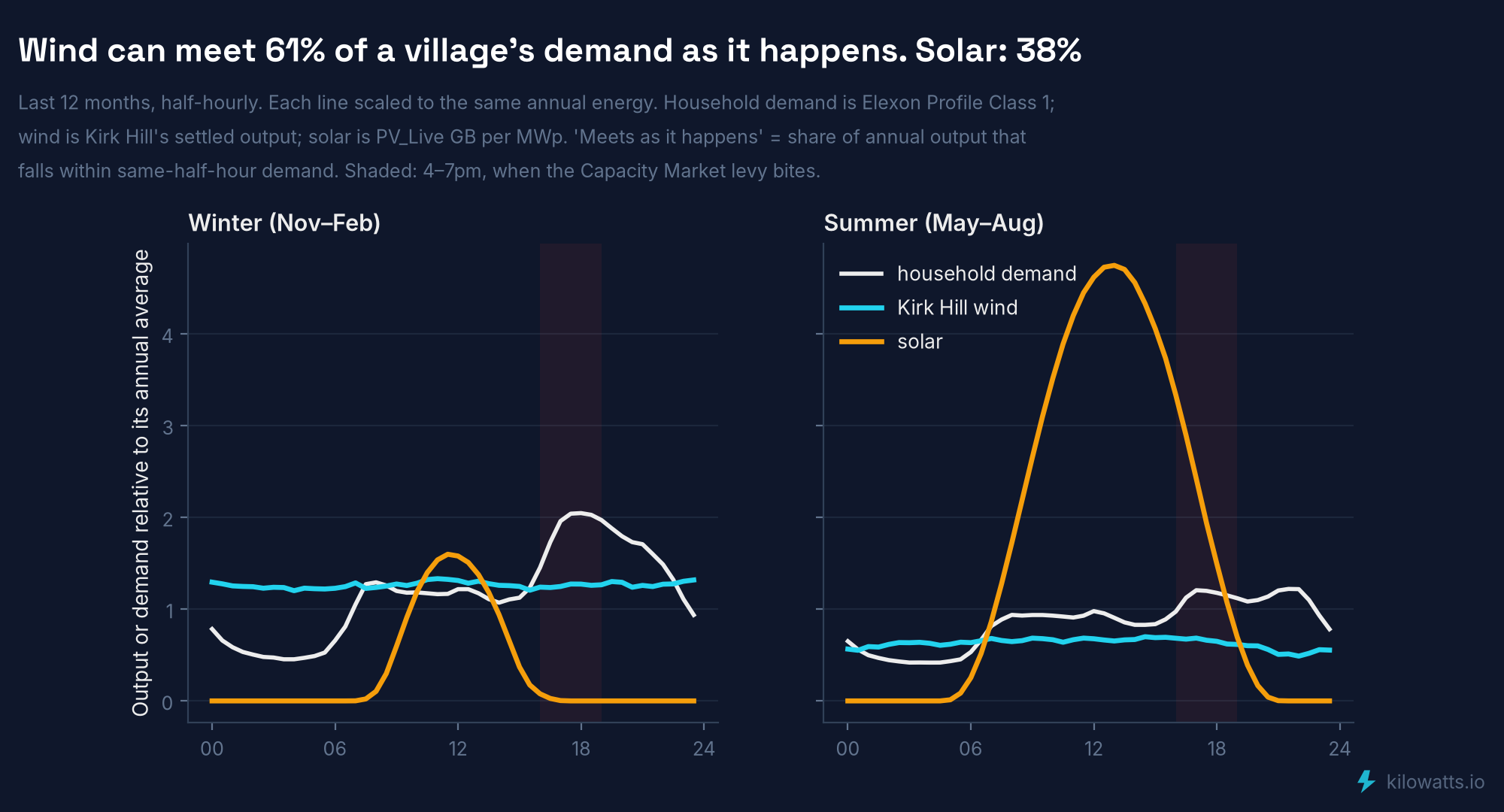
Scale a village's annual demand to equal its generation, and 61% of Kirk Hill's output lands in a half-hour when there is household demand to meet. For solar it is 38% — midday summer power arriving when the houses are empty. Solar produces nothing in the winter 4–7pm peak; Kirk Hill put 3.9% of its year there, against 5.5% of household demand. (Kirk Hill is one site in Scotland, and the solar line is a smoothed GB average, so if anything this flatters solar.)
What already exists: Britain's energy clubs
None of this is hypothetical. Energy Local has been running local matching "clubs" since a pilot in Bethesda in 2016. They work before P441 by using a partner supplier: members switch to a special tariff, and in every half-hour where the club's generator is producing, their use is billed at a cheaper "match" price. I pulled the numbers for every club from its pages and its public dashboard.
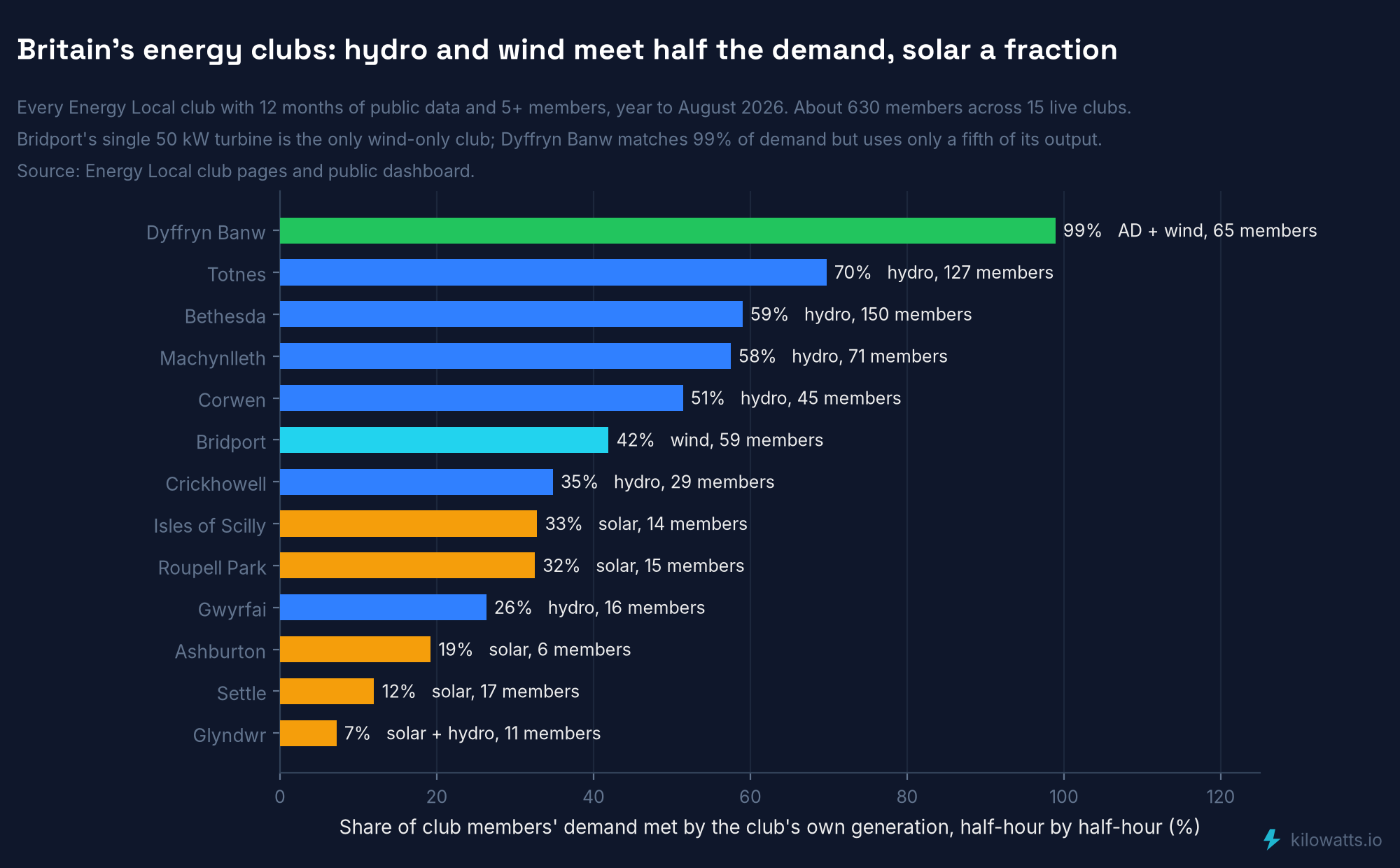
What they show, for the year to August 2026:
They are small. There are 15 live clubs with about 630 members between them. The median club has 17. Only Bethesda (150) and Totnes (127) have more than a hundred.
They mostly run on old hydro. Most generators are existing run-of-river schemes of 30–300 kW in Wales, not new build.
The generation technology decides the matching, just as the chart above predicted. Hydro and wind clubs meet 35–70% of members' demand as it happens. Solar clubs manage 7–33%. Bridport, on a single 50 kW turbine in Dorset, is the only wind club, at 42%.
The savings are real. Established clubs report 17–30% off unit rates, about £140–300 a member a year.
No club has ever had a battery. The only design I could find, in Bretherton in Lancashire, hasn't launched.
The supplier can end a club. When Octopus withdrew as partner supplier in February 2026, clubs had to move to another supplier. Capel Dewi in Carmarthenshire, with 54 members, closed rather than switch, two others have since disappeared from the website (no reason given), and the move raised members' standing charges by about £90–100 a year, eating a third to a half of the saving. And in the 2022–23 price crisis, match prices were raised to the level of normal prices, so savings all but disappeared.
That last point is the whole case for P441 in miniature. Today a club lives or dies on one supplier's goodwill, and it can only grow as big as one small generator and one substation allow. One Hebridean club, on Barra, can't form at all, because its 910 kW turbine is metered at a different voltage from the homes. P441 is meant to fix exactly that.
The fix: a heat pump running on the wind next door
The biggest single lever on a rural household's energy bill is heat, and a lot of it still comes from heating oil, LPG, logs and night storage heaters. So I ran the same exercise for an ordinary rural home next to Kirk Hill, heated by a heat pump, using Kirk Hill's real output and the local weather over the last year.
First, how much heat does a home there need? South Ayrshire as a whole is mostly on mains gas, because most of its people live in Ayr, Prestwick and Troon. Around Kirk Hill it's a different story. Comparing gas meters with electricity meters by postcode, roughly a third of homes around Maybole and Kirkoswald, and over 40% around Turnberry, Maidens and Dailly, have no mains gas, against under 10% in Ayr. (Postcode data drops the smallest postcodes, so treat those as approximate.)
The council's gas-heated homes burned an average of 11,900 kWh of gas in 2024, about 5% more than the GB average (DESNZ). After boiler losses that is roughly 10,000 kWh of heat, and gas homes are mostly the smaller, more urban ones. The rural, off-gas, often detached homes that burn oil or LPG need more. I've used 15,000 kWh of heat a year, including hot water. (Quoting the answer per kWh of heat, as below, makes it almost independent of house size anyway.)
The first thing in wind's favour is timing:
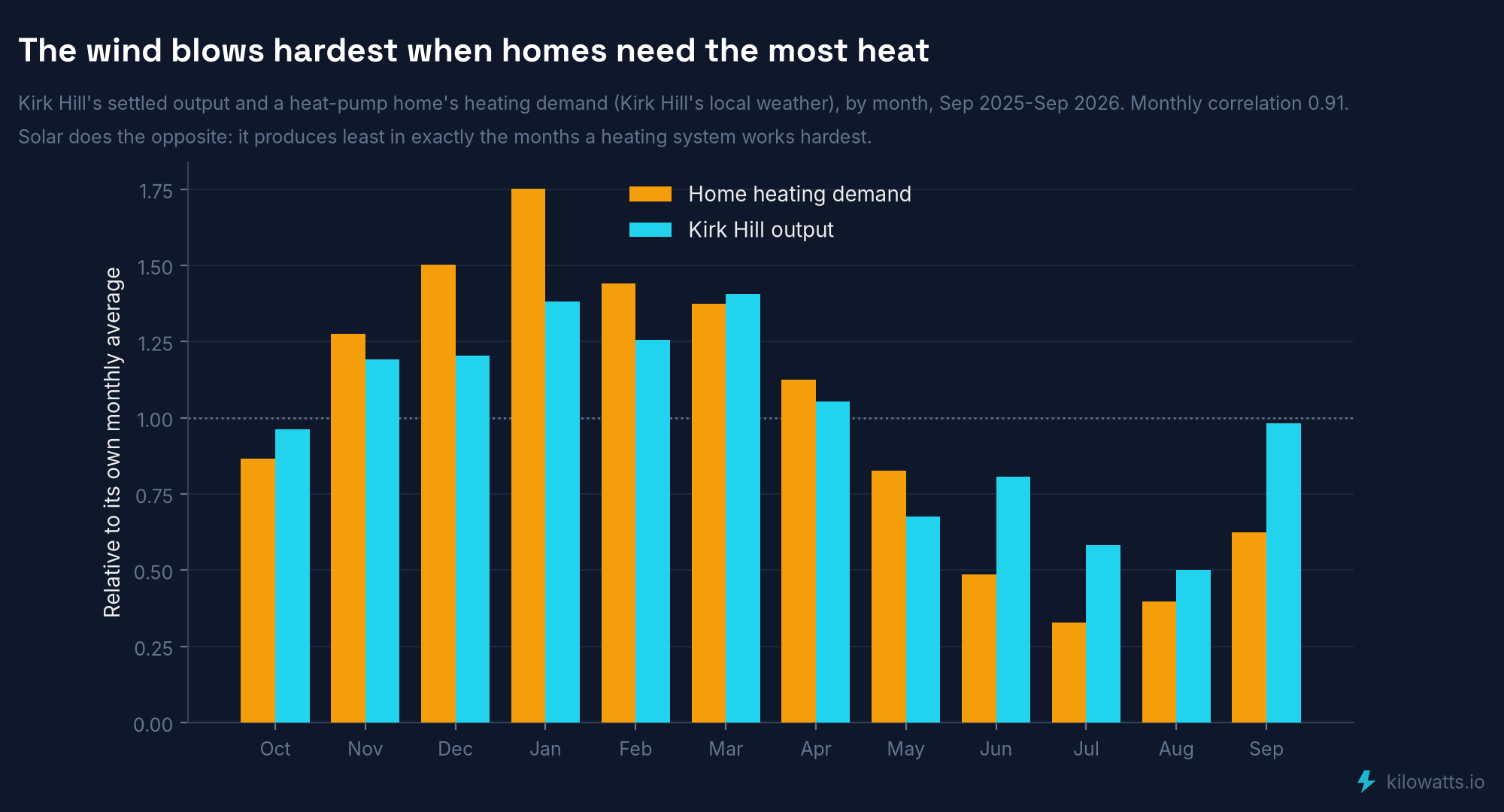
Month by month, Kirk Hill's output and a home's heating demand move almost together (a correlation of 0.91). The windy season is the heating season, which is the opposite of solar.
Now the cost. Give the community a share of the turbine that makes as much in a year as its heat pumps use. Price the local power at 13p, a typical community "match" price, and buy everything else on a tariff that tracks the wholesale market (Octopus Agile in South Scotland). Then compare the cost of a kWh of heat delivered into the house with every other way of heating a rural home:
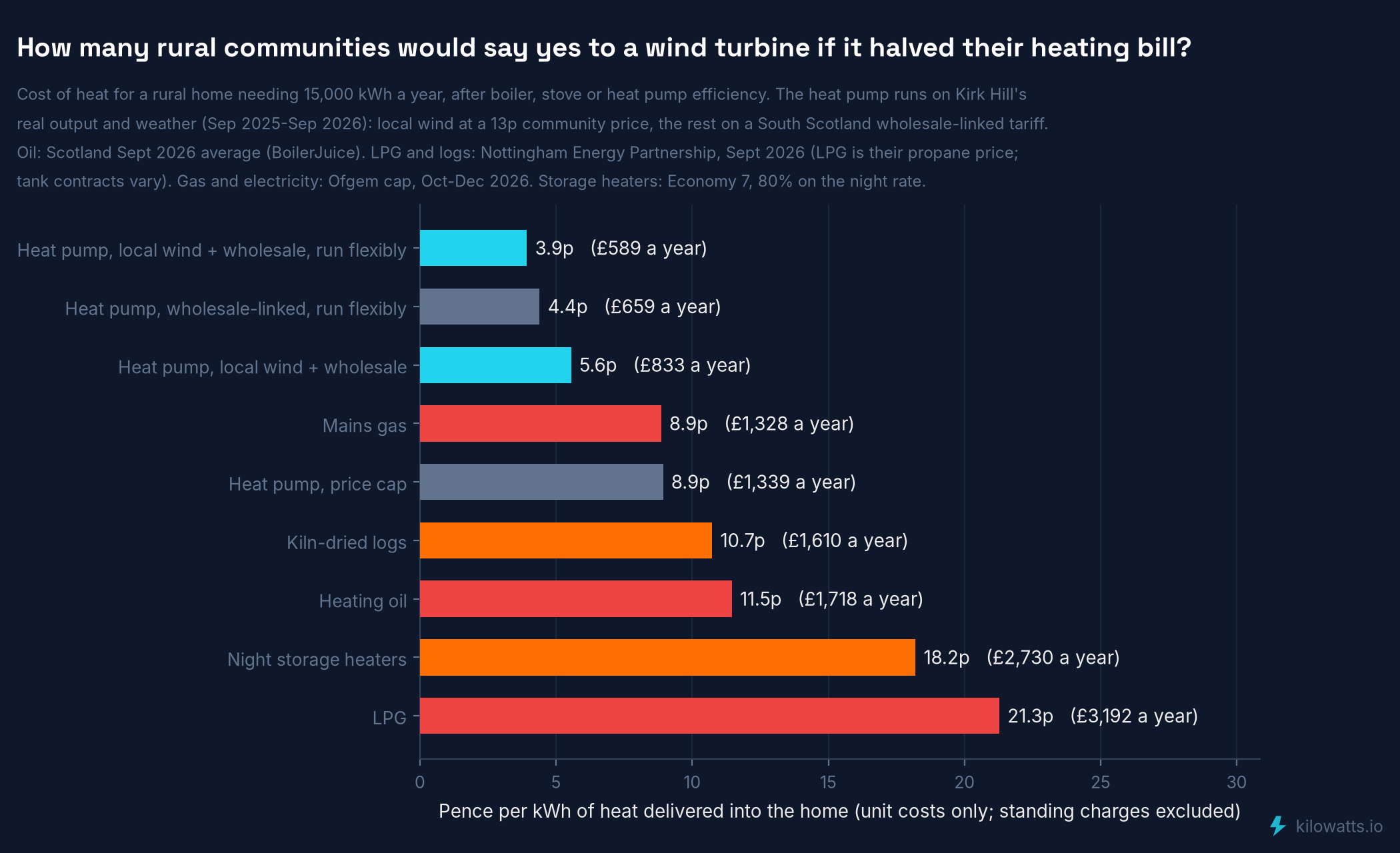
LPG: 21.3p per kWh of heat, about £3,200 a year for this home.
Night storage heaters: 18.2p, about £2,700.
Heating oil: 11.5p, about £1,700, at September's Scottish average. Oil has jumped sharply this year, and recent quotes are higher still.
Kiln-dried logs: 10.7p, about £1,600.
Mains gas: 8.9p, about £1,330, plus a standing charge of about £108 a year you'd stop paying if you left gas altogether.
Heat pump on the price cap: 8.9p, about £1,340.
Heat pump on local wind plus wholesale: 5.6p, about £830. If the heat pump also pre-heats the house and the hot-water tank when power is cheap, buying local wind or wholesale power whichever is cheaper in each half-hour, that falls to 3.9p, about £590.
So a heat pump running on its neighbours' wind costs half as much as oil, a quarter as much as LPG or storage heaters, and less than mains gas. That's the number that could change the conversation about onshore wind in rural places. The usual offer to a community is a benefit fund of a few thousand pounds a megawatt. This is a turbine that halves the heating bill of the people who can see it.
Two honest caveats. First, a lot of the saving comes from the heat pump and a wholesale-linked tariff, not the turbine: run flexibly on wholesale alone, with no turbine at all, it costs 4.4p. Local wind takes that to 3.9p. The bigger case for local wind is that it offers a fixed price for 15 or 20 years: wholesale-linked tariffs are cheap until they aren't, as 2022 showed, and oil has just reminded everyone how fast fuel prices can move. That certainty matters most to exactly the households that can't, or won't, run their heating around the market. Second, these are unit costs only. They leave out the cost of buying the heat pump, and they assume a scheme that doesn't exist yet.
The maths: what local power is worth
So what is sharing local power actually worth? The P441 workgroup did the sum, on 2024/25 rates. Elexon's analysis for the modification put the policy levies avoided by exempt supply at about £50/MWh (5p/kWh). Two years on, the total for a business is higher, and the mix has changed:
Renewables Obligation — P441 workgroup (2024/25): 32 · 2026/27: 32.7 · Notes: 0.472 ROCs/MWh × £69.34 buy-out (2024/25: 0.491 × £64.73). Households now pay only 25% (8.2); the Exchequer covers the rest.
Contracts for Difference — P441 workgroup (2024/25): 11 · 2026/27: 6.5 · Notes: Interim levy reset quarterly and cut mid-quarter when wholesale prices rise: £10.26, £10.56 → £2.07, £8.18 → £5.53, £2.98 for Q1–Q4. Day-weighted average, plus a £0.15 operational levy.
Capacity Market — P441 workgroup (2024/25): 5 · 2026/27: 13.9 · Notes: £3,474.5m of capacity payments (plus a £9.1m settlement levy) charged on 11.29 TWh of demand at 4–7pm on winter working days, i.e. £308.5/MWh in those hours. Spread over ~250 TWh of all supply (my assumption) = £13.9. Delivery year runs Oct 2026–Sep 2027.
Feed-in Tariffs — P441 workgroup (2024/25): not counted · 2026/27: ~9 · Notes: Levelisation varies by quarter; about £8–10. The workgroup's table left it out.
Nuclear RAB (Sizewell C) — P441 workgroup (2024/25): didn't exist yet · 2026/27: 4.2 · Notes: Quarterly interim levy: £4.68, £4.49, £3.75.
Policy levies — P441 workgroup (2024/25): ~50 · 2026/27: ~67 · Notes: For a business. A household avoids about 42, because of the RO point above.
BSUoS (balancing) — P441 workgroup (2024/25): 15.7 · 2026/27: 12.5 · Notes: Fixed tariff from 1 Oct 2026 (£13.74 before). Avoided only under P441 Class 5, not under other exempt-supply routes, and up for review.
The Capacity Market charge has nearly tripled, a new nuclear levy has arrived, and the CfD levy has fallen because high wholesale prices mean the contracts pay out less. (2026/27 rates: EMRS Key Figures for Payments 2026/27, Ofgem, DESNZ and NESO.)
Operators of existing local energy clubs told the workgroup the total benefit, including the price premium to the generator and the discount to the customer, runs to 10–15p/kWh.
Then, last November, the Budget changed the numbers. From April 2026 the Exchequer pays 75% of the Renewables Obligation on household bills — about 2.45p/kWh off every domestic unit rate, funded by grants to licensed suppliers. I think that's the right direction: it moves part of a per-kWh levy onto general taxation. But look at what it does to local energy:
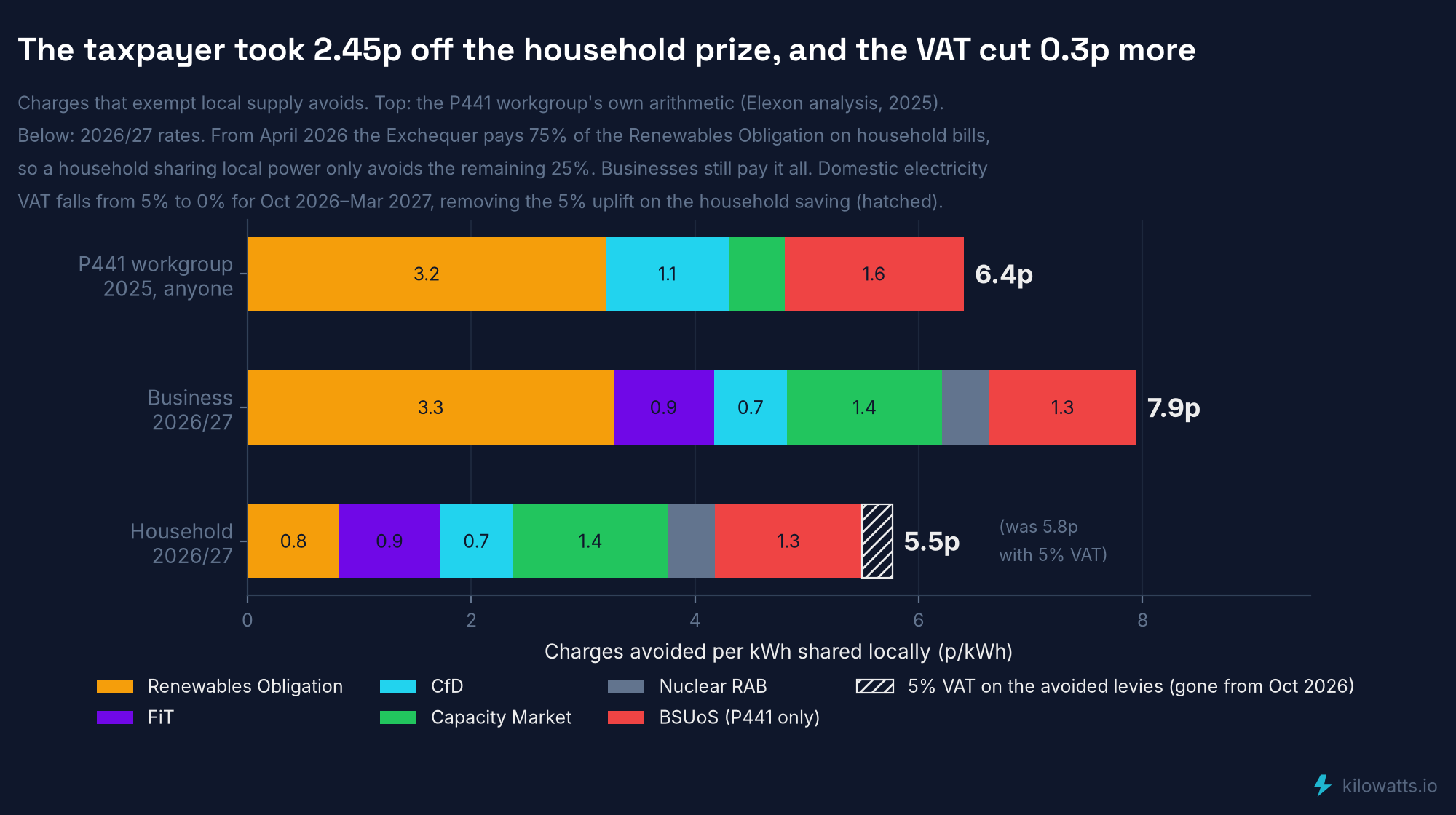
A licence-exempt supplier gets no grant. So when it sells to a household, it is competing against a tariff that already has 2.45p knocked off, and the RO it "avoids" is only the remaining 25%. Sell the same kWh to a business — which still pays the full RO — and the avoided levy is 7.9p. Sell it to a household and it is 5.5p.
And from 1 October the household number shrinks a little further. Domestic electricity VAT drops from 5% to 0% until the end of March 2027. VAT sits on top of the levies, so while it was 5%, every penny of levy a household avoided was worth 1.05p to it: 5.8p, not 5.5p. At 0% that uplift goes too. It is only 0.3p, but it points the same way. Businesses reclaim their VAT, so for them nothing changes.
Nobody designed this. But the effect is that local energy now pays best selling to commercial customers, and a scheme built around households has lost about a third of its levy advantage before it starts. That isn't a reason to put the levy back on household bills. It shows how much of local energy's case is really levy avoidance.
Which is exactly why Kirk Hill's neighbours, a golf resort and a grain distillery, are more interesting customers than its members.
Combine that with the shape of household demand — skewed to the evening, as the wind-and-solar chart earlier showed — and I think this significantly undermines community solar as a household proposition. The midday power doesn't match the demand, and the demand it could match is now worth less.
What it does do is put a premium on batteries. A battery, or a community battery, in the same portfolio moves the midday solar into the evening — into the Capacity Market window, where the levy avoided on matched volume is worth tens of pence per kWh rather than one — and turns a poor match into a good one.
Where I stand on levies
It's worth being straight about this, because it's easy to write about local energy as though the levies were simply a tax to be escaped.
I think per-kWh levies are distortive. The RO, CfD, FiT and Capacity Market pay for things that have already been built or contracted. None of that cost changes with how many kWh I use tomorrow. Charging it per kWh makes electricity look dearer than it is to produce, which penalises exactly the things we want people to do: heat pumps, EVs, electrifying. I'd rather those costs were recovered as a lump sum per connection, on capacity, or from general taxation, as the Exchequer has now started to do with the RO.
But while they're charged per kWh, avoiding them is part of what makes a community turbine pay. In my turbine numbers, levy avoidance is what lifts an 800 kW or 2.3 MW turbine from marginal to investable. The levy costs don't go away when a club avoids them. They are recovered from everyone else's bills instead. The P441 workgroup said as much about the balancing charges: if these sites weren't actually reducing system costs, the exemption "would be a subsidy paid by Final Demand not in Class 5 Complex Sites."
Some of it is real value, though. Generation close to demand saves on wires and losses, and that matters most for wind. The windy parts of Britain are mostly in Scotland, behind the B6 boundary where 58% of my Kirk Hill output sat. Scottish wind used by Scottish homes and businesses under the same substation never has to cross that boundary at all, and every kWh used locally is one less to curtail. That is a genuinely different proposition from an Ayrshire wind farm pretending to be local to a house in England.
The system already pays for some of that value, and it pays most in exactly the places on my map. I priced it for the same hypothetical 2.3 MW turbine, using Kirk Hill's real timing, in the south-west of England against southern Scotland:
Transmission losses. Elexon credits generation by zone for the losses it saves or causes. Over the last year a south-west kWh was credited at 1.006, a southern Scottish one at 0.976. — South-west England vs southern Scotland: +£16,000
Embedded export credit. NESO pays small generators for output at the winter peak: £17.27 per kW in the south-west this year, the highest in Britain; nothing in Scotland. — South-west England vs southern Scotland: +£18,000
Distribution credit. NGED pays HV-connected generators in the south-west for exporting at peak (7.8p a kWh on weekday evenings, much less at other times). — South-west England vs southern Scotland: up to +£45,000
Total — South-west England vs southern Scotland: about £79,000 a year, roughly 1.2p per kWh
That's real money, about a fifth of what the turbine would earn selling its power at 6p, and it isn't levy avoidance: it's the grid paying for generation where the demand is. South Wales gets less of it (around 0.35p a kWh from losses and the export credit alone). I've treated the distribution credit as a south-west-only figure because I haven't checked what Scottish networks pay, so read the total as an upper bound.
And the places that would benefit most are not going to move anyone's bill. The windiest corners of Britain are often remote, with older and harder-to-heat homes, more people off the gas grid and higher bills than average. A handful of schemes there won't show up in anyone else's levies.
The bigger worry is who community energy reaches if it scales. It takes organisers: people with the time, confidence and contacts to form a co-op, raise capital, get planning and negotiate with a supplier. Those are most plentiful in wealthier, better-educated places. If local energy spreads through them first, the places with the most social capital get the cheapest power, and everyone else pays a bigger share of the levies. That's the opposite of where help is needed.
Many of the windiest places are not those places. A turbine there would only happen with outside investment capital and a large anchor customer such as a water company. That's less romantic than a village co-op, but more likely to get built where it would do the most good.
5. Where it would work, and what it would cost
Where would new local wind make sense?
So where in Britain would a new community turbine do the most good? It needs four things to line up: plenty of wind, homes that are expensive to heat, a local grid that is still burning gas when the wind isn't blowing, and room on the wires. Here are the four layers:
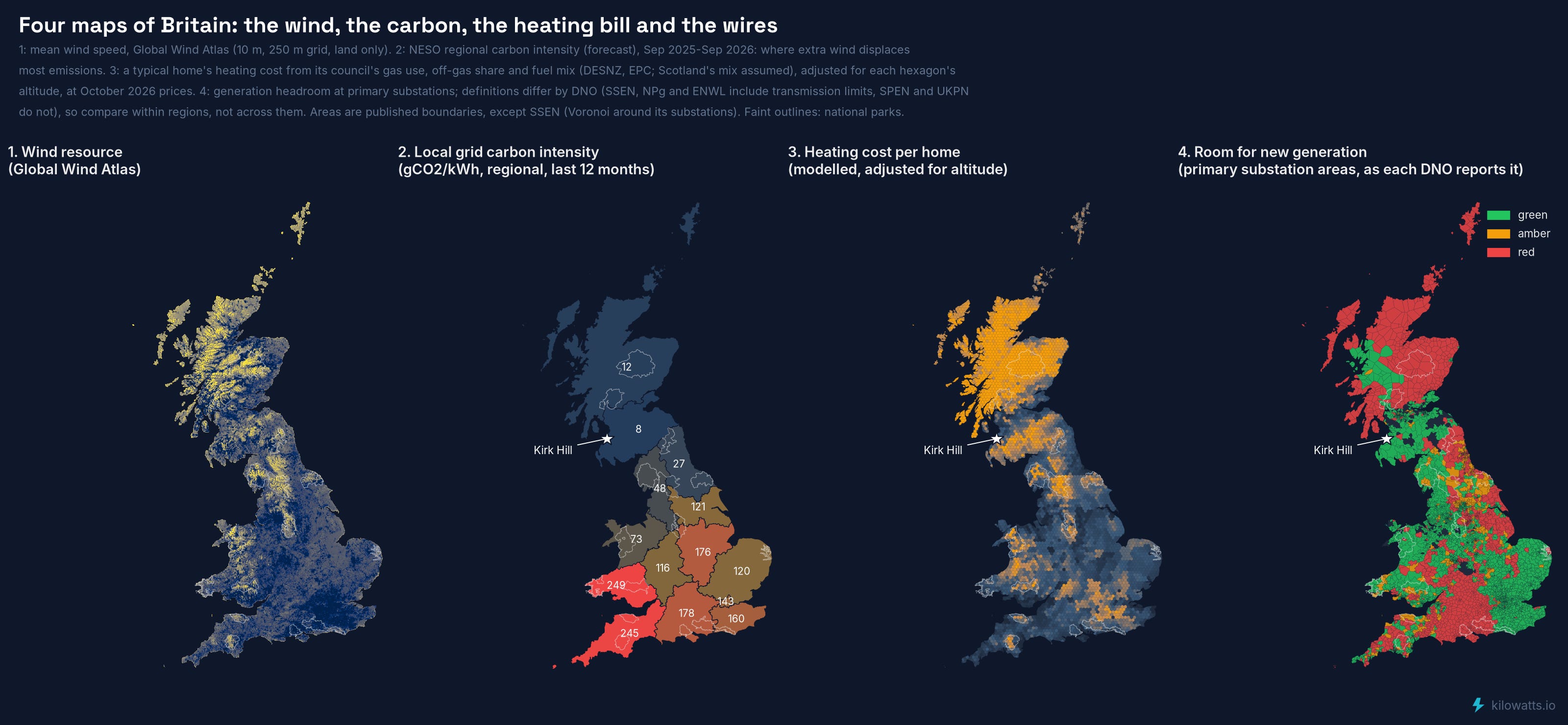
The carbon map is the one that changes the answer. Over the last year, the grid in the north of Scotland averaged 12 g of CO₂ per kWh, and in the south of Scotland 8 g: it is already almost entirely wind, hydro and nuclear. Extra wind there displaces almost nothing; it mostly adds to the queue to cross B6 and the bill for switching turbines off. At the other end, South Wales (249 g) and South West England (245 g) have the dirtiest local mixes in Britain, because they lean on gas. A kWh of local wind used there displaces far more gas than the same kWh in Ayrshire.
The network map is messier, because every network company measures spare capacity differently. I've used each company's own published service areas for its primary substations, and for SSEN, which doesn't publish them, areas drawn around each substation. It makes the same point about the north of Scotland: almost every primary substation there has no room for new generation until transmission reinforcement arrives. Plenty of England is red too, including parts of Yorkshire and the south-west, so no region gets a free pass.
Put the first three together, leave out the regions where the grid is already low-carbon and the places already crowded with wind farms, correct the heating cost for altitude (a village at 400 m needs much more heat than the town below it), and take out the areas where the network company says there is no room for new generation. I've also taken out eastern Norfolk and Suffolk. Their local substations often look open, but everything there sits behind East Anglia's EC5 export boundary, where around 13 GW of mostly offshore wind is already queuing to get out. Like Scotland, new wind there would mostly add to the queue:
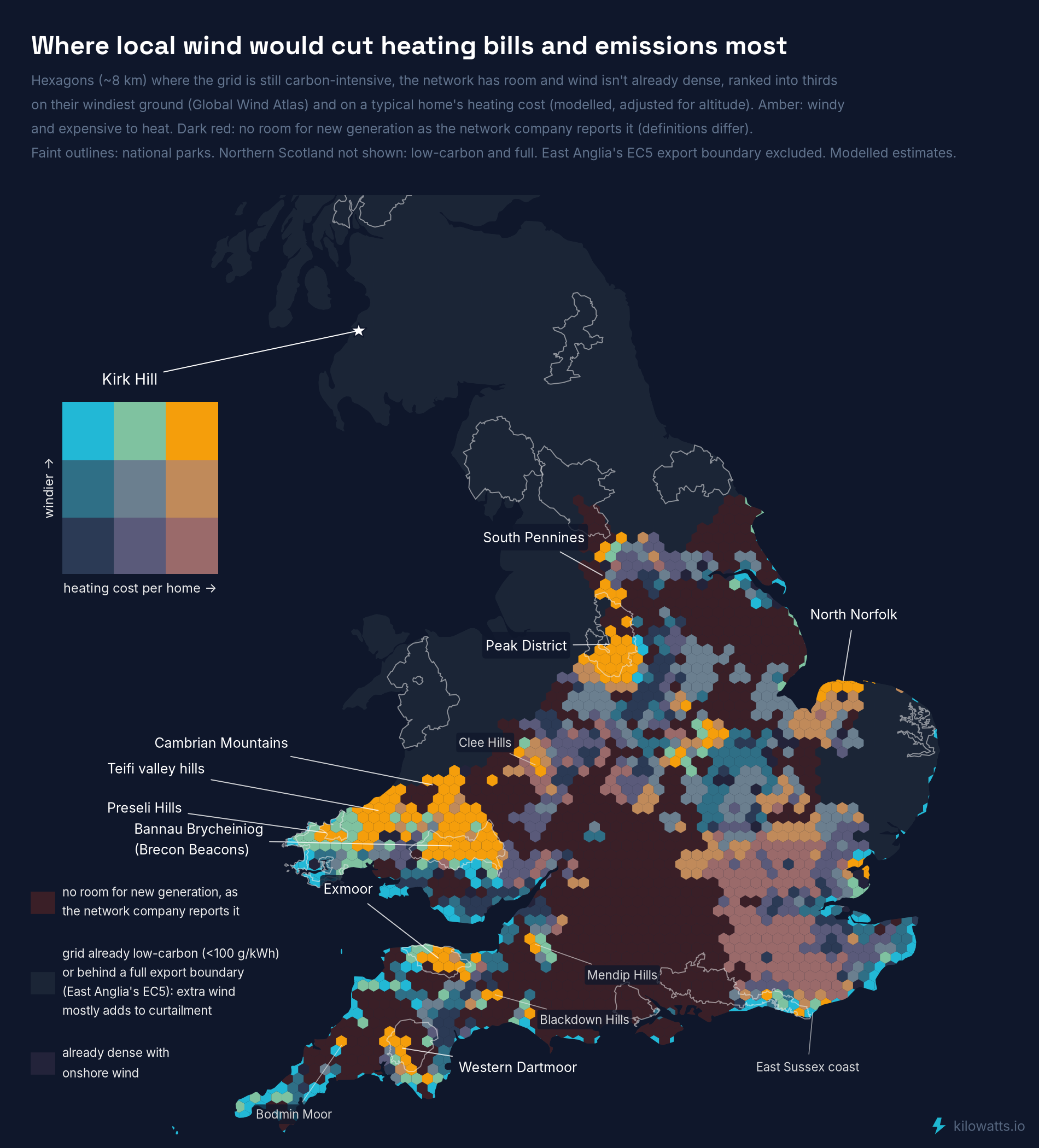
Amber is windy, expensive to heat, and still carbon-heavy: the Cambrian Mountains, the Brecon Beacons and Preseli Hills, Exmoor, the Peak District and South Pennines, a strip of north-west Norfolk outside the EC5 boundary, and a patch or two of high moorland elsewhere in the south-west. Not all of them are places where you could build, and the map ignores planning designations (the faint outlines are Britain's national parks). The dark red is where the wires are already full, as each network company reports it, and that needs reading with care: the big dark-red block across central southern England is SSEN's area, which counts transmission limits in its figures, while its neighbours mostly don't. So what's left in colour is the shortlist. But it answers the question differently from the usual one. The best place for a new community turbine is not where the wind is strongest. It's where the wind is good, the homes are cold, and the grid still needs it.
The caveats: heating costs are modelled from council averages and adjusted for altitude, not measured; Scotland's off-gas fuel mix is assumed; regional carbon intensity is NESO's forecast, not outturn; and the network data is as each company publishes it. These are estimates, not bills.
What would a local turbine cost?
⚠️ Health warning. There is no scheme here, no share offer and no investment of any kind. Everything from here on about a local turbine (sizes, costs, returns, loans, paybacks) is my own speculative modelling of a hypothetical site, built on public data and a lot of assumptions, to test whether the idea could ever work. It has not been checked by a developer, a lender or a landowner. It is not financial advice and not an invitation to invest in anything.
To get beyond Kirk Hill, I modelled a hypothetical community turbine on an exposed inland hilltop, about 10 miles from the coast, with a mean wind of 9 m/s at hub height. That's a good but not exceptional site; Kirk Hill, about 4 miles inland, does a little better. I tried four sizes, from a 100 kW farm-scale machine to a 3.6 MW one, and connected the output to a primary substation serving a few small towns and villages, using that substation's real half-hourly demand.
It only works at scale, and with businesses
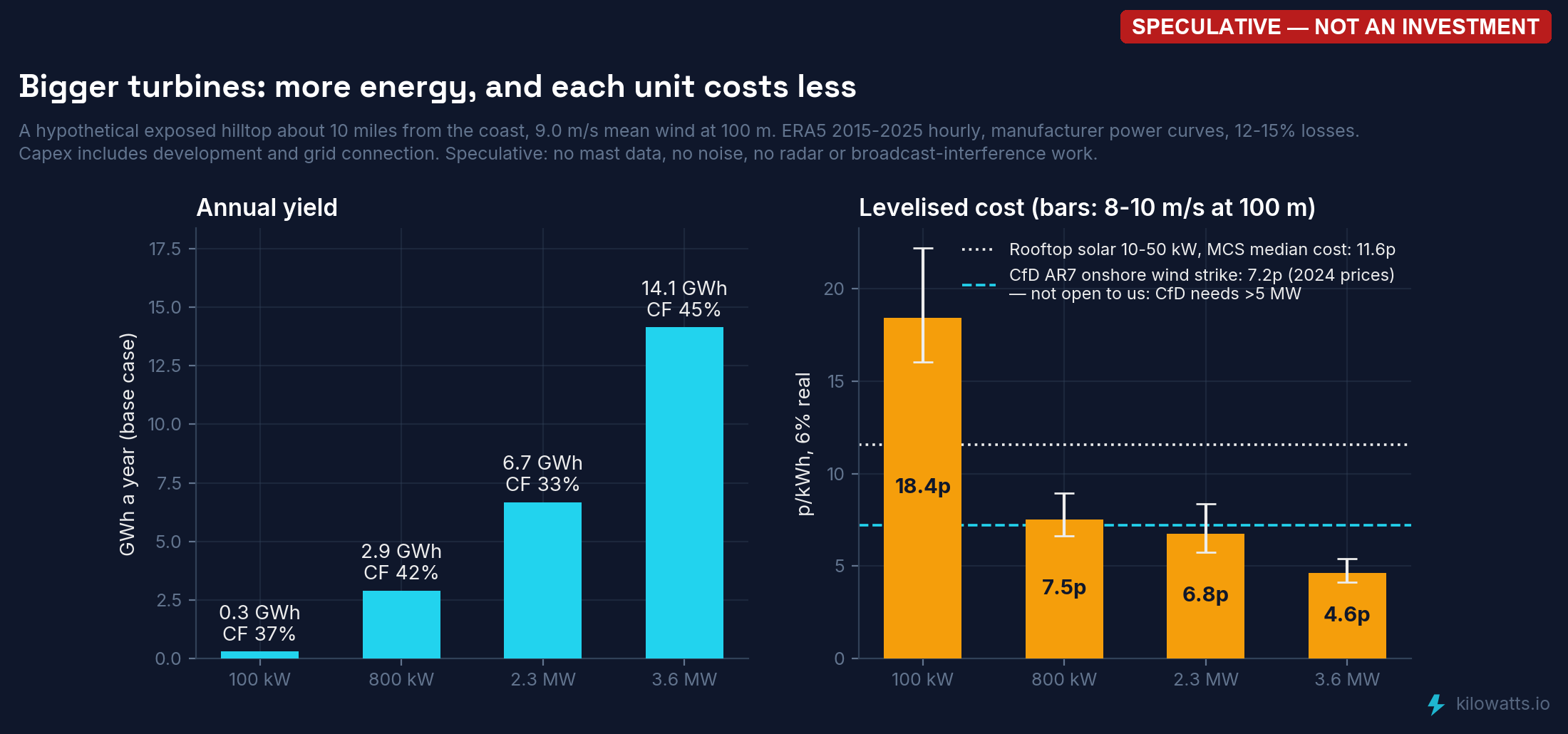
The first thing the numbers say is that small doesn't work. A turbine's cost per unit falls steeply with size: about 18p/kWh for a 100 kW machine, more than rooftop solar, down to 7.5p at 800 kW, 6.8p at 2.3 MW and 4.6p at 3.6 MW. Those last three are at or below what the government pays big onshore wind farms under a CfD, a contract a community turbine this size can't get.
The second is that who buys it matters as much as how big it is. A 100 kW turbine loses money whoever buys its power. From 800 kW up, the customer makes the difference:
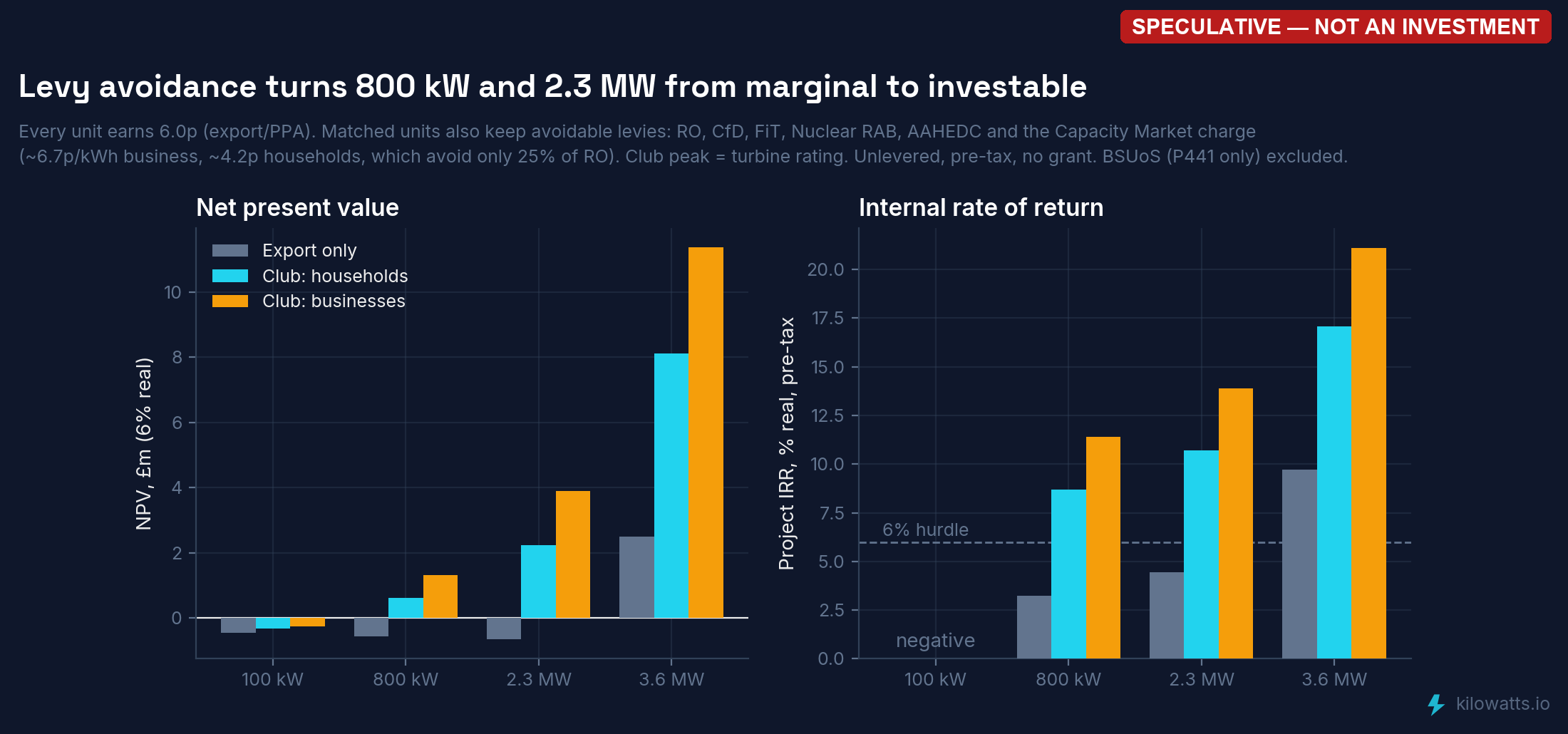
At 2.3 MW, selling everything to the grid returns about 4.5%, below any sensible hurdle. Sell the power locally to a club of households and it rises to 10.7%. Sell it to a club of businesses and it's 13.9%, because businesses still pay the full Renewables Obligation.
So how windy does a site need to be? I ran the same model across a range of long-run mean wind speeds at hub height:
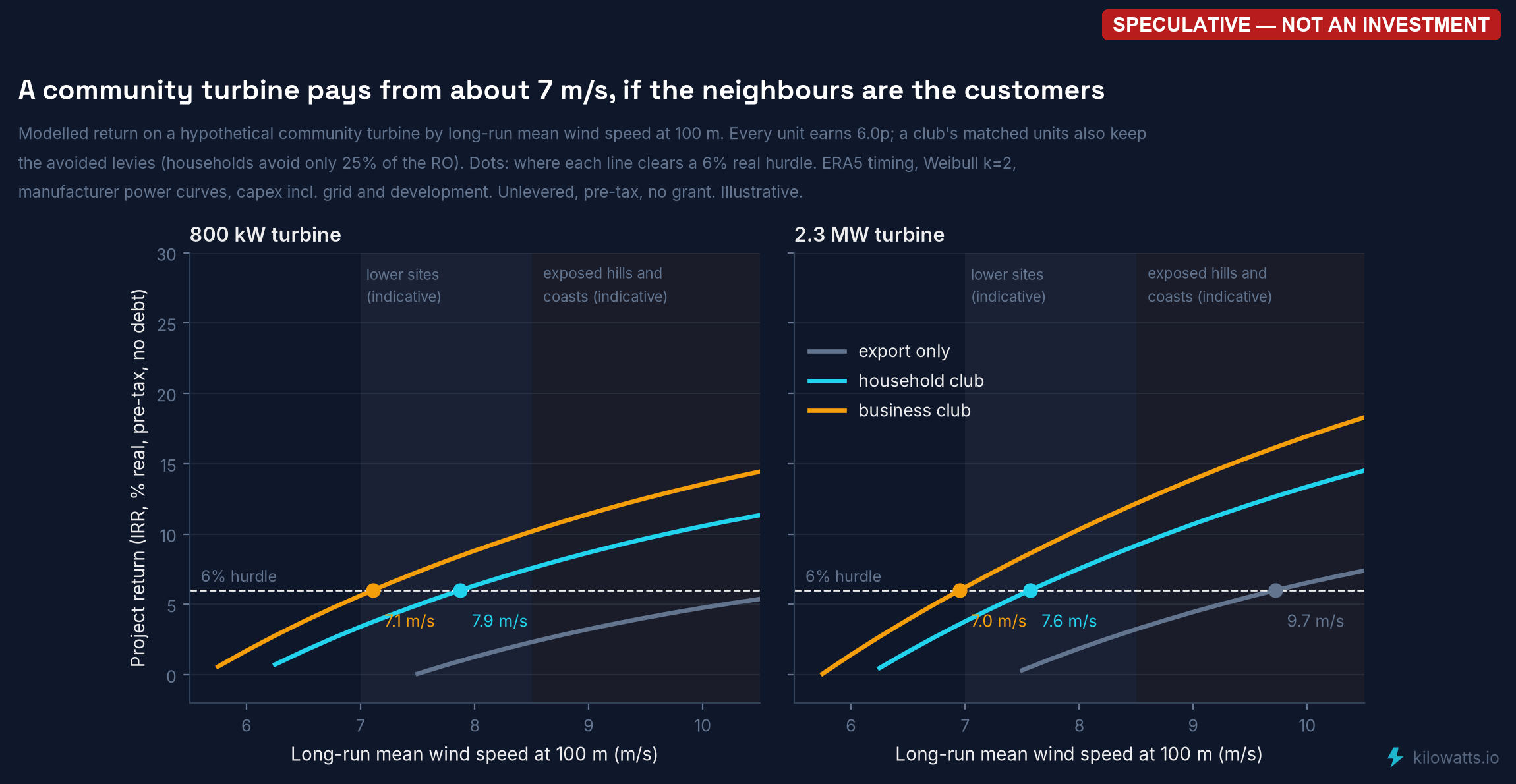
With a 6% real return as the hurdle, and no debt:
With business customers, a 2.3 MW turbine pays from about 7.0 m/s, and an 800 kW one from about 7.1 m/s.
With household customers, it needs about 7.5–8 m/s, because households avoid less of the levies.
Selling to the grid alone, the 2.3 MW turbine needs nearly 10 m/s, and the 800 kW one doesn't get there at any realistic site.
A 100 kW turbine never pays, at any wind speed.
That is a big difference. Plenty of exposed hills and coasts across Britain average 8–9 m/s or more at hub height. The hypothetical site I modelled, at about 9 m/s, clears the bar comfortably with a local club, and fails on export alone. In other words, at a lot of windy sites the difference between a turbine that gets built and one that doesn't is whether the neighbours buy its power.
Then there's the size of the customer base. A 2.3 MW turbine on that site would make about 6.7 GWh a year. A village of 400 homes uses about 1.3 GWh of electricity a year. So a single village could take less than a fifth of it. To match a turbine that size you need about a third of the whole primary substation's demand, several villages and every farm in between. And you need its biggest users on board.
Kirk Hill already has two: a five-star resort and a grain distillery within 7 km. Elsewhere they would have to be found, and the obvious candidates are the loads that every rural area has and that never move: water and sewage works, hospitals, distilleries and food factories, and public buildings that run day and night.
Water deserves a closer look, because it is an energy business in disguise. The industry uses about 3% of all the UK's electricity (Water UK): pumping water out of rivers and boreholes, cleaning it, pushing it through the mains, then collecting the sewage and treating it again. Scottish Water alone needs about 442 GWh a year, enough for nearly 140,000 homes, and is Scotland's largest single electricity user (Scottish Water). That's seven times what Kirk Hill generates. Its treatment works are scattered across every part of rural Scotland, under the same substations as the turbines. They run round the clock, some of their pumping can move to when the wind blows, and they pay exactly the charges that local supply avoids.
That's the thread from Kirk Hill to any local scheme. Community energy sold to households, whether by bill credit from 600 km away or by local matching next door, is a thin business. It becomes a real one at megawatt scale, with a few large, steady, business customers to anchor it. Around Kirk Hill those customers are already there. Elsewhere they have to be found.
The other thing a community scheme sells: a fixed price
Back to the hypothetical local turbine, and to a second reason businesses make better partners, one that has nothing to do with levies.
A wind turbine is almost all up-front cost. Once it's built, the wind is free, so what makes it financeable is certainty about the price its power will fetch for the next couple of decades. The big developers get that from the government. A Contract for Difference guarantees a fixed price for the output, and from the 2025 round that guarantee runs for 20 years instead of 15 (pv magazine). But a CfD is only open to projects of more than 5 MW (DESNZ). The small-scale scheme below that, the Feed-in Tariff, closed to new projects in 2019. So even the biggest turbine I modelled, at 3.6 MW, is too small to get a government price guarantee. Kirk Hill, at 18.8 MW, would qualify on size.
A community scheme can make its own. That was the real promise of Ripple: members paid up front and got their share of the output at roughly its running cost for 25 years. It was a fixed price from the generator to the consumer for the life of the asset, which is exactly what a CfD provides. Kirk Hill lost that when it moved to selling wholesale and paying members a dividend. It now takes whatever the market pays, like any merchant generator.
The trouble with fixing that price with households is that households move. People sell up, retire elsewhere, die, or simply switch supplier. Under a local scheme like P441, a member who moves out of the area can no longer take the power, but they still hold the shares. And keeping a share register of thousands of people, and tracking who is still entitled to what, is hard, unglamorous work. Ask the Kirk Hill volunteers.
Businesses don't have that problem, or not nearly as much. A water treatment works isn't going to move. The Girvan distillery has been on the same site since the 1960s. They can sign a 15- or 20-year supply contract, they are creditworthy enough for a bank to lend against it, and, because of the levies, each kWh is worth more to them than to a household.
So my instinct is to split the roles: households as owners, businesses as buyers. Let the community own the turbine and share in its returns. Sell the power, on a long fixed-price contract, to the few large local users who will still be there in 20 years. That gives the scheme its own CfD, and the village its dividend.
Who pays for it?
⚠️ Again: none of this is a real investment. These are speculative numbers for a turbine that doesn't exist, to show how the finance might work. The costs, loan terms and returns are my assumptions, not quotes.
There is a hole in "households as owners". Most villages don't have a few million pounds lying around.
On my model, a 2.3 MW turbine costs about £4.6 million all-in: £3.45 million for the machine, £0.7 million for the grid connection, and £0.45 million of development costs (planning, surveys, legal) that are spent before anyone knows whether it will be built. An 800 kW turbine is about £2.3 million.
This is where scale and a contracted customer pay off a second time: they let you borrow. A bank will lend against a turbine's income only if it can see that income. Sold to the grid at whatever the market pays, a 2.3 MW turbine might support debt for 40% of its cost. With a 15-year fixed-price contract to supply a club of local businesses, it could plausibly support 70%.
The loan I've assumed is a 15-year amortising loan at 4% a year in real terms, roughly 6.5% at today's inflation, repaid over the life of the supply contract. The bank lends as much as the turbine's cash flow can cover with a 35% margin to spare, up to 70% of the cost. Where the power is sold to the grid instead, I've assumed a more cautious bank: a 60% margin and at most 40% of the cost. That changes two things at once:
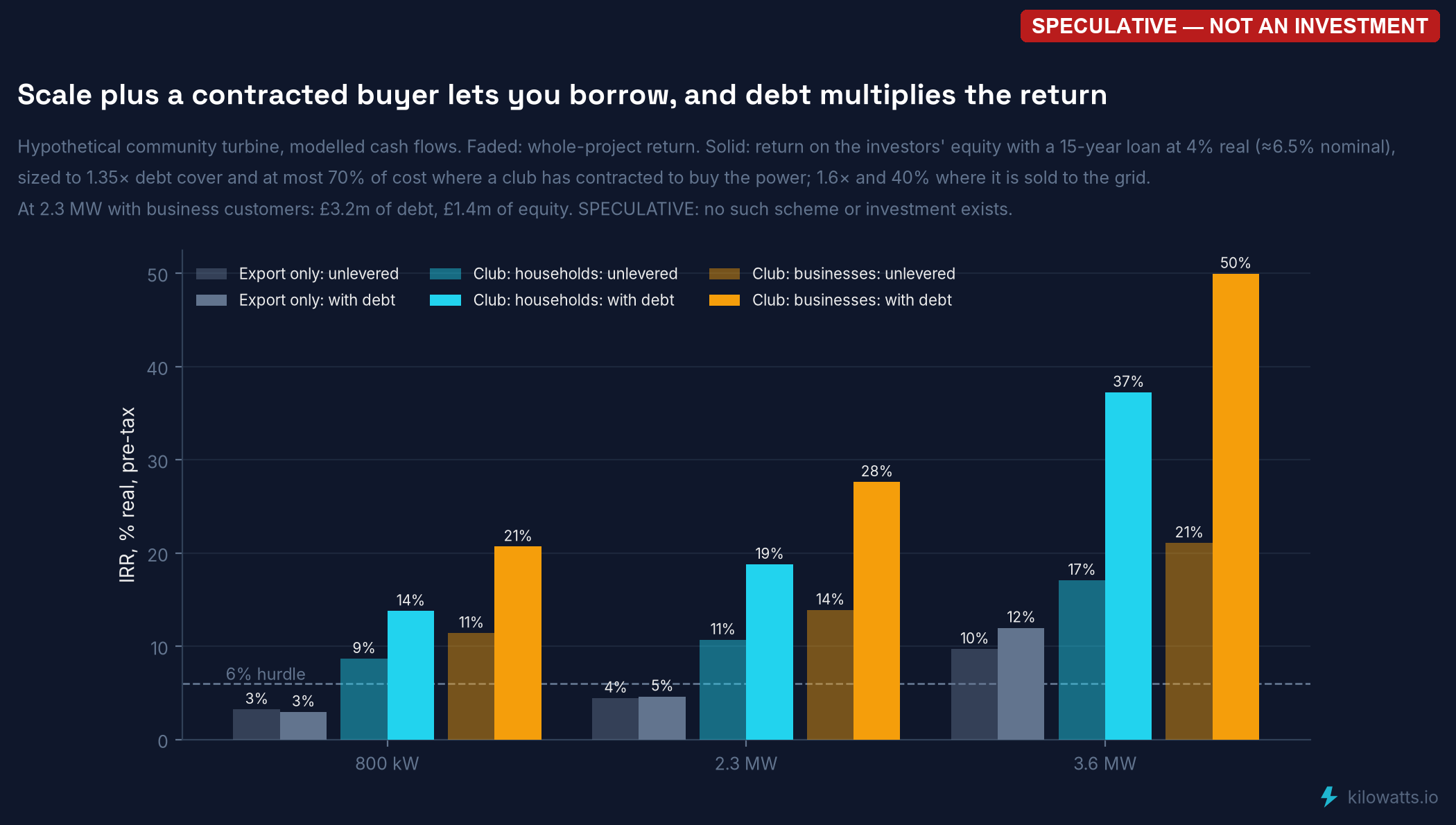
The equity to raise halves, from about £2.8 million to about £1.4 million.
The return on that equity roughly doubles. The whole project returns 13.9% with business customers. The investors' share, with the bank taking its fixed 4% real on the rest, returns about 28%. The export-only case barely moves, at 4–5%, because there's so little cheap debt to add.
The same mechanism works in reverse, though. Debt magnifies bad years as much as good ones: a run of calm winters, or an anchor customer that closes, hits the equity holders first and hardest. Big local employers do close. And these are my illustrative loan terms, not a lender's.
Even £1.4 million is a lot for one village. Kirk Hill's 5,600 members put in about £2,360 each on average. At that rate the equity needs nearly 600 investors, and a typical village has around 400 households, many of them on tight budgets. If a third of them put in £2,000 each, which would be a remarkable turnout, the village would raise under £300,000.
Widen the net to everyone on the same primary substation, though, and the sums start to look possible. The rural primary substation in my model serves about 4,640 connections: a few villages and the farms between them, perhaps 10,000 people. For the 2.3 MW turbine that means:
with no debt at all, £4.6 million, or about £990 for every connection on the substation;
selling to the grid, with 40% debt, £2.8 million, about £600 each;
with a contracted club and 70% debt, £1.4 million, about £300 each.
The last one is a sum a substation's worth of people could plausibly raise, with help from outside. The first is not. Which is the case for the business customers, the long contract and the bank, in one line.
⚠️ Illustration only. The paybacks below are a thought experiment on made-up club terms, not a forecast and not an offer. Real schemes can lose money.
So what would £300 actually buy you? A member who invests and also buys the power gets two things: a share of the profits, and a discount on the part of their own demand the turbine meets. Both come out of the same pot, the levies and balancing charges avoided on each matched kWh: about 5.5p for a household and 7.9p for a business. I've assumed the club splits that pot half and half, between a discount to the customer and extra income for the turbine.
How much of your demand the turbine meets depends on when you use power. My own Kirk Hill numbers give a realistic range: 18% with my batteries charging by the clock, 54% if I re-timed them to follow the wind, and 62% with the batteries carrying wind from one day to the next. Taking a household using 3,800 kWh a year (typical for a rural home with electric extras), investing £300, and a small business using 30,000 kWh and investing in proportion, about £2,350:
Household, £300 — Share of demand matched: 18% · Bill saving a year: £19 · Profit share a year: £50 · Payback: 4.3 years
Household, £300 — Share of demand matched: 54% · Bill saving a year: £56 · Profit share a year: £50 · Payback: 2.8 years
Household, £300 — Share of demand matched: 62% · Bill saving a year: £65 · Profit share a year: £50 · Payback: 2.6 years
Business, £2,350 — Share of demand matched: 18% · Bill saving a year: £213 · Profit share a year: £394 · Payback: 3.9 years
Business, £2,350 — Share of demand matched: 54% · Bill saving a year: £640 · Profit share a year: £394 · Payback: 2.3 years
Business, £2,350 — Share of demand matched: 62% · Bill saving a year: £735 · Profit share a year: £394 · Payback: 2.1 years
These bill savings are deliberately conservative: they count only the avoided levies. Real Energy Local members save more, about £140–300 a year at established clubs, because the match price also undercuts the supplier's normal margin. So treat the bill column as a floor.
Two things jump out. The profit share does most of the work for a household: the discount on 3,800 kWh is small money even when most of it is matched. And for both, behaviour roughly doubles the bill saving: going from 18% to 54% is worth more than any of the engineering.
But treat the payback as a best case. It assumes the co-op pays out all its spare cash, with debt at the rates above, no tax and a turbine that never has a bad year. Most community benefit societies cap what they pay members, often at around 5%, and put the rest into a community fund. At a 5% cap, the household payback stretches to about 9 years at 18% matched, and about 4 at 54%. The business's stretches to about 7 years and 3. It's still a good deal, but it's a long way from a get-rich-quick scheme. Under a cap, matching more of your own demand is the one lever you control that shortens it.
So the village alone can't own it. It needs investors from further afield, and it's not hard to see where. The nearest town or city has far more people than the countryside around the turbine, and many already have a community energy group that has raised money for local solar before. A share offer open to the wider catchment could plausibly raise several hundred thousand pounds more.
That still probably leaves a gap, and the biggest risk is the development money, which is lost if planning fails. So here's the more speculative bit: could a fund or a utility take a share? Some possibilities:
A specialist community-energy investor or lender. Thrive Renewables, which bought the unbuilt Whitelaw Brae project, invests in exactly this kind of site. Triodos and others lend to community schemes once there is a contract to lend against.
The water company itself. If it's the anchor buyer, it could also be a part-owner. The water industry has committed to about 3 GW of its own solar and wind, and a turbine it partly owns and buys from on a long contract is a way to hedge its power bill.
An energy supplier. Some suppliers now back turbines in return for giving the neighbours cheap power when it's windy. Octopus's "Fan Club" is the best-known example.
Great British Energy. Its £1 billion Local Power Plan exists to fund community energy, and development-stage money is exactly what it could provide. It would also be an early test for its new head of local energy.
Kirk Hill already shows the model: the co-op holds 58%, a private investor (Bruntwood) holds 42%, and a bank lent against the lot. A new local scheme would probably look similar. The community would hold a stake, with a right to buy more over time, while a partner with deeper pockets takes the development risk. That's less pure than a village co-op, but it can actually be built.
6. Heat, cars and batteries: testing it on my own house
Testing it on my own house
Heat is one half of the rural cost of living; the car is the other. My house is a useful test of both, because two EVs and a big battery make almost all its demand movable. So is levy-free local wind actually worth having to a household like mine? I can test that on myself. My smart meter reports every half-hour to E.ON Next's Kraken platform, so I can line up what my house took from the grid against what my 2.5 kW of Kirk Hill generated.
One big caveat first. This is grid import, net of everything behind the meter. I have 5 kWp of rooftop PV (3 kW east, 2 kW west) and a 19.2 kWh battery, and the battery refills overnight on my EV tariff. So the meter doesn't show what the house uses. It shows what the house chose to take, and when.
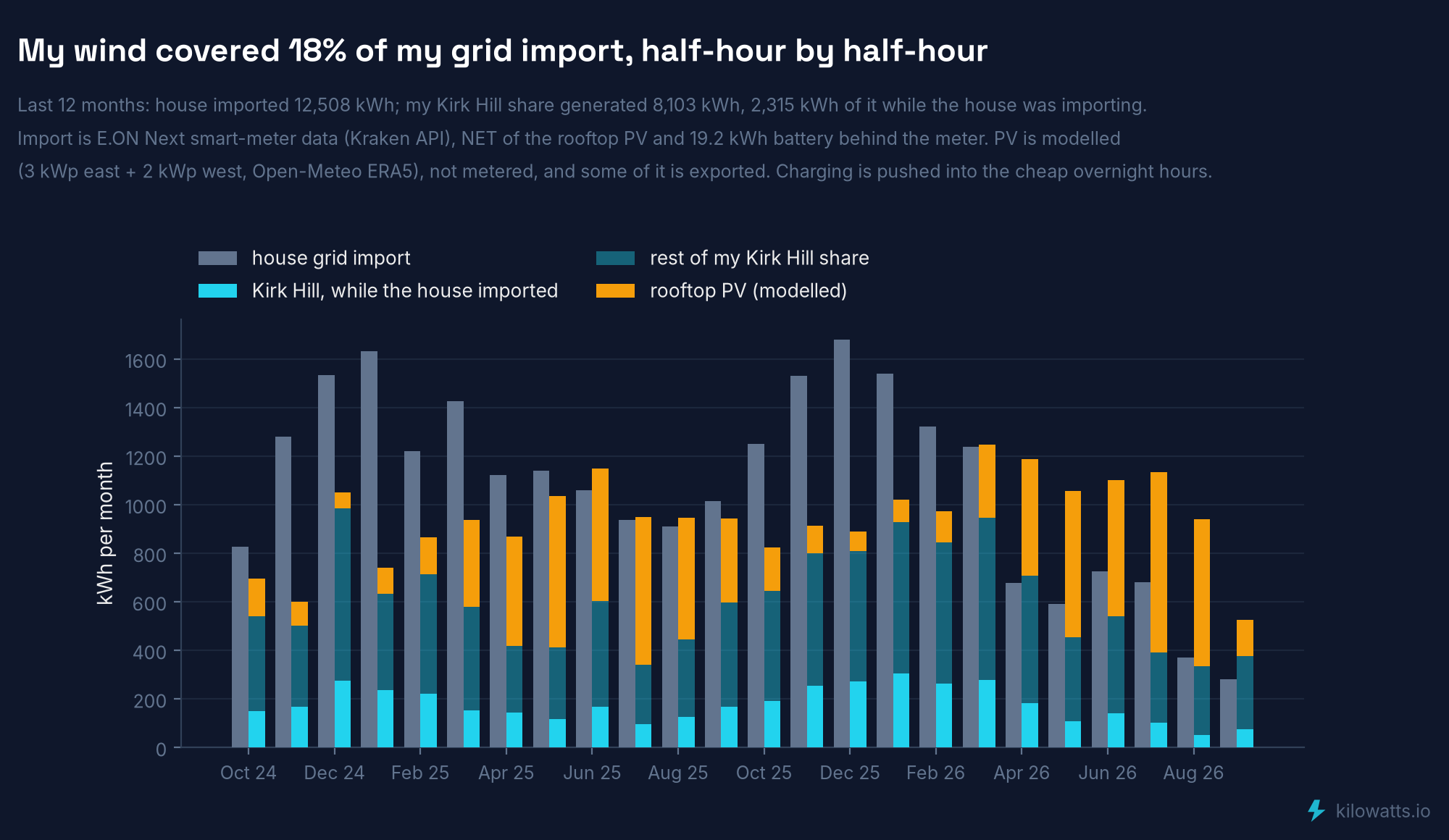
Over the last twelve months the house imported 12,508 kWh and my share of Kirk Hill generated 8,103 kWh. But only 2,315 kWh of that wind arrived in a half-hour when the house was importing. So only 29% of my wind was usable as it happened, and it covered 18% of my import. That's far below the 61% for the notional village. The reason is the battery and the EV tariff: they push almost all my import into the small hours, while the wind blows whenever it likes.
The carbon picture is more flattering:
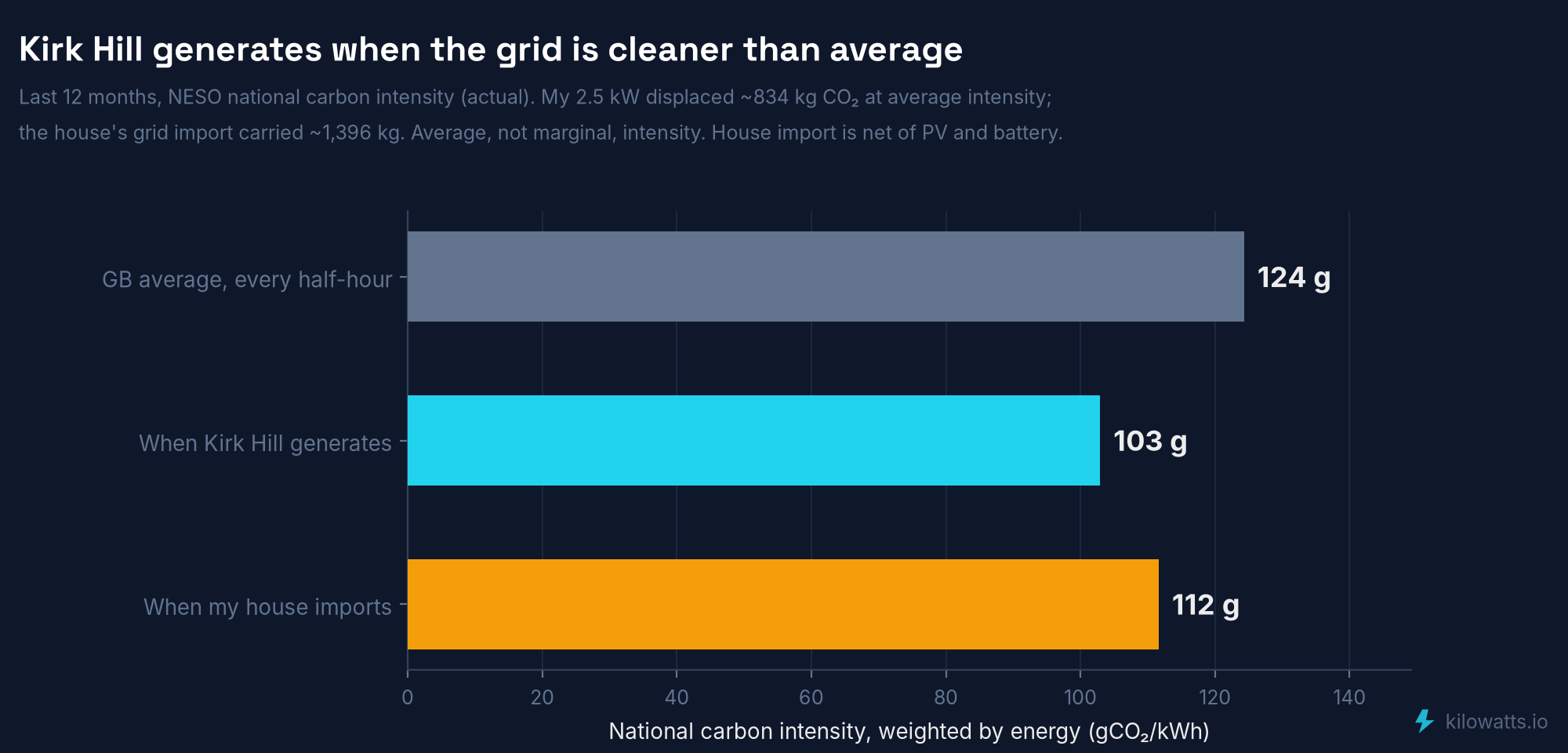
Across the whole year, national grid carbon intensity averaged 124 g/kWh. Weighted by Kirk Hill's output it was 103 g, so the farm generates when the grid is already cleaner than average. That is partly circular, since the grid is clean because the wind is blowing, and it means an average-intensity estimate of what my share "displaced" (about 830 kg CO₂) overstates the real effect, which depends on the marginal plant. My house imported at 112 g, also cleaner than average, because the overnight EV window is when the grid is quiet. Again, that's import net of PV and battery, not the house's true footprint.
Carbon intensity is also a rough stand-in for the wholesale price. When the grid is dirty, gas is setting the price at the margin, and when it's clean, wind and solar are pushing prices down. So "charging when it's clean" and "charging when it's cheap" mostly point the same way, at least nationally.
A thought experiment: if my wind came to me levy-free
About 99% of what my house takes from the grid is flexible. It is batteries: the 19.2 kWh one on the wall and the two in the cars. So suppose P441-style rules applied to Kirk Hill as if it were next door. My 2.5 kW would reach me with no levies and no network charges, and I would fill the batteries from it with perfect foresight, buying whatever else I needed at the historic Octopus Agile price.
To keep it honest, each day the house has to take the same energy it actually took: grid import plus modelled rooftop PV, 16,697 kWh over the year. It can take that energy at any time of day, at up to 7.5 kWh a half-hour (my observed 99.9th-percentile import).
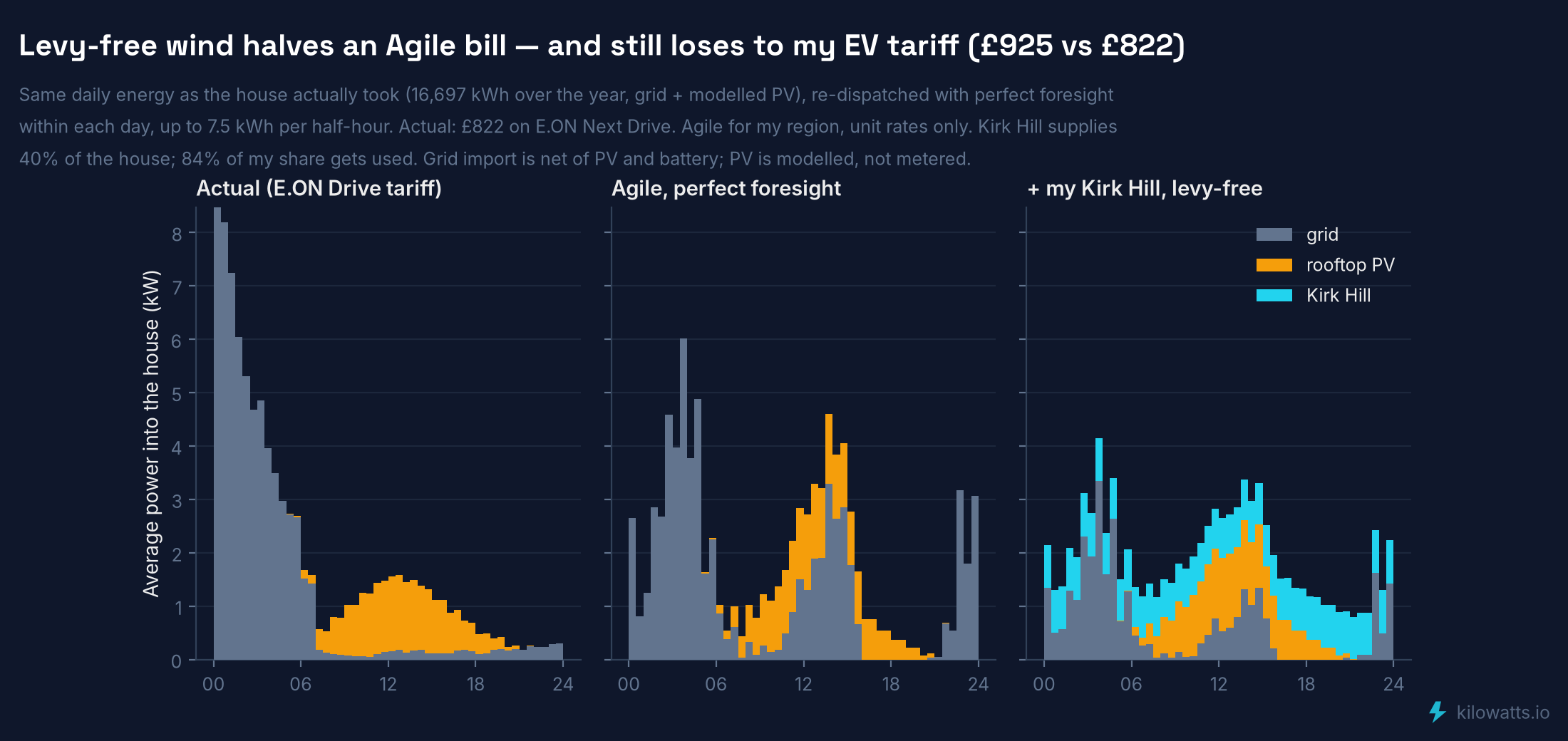
What actually happened (E.ON Next Drive EV tariff) — Grid kWh: 12,481 · Grid cost: £822 · Average p/kWh: 6.6
Agile, perfect foresight, rooftop PV only — Grid kWh: 12,481 · Grid cost: £1,731 · Average p/kWh: 13.9
Agile, perfect foresight, + my Kirk Hill levy-free — Grid kWh: 5,789 · Grid cost: £925 · Average p/kWh: 16.0
Three things surprised me.
1. Owning the wind works in principle. With perfect foresight and a big enough battery, the house could use 84% of my share of Kirk Hill. That would cover 40% of everything the house needs and halve the Agile bill. Each kWh of wind used at home saved about 12p, against about 8p it would have earned sold at the wholesale system price. That gap of roughly 4p is the levy and network saving, right where the P441 arithmetic says it should be. It's also, as above, 4p that somebody else's bill would pick up.
2. My EV tariff still beats it. 97% of my import was billed at the off-peak rate. That was 6.7p/kWh for most of the year and has been 2.99p since April 2026, including the supplier's own daytime dispatch slots. It cost me £822. Levy-free wind topped up from Agile, with perfect foresight I don't actually have, would have cost £925. The EV tariff is the better deal today, and that's before counting standing charges, which apply to both. Retail tariffs for households with EVs and batteries are already offering most of what local energy promises. How long suppliers can keep offering 3p nights is a different question.
3. Dispatch changes shape completely. On the EV tariff everything happens between midnight and 6am. On Agile, the house chases the 4am trough and the negative-priced midday solar hours: 786 kWh bought at below-zero prices. With my wind free, charging spreads across the whole day and evening, following the wind. That flattens demand, which is exactly what a local network wants to see. And the remaining grid purchases get dirtier (106 g against 92 g), because the wind has already covered the cleanest hours.
From 18% to 62%: what each lever is worth
That comparison takes a day at a time. A battery and two cars can do better than that, because they can carry energy from a windy day to a calm one. So I rebuilt it as a small optimisation (a linear program). It keeps the house taking exactly the grid energy it actually took, day by day, and stores energy ahead of need up to a set limit. Then I added the levers one at a time.
I left the rooftop PV out of this version, because it turns out the house exports some of it (902 kWh over last summer, on the export meter) and Kraken doesn't see that. So everything here is measured against the same thing as the 18%: grid import, net of the PV and battery.
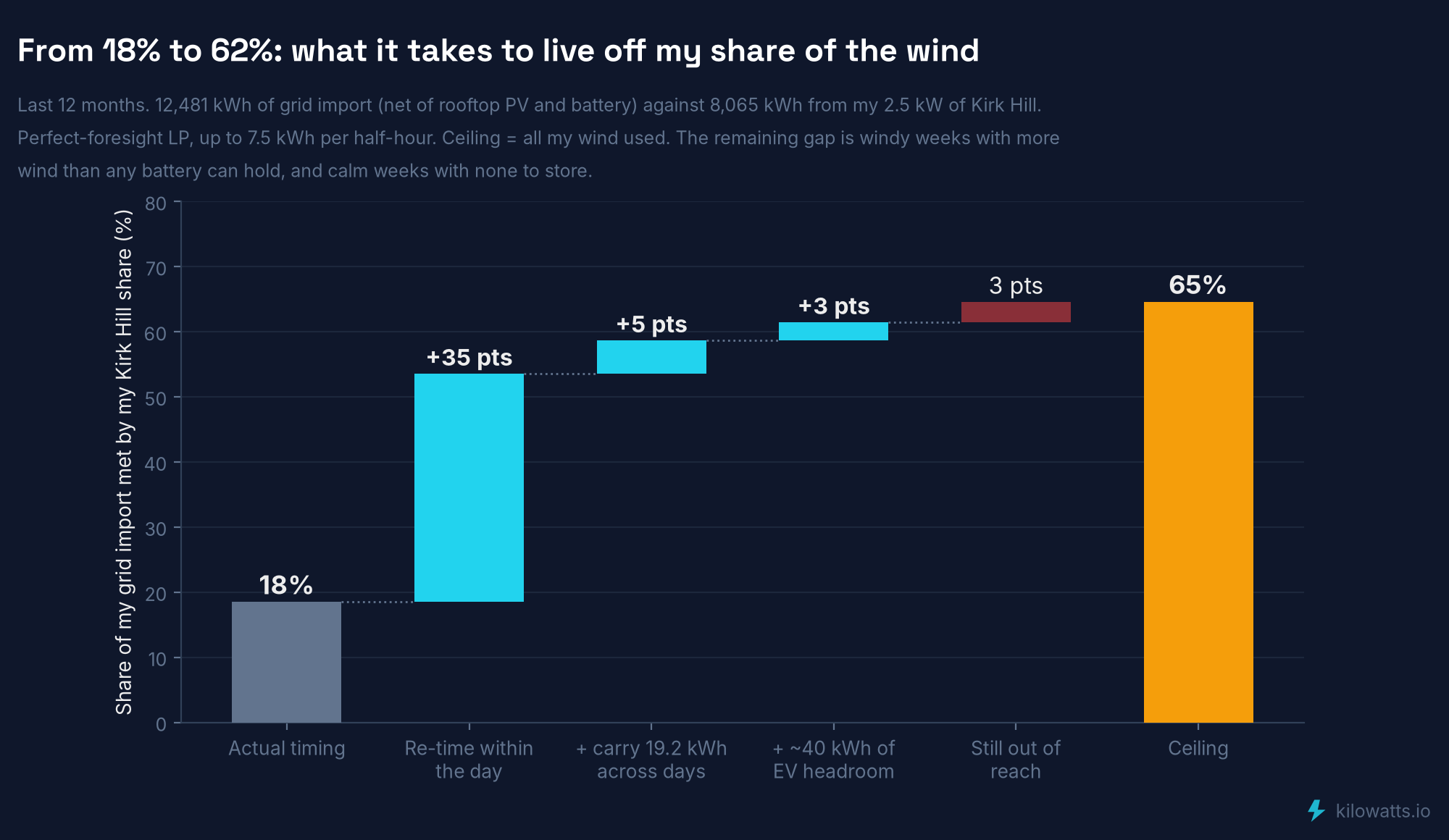
Re-timing within the day adds 35 points (18% → 54%). This is almost all of it. No extra hardware, just charging when the wind blows rather than when the clock says it's cheap.
Letting the 19.2 kWh home battery carry energy across days adds 5 points (→ 59%).
Using about 40 kWh of spare EV battery as a cross-day store adds another 3 (→ 62%).
The last 3 points are out of reach. The ceiling is 65%, because my share only generated 8,065 kWh against 12,481 kWh of import. What's left is windy weeks with more wind than any battery I own can hold, and calm weeks with nothing to store.
And here is what it does to the shape of charging in the house:
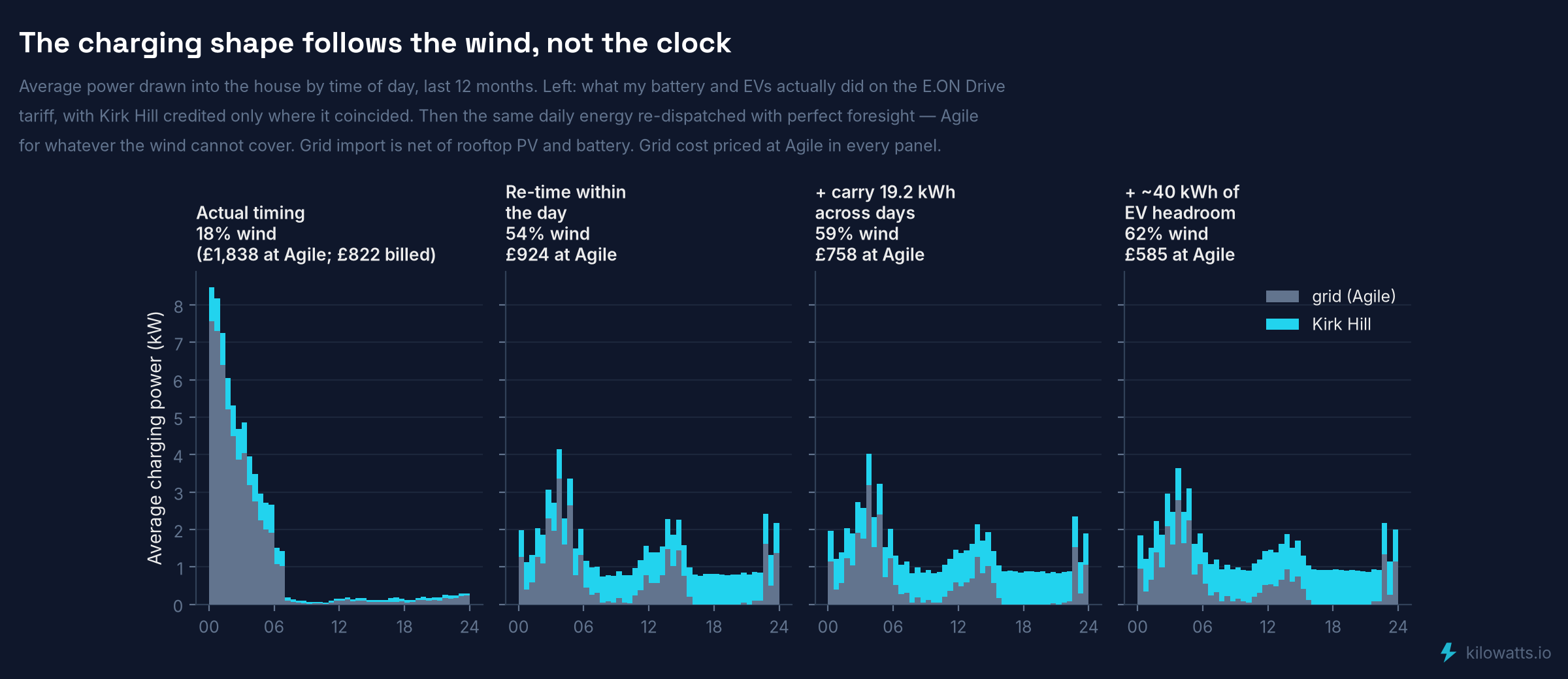
Today, everything is crammed into 00:00–06:00: an 8 kW average at half past midnight, and almost nothing after 7am. Following the wind turns that into a steady 1 kW base from breakfast to bedtime, with Agile still used for the 4am trough and the midday solar glut. The extra storage doesn't change the shape much. It moves the grid purchases out of the evenings.
This is also where the money flips. Priced at Agile, the grid top-up falls from £924 re-timing within the day, to £758 with the home battery, to £585 with the cars as well. That is the first scenario that beats the £822 I actually paid on the EV tariff. Levy-free wind only wins once you have enough storage to wait for it.
Would solar do the same job? I re-ran every step with a share of local solar making exactly the same amount of energy in a year as my share of Kirk Hill:
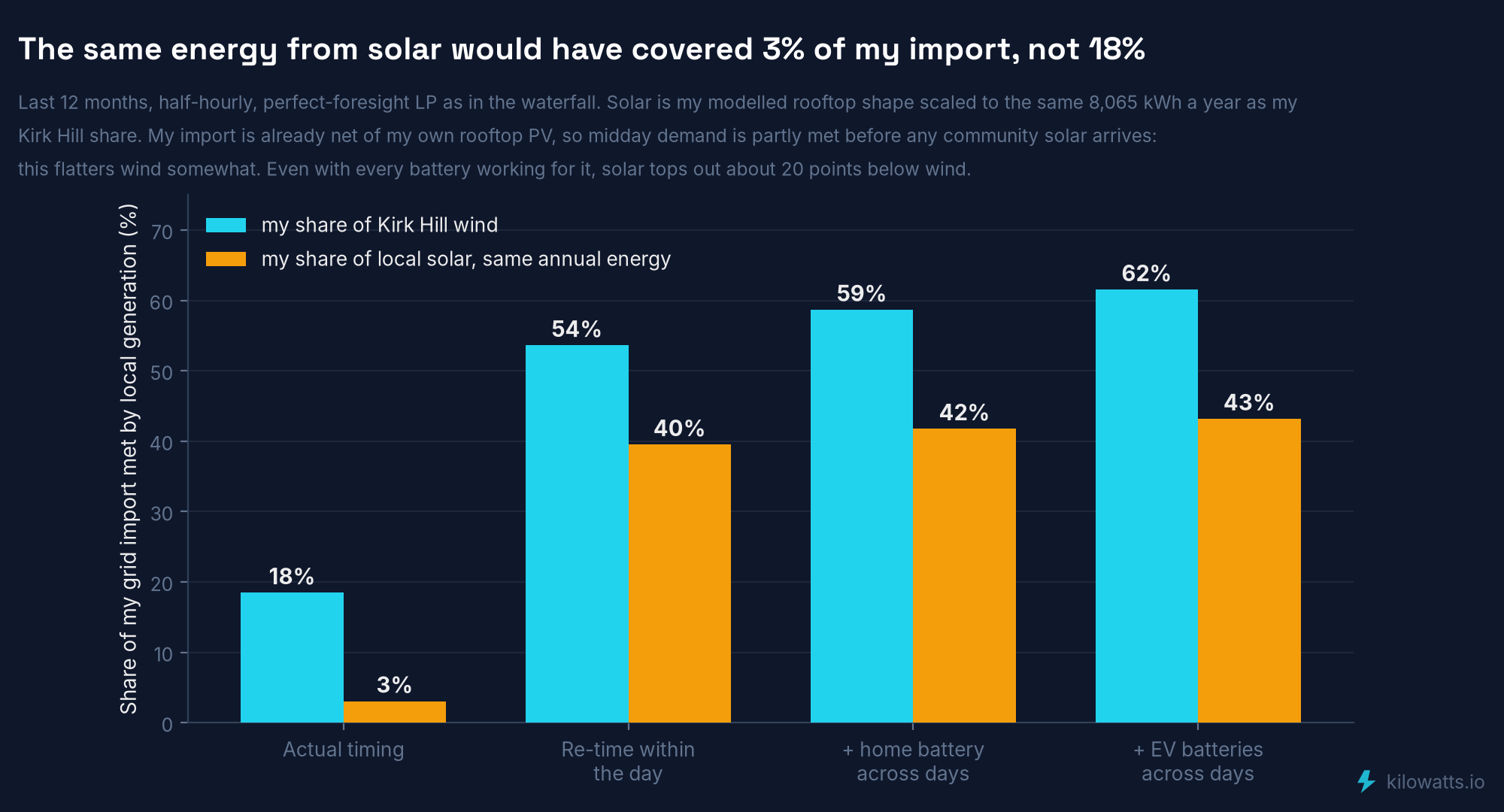
On my actual timing, the solar would have covered 3% of my import, against 18% for the wind. Even with both batteries and both cars working for it, solar tops out at about 43%, against 62%. That's partly because my rooftop panels already cover some of my midday demand, which flatters the wind. But the shape is the point: solar arrives at lunchtime in summer, and a household's heating, cooking and car charging don't.
But can a battery live on flexibility payments?
The other thing a community battery can earn is flexibility payments from the distribution network, for turning up or down when the local grid is stressed. Here is what that looks like in one rural zone in England:
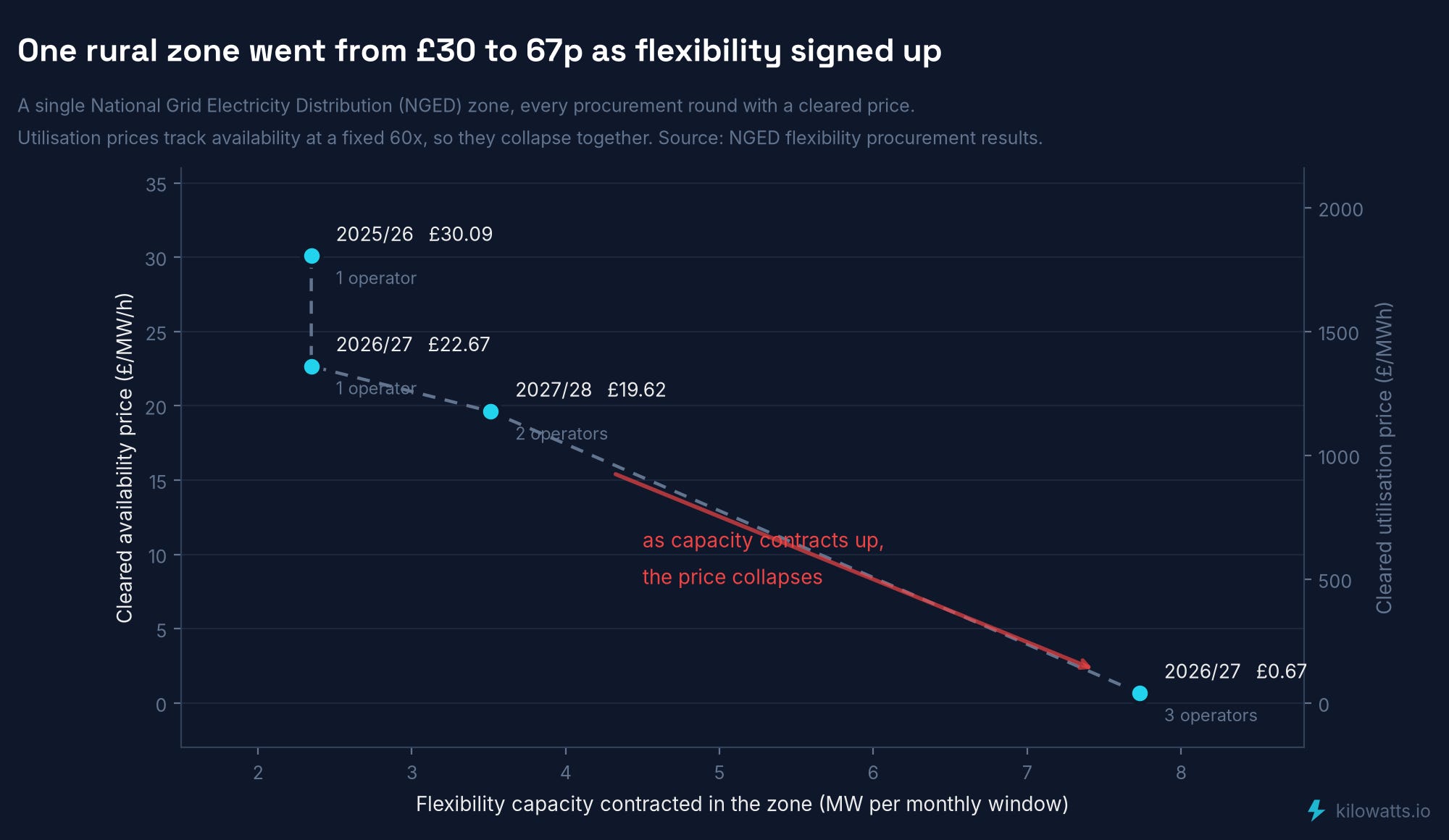
The zone went from about £30/MW/h to 67p in a couple of procurement rounds, as registered capacity tripled and three operators turned up. The high prices exist because nobody has built anything yet; they vanish when somebody does.
So I'm not yet convinced a community battery can get the length of income it needs from flex payments. A battery is a ten-to-fifteen-year asset, and these are one-year auctions in zones where two new entrants can crash the price.
The obvious place for long-term income is the Capacity Market, which pays power stations and batteries to be available at winter peaks. It already offers what local flexibility doesn't: new builds can get agreements of up to 15 years. But three things make it harder for a community battery than it sounds:
Batteries only count for a fraction of their size. A battery that can run for one hour is credited with about 10% of its power rating, and a two-hour battery about 21%, because a long cold evening outlasts them. A 1 MW, two-hour community battery counts as about 0.2 MW.
The price has fallen hard. The latest four-year-ahead auction cleared at £27.10 per kW per year, less than half the £60-plus of the three before it (Modo Energy). At that price, the 1 MW battery would earn about £5,700 a year. That's useful, but it won't pay for the battery.
The minimum size is 1 MW of credited capacity. On those derating factors that's about 5 MW of two-hour batteries, so anything community-sized has to bid through an aggregator, who takes a cut.
There's also an irony here. Capacity Market payments are funded by the Capacity Market levy, the same charge that has nearly tripled in the table above, and part of what local supply avoids. A community battery could end up both paid by the levy and helping its members avoid it.
That's not to say it can't get there. Longer local flexibility contracts, five years or more, would change the picture completely. So would stacking flexibility, the Capacity Market and P441 local supply, so the battery has a floor to its income rather than just a ceiling.
What I've learned
The short version: onshore wind could be one of the most direct ways to cut the cost of living in rural Britain, if the people who live next to it are allowed to use it. Here is what I'd take from owning a piece of one and working one up:
Rural Britain pays more for energy, out of less pay. Energy and fuel take 9–12% of a typical wage in the countryside and small towns, against 4% in central London. The gap is cars, oil and LPG heating, and lower earnings, not the price cap.
The wind is often in the same places, and does nothing for them. One national price, levies on every kWh, and power sent hundreds of miles away or paid to switch off. Resource and need sit side by side; the market keeps them apart.
Local wind could halve rural heating bills, and solar can't. A heat pump on its neighbours' wind costs about 4–6p per kWh of heat, against 11.5p for oil and over 18p for LPG or storage heaters. With £9,000 now on offer to switch off oil or LPG in England and Wales, the upfront cost has rarely been lower.
Use Scotland's wind; build new wind where the grid is still dirty. North of the border the grid is nearly carbon-free and full, so the win is local demand for wind that already exists. New community turbines do most good where homes are cold and the local grid still runs on gas.
It only pays at scale, with business anchors and a fixed price. A 100 kW turbine loses money. A multi-megawatt one pays from about 7 m/s if big, steady users sign a long contract, which also lets a bank lend and halves the money the community has to raise.
The turbines are the easy part. Kirk Hill runs almost exactly to its forecast. What failed was the company around it, and volunteers had to save it.
Be honest about levies. Much of the saving is levy avoidance, which others pay. The better fix is to stop charging levies per kWh at all.
Watch who benefits. The best-organised places will get there first. The places that need it most will need outside capital and an anchor customer to get there at all.
The usual offer to a community that hosts a wind farm is a benefit fund: a few thousand pounds a megawatt for the village hall. The offer this piece is about is different. It's a heating bill cut in half, a fixed price for twenty years, and a share in the turbine on the hill. I suspect a lot more rural communities would say yes to that.
Kirk Hill is doing what it said it would. The rules around it — whether levies stay on every kWh, who gets the saving when they're avoided, how local is local, how long a contract runs — are what will decide whether the people who live next to Britain's wind finally get to use it.
Method. Kirk Hill output is the settled metered volume (BPI record, BM unit E_KHLLW-1) from Elexon P114 flow S0142, taking the most mature settlement run available for each day (II → DF), 29 April 2024 to 12 September 2026. My share is 2.5 kW / 18,800 kW of total output. Household demand is Elexon Profile Class 1; solar is Sheffield Solar PV_Live GB outturn per MWp. Levy rates for 2026/27 are from EMRS, Ofgem, DESNZ and NESO, set out in the repo. The flexibility chart uses NGED's published procurement results for one zone. My house's grid import is half-hourly smart-meter data from the E.ON Next Kraken API (from 7 October 2024), net of rooftop PV and battery. Carbon intensity is the NESO Carbon Intensity API national actual. Rooftop PV is modelled from Open-Meteo ERA5 plane-of-array irradiance (35° tilt assumed, performance ratio 0.75, about 850 kWh/kWp), not metered. The re-dispatch uses Octopus Agile (AGILE-24-10-01) unit rates for my region inc VAT. It applies a daily energy balance with perfect foresight, so it understates what cross-day battery and EV shifting could do.