


How would you spend £40,000 from a prince?
That is not rhetorical. The Duchy of Cornwall has opened a community fund for my village, grants up to £40,000, deadline 15 December. The village hall here is a charity with a turnover of about £23,000 that ran a small deficit last year. It could apply. It has three trustees and no shortage of things it could spend the money on.
And as I was finishing this, the question stopped being local. On 17 September the government opened the first £30 million of the Local Power Plan — "the first downpayment on up to £1 billion" — of which £20 million is a Community Fund making grants to community organisations to build community-owned clean energy assets. Applications opened that morning. Village-owned wind farms, hydro schemes, and, in the announcement's own words, "solar panels on local buildings".
So somewhere between one and a thousand other places are about to ask themselves the same thing my village is asking, with rather more money attached. Which makes me keener than ever to be told what I have got wrong.
I think the answer might be solar panels. I have spent a few weeks trying to work out whether that is right and I am not certain. Along the way I found some things about this village that are more interesting than the village hall, and a handful of questions I genuinely cannot answer. This piece is mostly about the second category.
The village
Princetown sits in the middle of Dartmoor, about 420 metres up, on the B3212 — a single road across an otherwise empty moor. It is one of the highest settlements in southern England and it feels it. The weather arrives from the Atlantic and hits the moor, and what falls on Princetown falls with some enthusiasm.
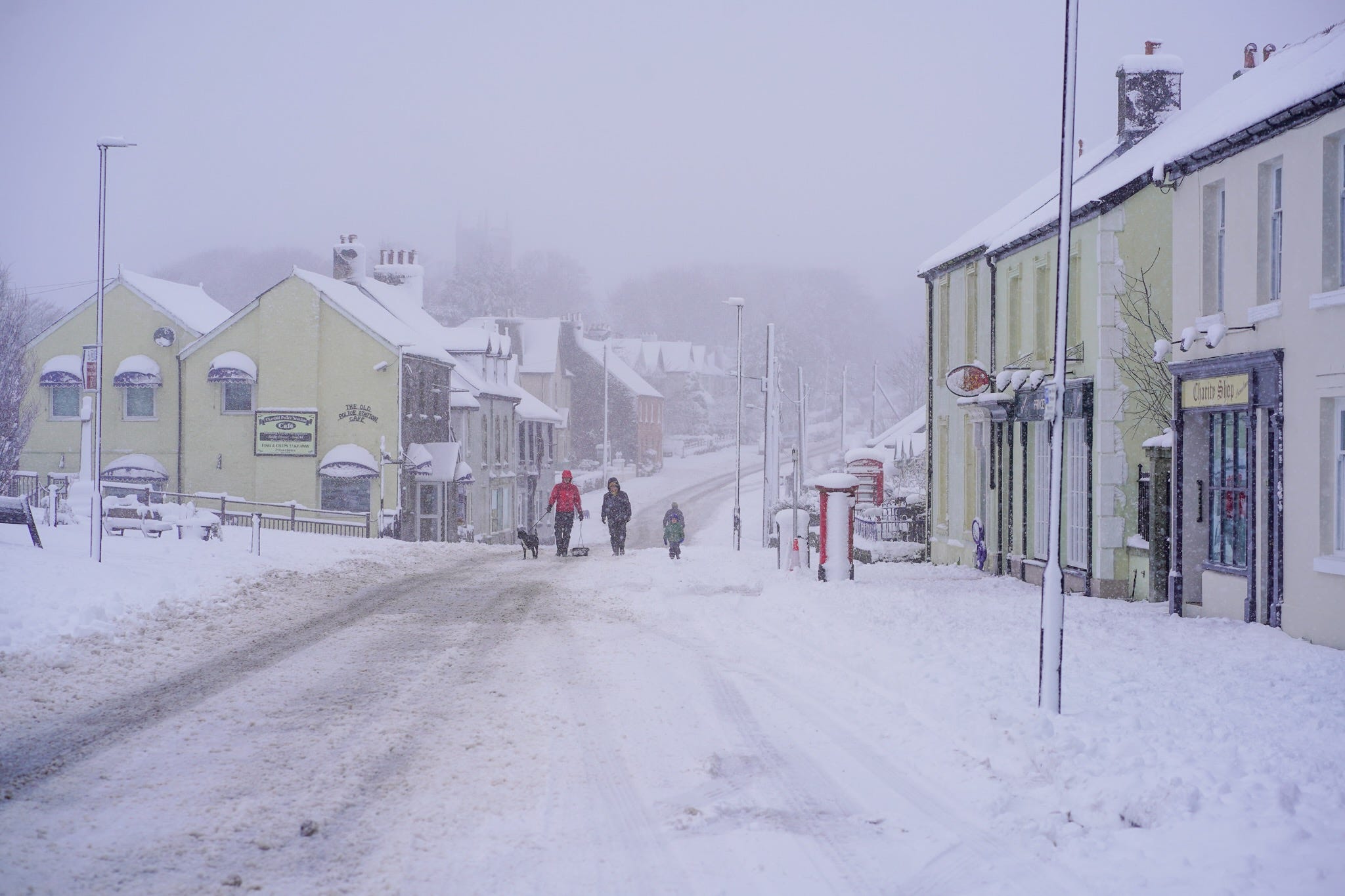
The high street in February. Princetown gets about ten days a year with more than a centimetre of snow. Plymouth and Exeter, the two nearest cities, get one. Photograph by Rory Atwood.
It exists because of the prison. The prison was built in 1809 for French prisoners of war, and everything else followed: terraces for warders, a church, later the school and three estates of houses for officers' families. Around 865 people live in households here. The commonly quoted population of 1,500 includes 577 people who were inside — 40% of the census count was not living in a home.
In 2024 the prison closed. Radon, since you ask. Nobody expects it to reopen. There is a high street with a good deal less on it than there used to be, an abandoned petrol station, and a car park where three million people a year drive past on their way somewhere else.
The prison closing was an energy event
I did not expect this to be the interesting part.
HMP Dartmoor's Display Energy Certificates — four buildings, metered, not modelled — show the estate running at 3,061 MWh of electricity and 4,297 MWh of gas. That is roughly 1.7 times the energy of every home in the village combined. The gas grid was brought into Princetown by an independent transporter about twenty years ago, and the prison was 55% of its throughput. That has gone. 226 domestic gas meters remain, on a network built around a customer that no longer exists.
Divide the prison's consumption by the people in it and you get something I did not expect at all.
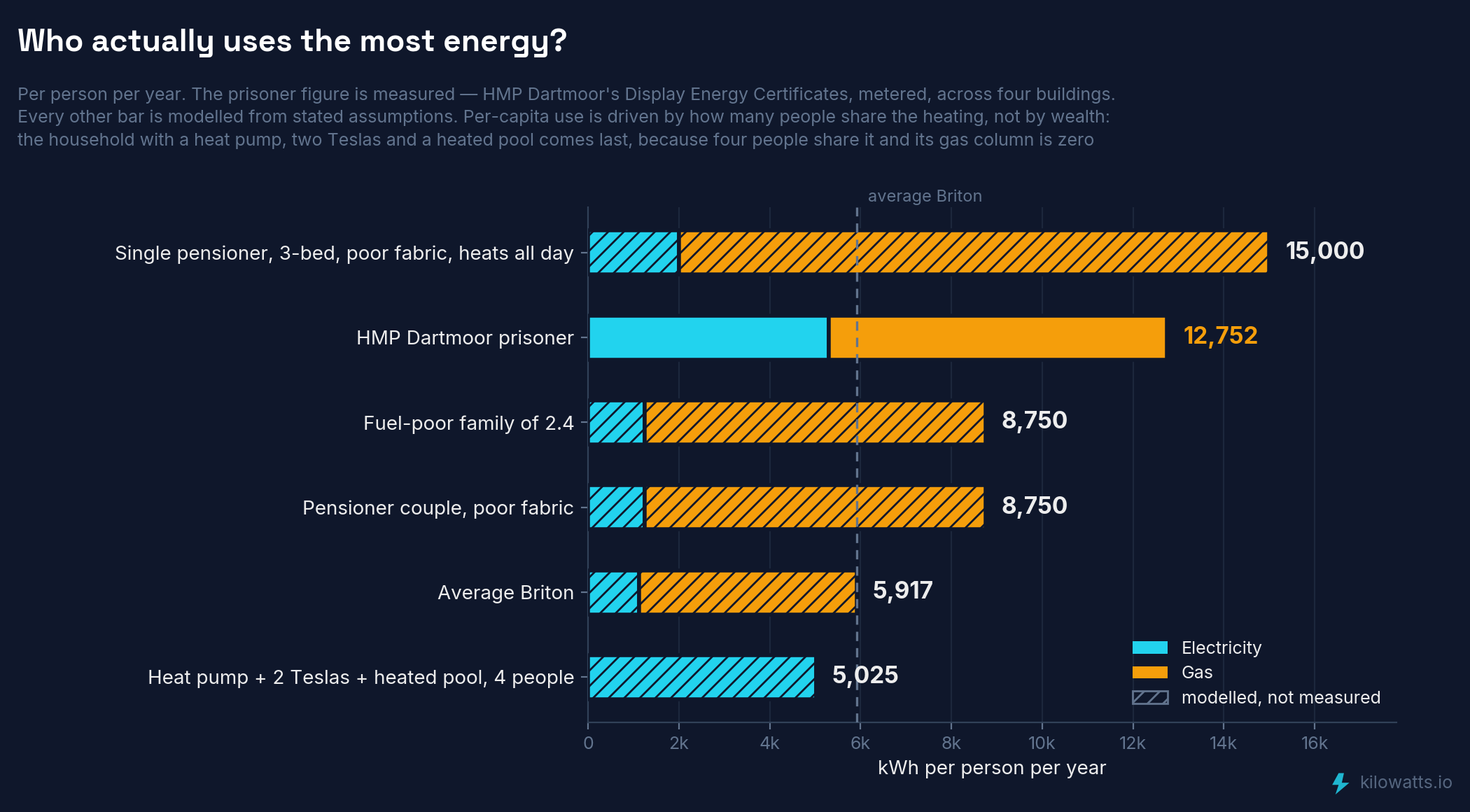
A prisoner at HMP Dartmoor used about 5,305 kWh of electricity a year. A household with a heat pump, two Teslas and a heated swimming pool, spread over four people, comes to about 5,025 kWh each. Six per cent apart.
Both are roughly 4.7 times the average Briton. Which is worth a moment, because per-capita electricity consumption is still invoked in some quarters as a proxy for prosperity or industrial vigour. It cannot tell a heated swimming pool from a prison cell.
The affluent household, incidentally, comes last on total energy per person. Everything visible about its consumption is substitution — the gas column has gone to zero and four people share what is left. The stereotype that survives the arithmetic is the least fashionable one: the highest per-capita user is somebody living alone in a badly insulated house, because heating a house costs about the same whether one person lives in it or four.
Only the prisoner row there is measured. The rest is my construction from stated assumptions, and I would welcome being corrected on any of it.
What the village actually needs is warmth
It is cold here, and not in a way Devon prepares you for. On identical data over the same three years, Princetown runs to 2,302 heating degree days — marginally more than Glasgow, and more than Aberdeen. Plymouth, twelve miles away, is 1,402. Drive out of the city and up onto the moor and the heating demand rises by two thirds. The metered data agrees: DESNZ postcode statistics for 2024 put Princetown's mean domestic gas consumption 14.9% above the South West and 13.5% above its own local authority — but within 0.02% of the England average. The South West sits below England on gas because its winters are mild. Princetown gets no such discount. It consumes like a colder region while sitting inside a warm one.
And the housing is bad. On the Government's Indices of Deprivation, 58% of homes in Princetown's neighbourhood fail the Decent Homes standard, against a national median of 14% — the worst 1.4% of England's 33,755 neighbourhoods. Excess cold is one of the three hazard categories that make a home fail, which here is not a coincidence.
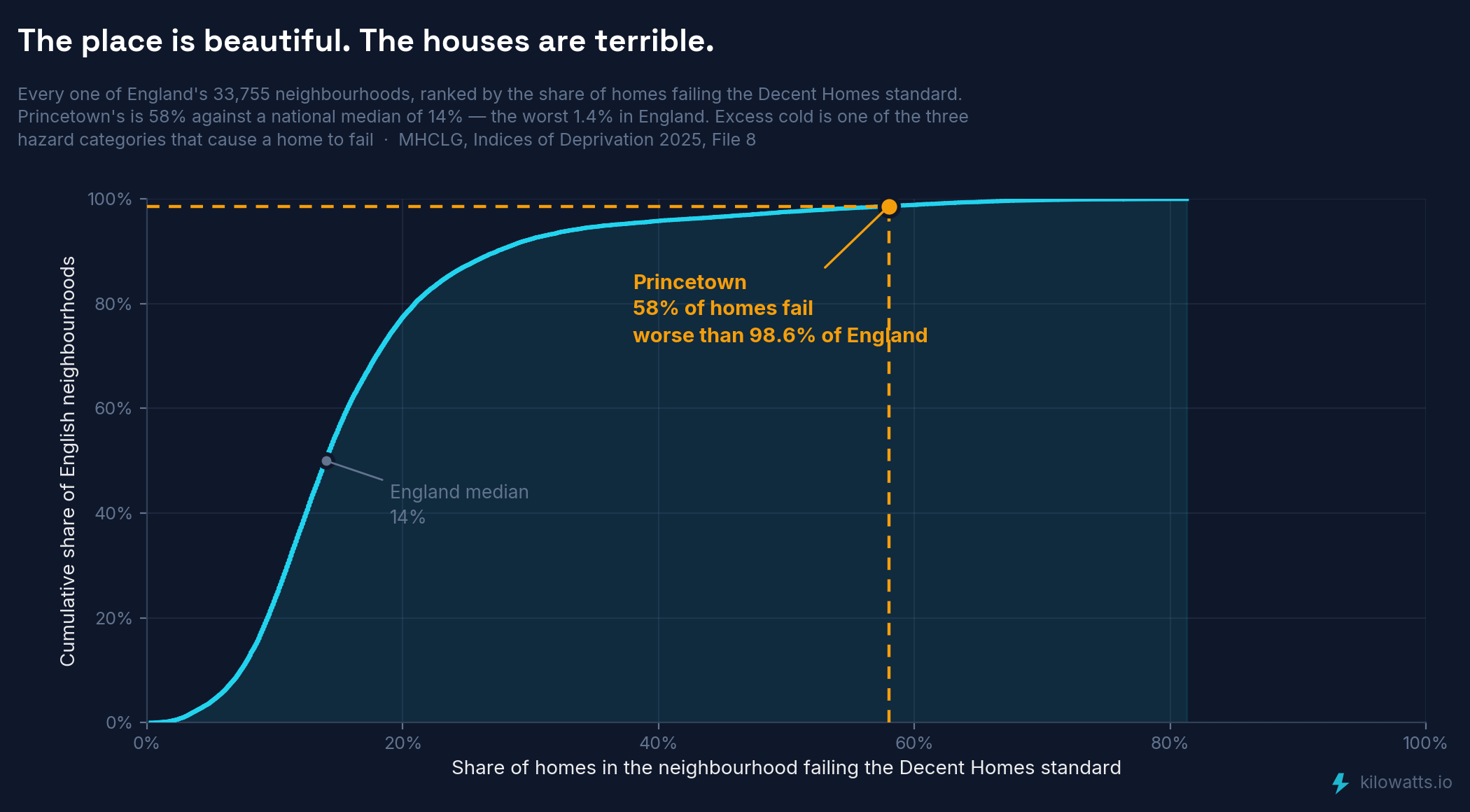
Some of it is unusually hard to fix, and it is worth knowing where it came from. Princetown's housing was built by the state. In the years after the war the Prison Commissioners put up three estates of Cornish Units for officers' families, starting in 1950 — precast concrete, a type found right across Devon and Cornwall — on land held by the Duchy of Cornwall, and the council built more alongside them. The Cornish Units were designated defective in 1984. They were sold off from the 1980s onwards, unremediated, and unremediated is how they remain: they change hands today at about £152,000 against £250,000 elsewhere in the village, often to cash buyers, because lenders will not touch them.
And there is a trap inside that. A designated defective house is hard to mortgage; being hard to mortgage is what makes it cheap; being cheap is what puts it within reach of someone who does not have the cash to repair it. Repairing it to an approved scheme would cost a large fraction of what the house sold for, and you cannot borrow that against a house no lender will take security on. So the people who end up owning these houses are, more or less by selection, the people least able to fix them — and every piece of green finance built in the last decade, from retrofit loans to green mortgages to property-linked finance, assumes a mortgageable asset. None of it reaches here.
I should say that I know remediation works, because I live in one of these houses. Mine has been repaired, and it now runs an air source heat pump at an annual coefficient of performance pushing four — at 420 metres, on Dartmoor, in a precast concrete house built in 1950. That number is worth dwelling on, because it says the climate is not the obstacle and nor is the technology. The fabric was the obstacle. Fix the fabric and everything downstream of it becomes ordinary.
Which leaves exactly one problem, and it is the one this article keeps arriving at. It is all entirely possible. It is just expensive, and the money is the thing that cannot be borrowed.
That is three estates rather than the whole village — most of Princetown is cavity-walled or granite. But the wider picture is no better. The common factor is not any one construction type. It is an old, hard-to-treat housing stock at 420 metres, built by public bodies that no longer exist, sold to the people living in it, and left there.
The bit nobody expects
Then I went looking for the company we keep, and found the most surprising thing in this whole exercise. Not one of England's 338 worst neighbourhoods for housing condition is in a major city. Birmingham, Manchester, Liverpool, Leeds, Hull, Blackpool and Plymouth have none between them. The list is North Yorkshire, Shropshire, Herefordshire, Somerset, Cornwall, Wiltshire, Northumberland, Dorset — and West Devon. The Cotswolds has eight.
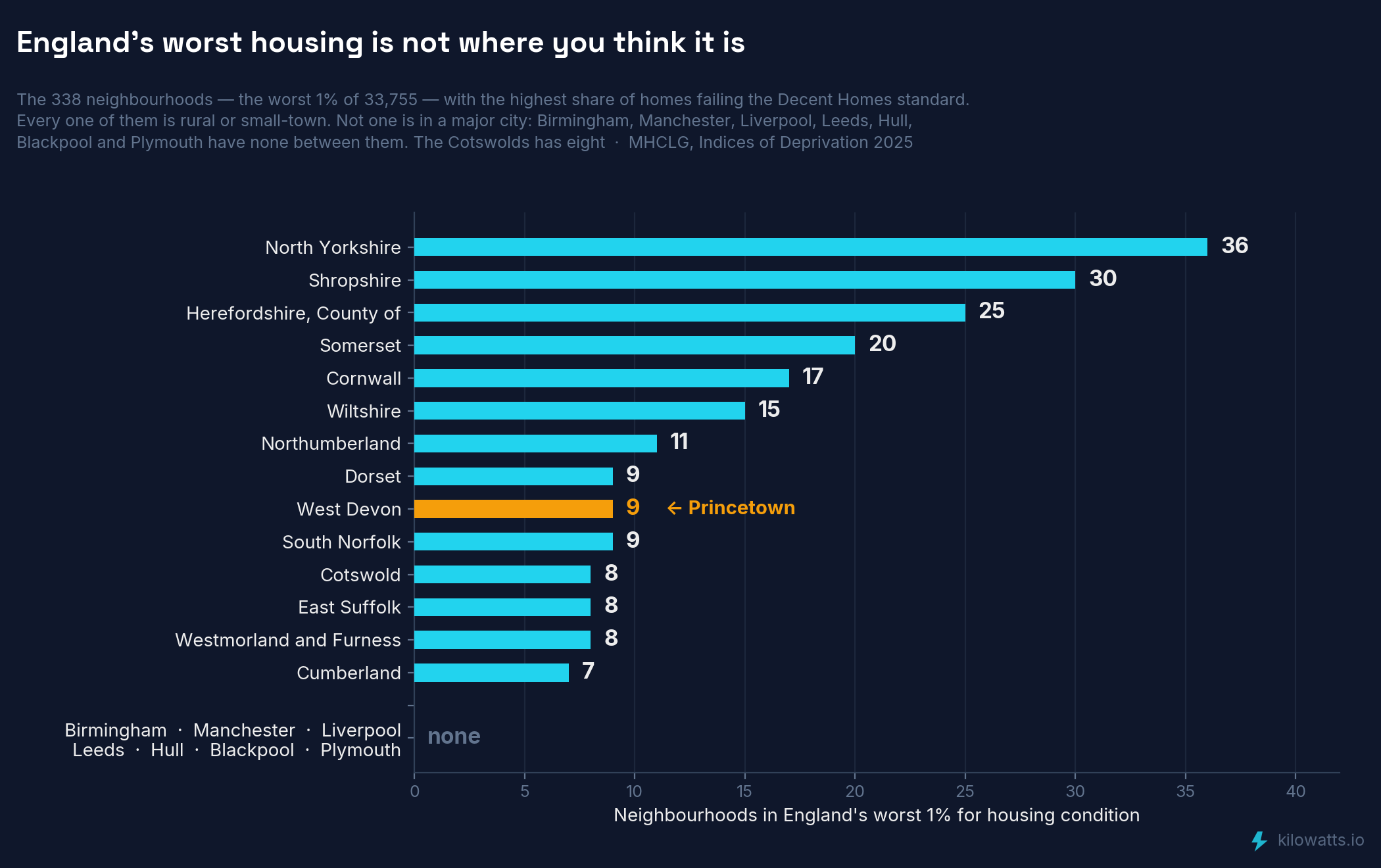
Which makes sense once you see it. Decent Homes failure is driven by Category 1 hazards, disrepair and lack of modernisation, and cities have had seventy years of slum clearance, council rebuilding and cavity-wall programmes. What is left at the bottom is old, solid-walled, often listed or in a conservation area, frequently off the gas grid, and expensive to do anything about. That is not an urban housing problem. It is a rural retrofit problem, and it is close to invisible because it is spread thinly across places that photograph well.
The same dataset, incidentally, rates Princetown decile 9 for the Outdoors sub-domain: air quality and road safety are excellent. The place is beautiful. The houses are terrible.
So fix the houses
Except that is not a choice anyone was offered. The fund goes to community organisations, for projects that benefit the village — to organisations, not to households. Nobody was ever going to hand £40,000 to a family living in a cold house, however much they needed it.
And the scale says the same thing from the other direction. 219 of the village's 378 homes fail the standard. Spread the grant across them and it is £183 each. Concentrate it and it buys external wall insulation on two houses, or most of one structural repair. Doing the failing homes properly is a £3.7 million job; the grant is 1% of it. There is no version of this — targeted or spread, permitted or not — where £40,000 makes a dent in the housing.
So the honest position is that the thing most worth doing is the thing the money cannot touch. That is not an argument for doing nothing. It is an argument for asking what £40,000 can do that keeps working after it has been spent — because a grant spent on fabric is spent once, and a grant spent on generation pays out for twenty-five years.
Which is how I ended up looking at the village hall roof. It is the opposite of the housing in every respect that matters. The housing is 219 separate owners, 219 separate decisions and 219 separate sets of scaffolding; the hall is one building and three trustees. The housing needs £3.7 million and the grant covers 1% of it; the hall needs about £40,000 and the grant covers all of it. Some of the housing must be structurally repaired before anything sensible can be done to it at all; the hall was built in 2009 and needs nothing doing to it first. Retrofitting a Cornish Unit means somebody living in a building site for months; panels on a hall roof mean a week of scaffolding and nobody moves out.
And it is the only one of the two that produces something rather than merely consuming less. You cannot sell the heat you didn't lose through a wall. You can sell electricity.
On my figures — which need the hall's meter readings before I would stand behind them — an array there is worth something in the order of £6,000 to £7,000 a year. Over twenty-five years that is £168,000: about ten houses' worth of insulation, eventually, rather than two houses' worth now.
But does any of that work here?
Two complications, and then a third that I cannot resolve at all.
It is not very sunny. A roof here yields about 945 kWh/kWp, 11% below Plymouth — and the gap is worst in summer, at −14 to −16%. That is orographic cloud: the moor lifts moist south-westerly air, it cools, it condenses, and the effect is strongest exactly when surface heating is strongest. Colder than almost anywhere in England, and less sunny than the coast you can see on a clear day from the top of the hill.
Nobody can charge a car. There is no rapid charger anywhere on Dartmoor. They ring the moor and follow the A-roads, and the middle has none. Okehampton is thirteen miles from Princetown as the crow flies and twenty-four by road, because you cannot drive across the middle.

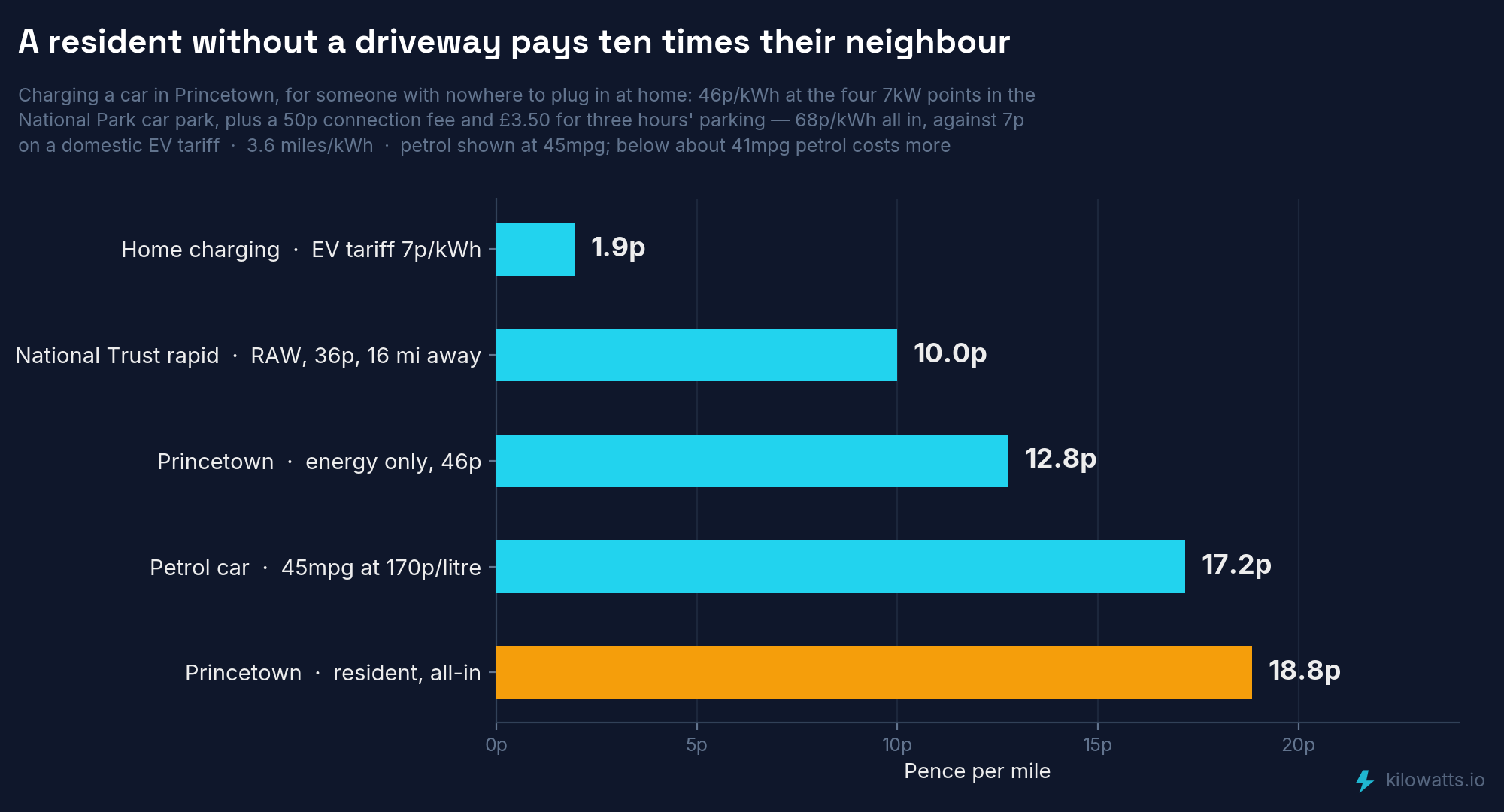
The four 7 kW points we do have cost a resident without a driveway about 68p/kWh once the £3.50 parking charge is counted — roughly ten times what a neighbour with a driveway pays overnight, and, at today's pump prices, a shade more per mile than running a petrol car.
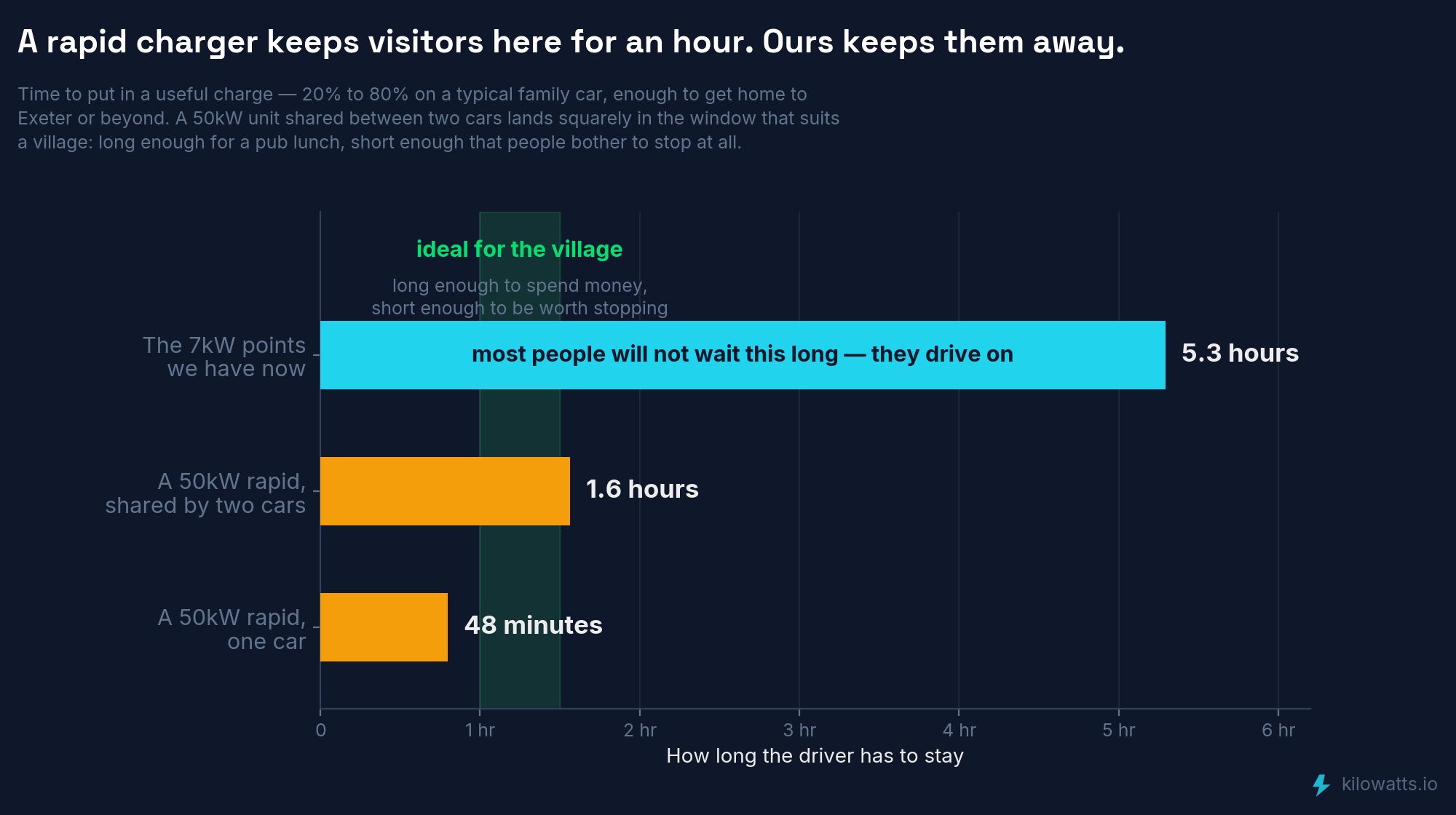
And the slow points are not a substitute. Putting a useful charge into a family car at 7kW takes over five hours; most people will not wait, so they drive on. A 50kW unit shared between two cars takes an hour and a half — which happens to be exactly the window a village wants.
There is a car park beside the hall that could take a charger, and an operator would pay for it. What interests me is where the money goes — and there is a coincidence here that seems too good to leave alone. Visitors come when it is sunny. So does the generation. A moor car park on a bright Saturday in May is full of cars whose owners have driven eighty miles to look at the weather, parked under a roof that is producing more electricity than anything on site can use.
And if the roof and the charger were on the same side of the meter, that electricity would never touch the grid at all. Roughly 40% of a commercial electricity price is network charges and policy levies — DUoS, TNUoS, balancing, the Renewables Obligation, Contracts for Difference, the Capacity Market. None of it applies to an electron that goes from a roof to a car forty metres away without using the distribution network. That is not avoidance; it is simply not using the thing the charges pay for. Generate it on a sunny afternoon, sell it to somebody who came because it was sunny, and the entire middle of the value chain disappears. Princetown has an abandoned petrol station, which makes the comparison a literal one: a petrol station was at least somebody's business here, whereas with a charger the operator and the energy supplier take almost the whole margin and none of it stays local. If the hall supplied the electricity off its own roof it would keep a real share. I have not found anyone in the UK who has actually structured it that way, which is the first of my questions.
Who else could use it
An array on one roof produces more than that roof needs, most of the time, and exporting it earns a few pence. So who else is there?
Next door is the primary school — oil-heated, no generation of its own, and a weekday daytime load that matches solar almost perfectly until the six weeks of the year when the sun is best and the school is shut. On the same site is the youth club, which is used in the evenings, which is when a battery would be discharging anyway.
And then the two loads I cannot see at all. The village has a brewery, and a distillery under construction. Neither appears anywhere in the public data this article is built on — industrial premises with low building-services demand are exempt from energy certificates, and a certificate only measures heating, lighting and ventilation in any case. The two largest process energy users in Princetown are invisible to every dataset I have used.
The brewery, it turns out, has already put 75 kW of solar on its own roof. Which is worth sitting with for a second, because it answers a question I had been treating as open. Does solar work up here, eleven per cent down on Plymouth, with the cloud and the weather and the altitude? Somebody has already run those numbers with their own money, without a grant, and built something nearly twice the size of what I am contemplating. That is a better piece of evidence than anything in my spreadsheet.
It also means the brewery is not a customer. It is another generator, exporting into the same constrained network on the same sunny afternoons. Two arrays in one small village, and the question of who buys the surplus gets more interesting, not less.
The distillery is the open one, and it comes with a detail that says more about this village's energy system than anything else I found. It is running on LPG — bottled gas, delivered by tanker — because when it needed a connection the mains gas network here had no capacity left. The prison was using it.
The prison then closed, and took 55% of the network's throughput with it. The constraint dissolved about eighteen months after the decision was made. So the village now has a gas network that has lost its anchor customer, and a new industrial user that could have replaced it burning a dearer fuel out of a tank in the yard.
As an offtaker for our electricity, my instinct is that its heat demand is the wrong shape to be useful — distilling wants steam at 100°C and up, well above anything a roof full of panels will provide, and it comes in batches. But refrigeration might be the best match in the village: cooling and cold storage run continuously, year-round, and hardest in summer, which is exactly when the roof is producing and when the school is shut. And a distillery throws off a great deal of low-grade waste heat at the condensers, which somebody cleverer than me might have a use for.
And then the battery, which is where I get stuck
In 1959, British Pathé sent a film crew to Princetown.
What they filmed was a 3 megawatt gas turbine — a Bristol Siddeley Proteus, an aero engine, the same unit that flew the Bristol Britannia — installed at Princetown by the South Western Electricity Board and started remotely, from a building somewhere else. The newsreel calls it the world's first unmanned power station. There is a lovely shot of a man's hand on a switch, and then a turbine spinning up on Dartmoor.
Strip out the newsreel voice and what that is, in modern language, is fast-start, remotely dispatched, embedded generation at the end of a constrained rural network. Seventy years before anyone called it flexibility.
It is long gone. And the network here is constrained again: the primary substation at Yelverton is short of capacity across the winter, through the day and into the evening, and this winter the network is paying close to £2,000 per MWh for energy delivered into that constraint. Twelfth of 503 zones in the region on price. My village once had three megawatts of exactly the thing that is now scarce, and has none.
So: should the village hall put in a battery?
Here is the cautionary half. The neighbouring zone at Tavistock was on much the same money — until its registered capacity tripled and three operators turned up. It now pays about £40.
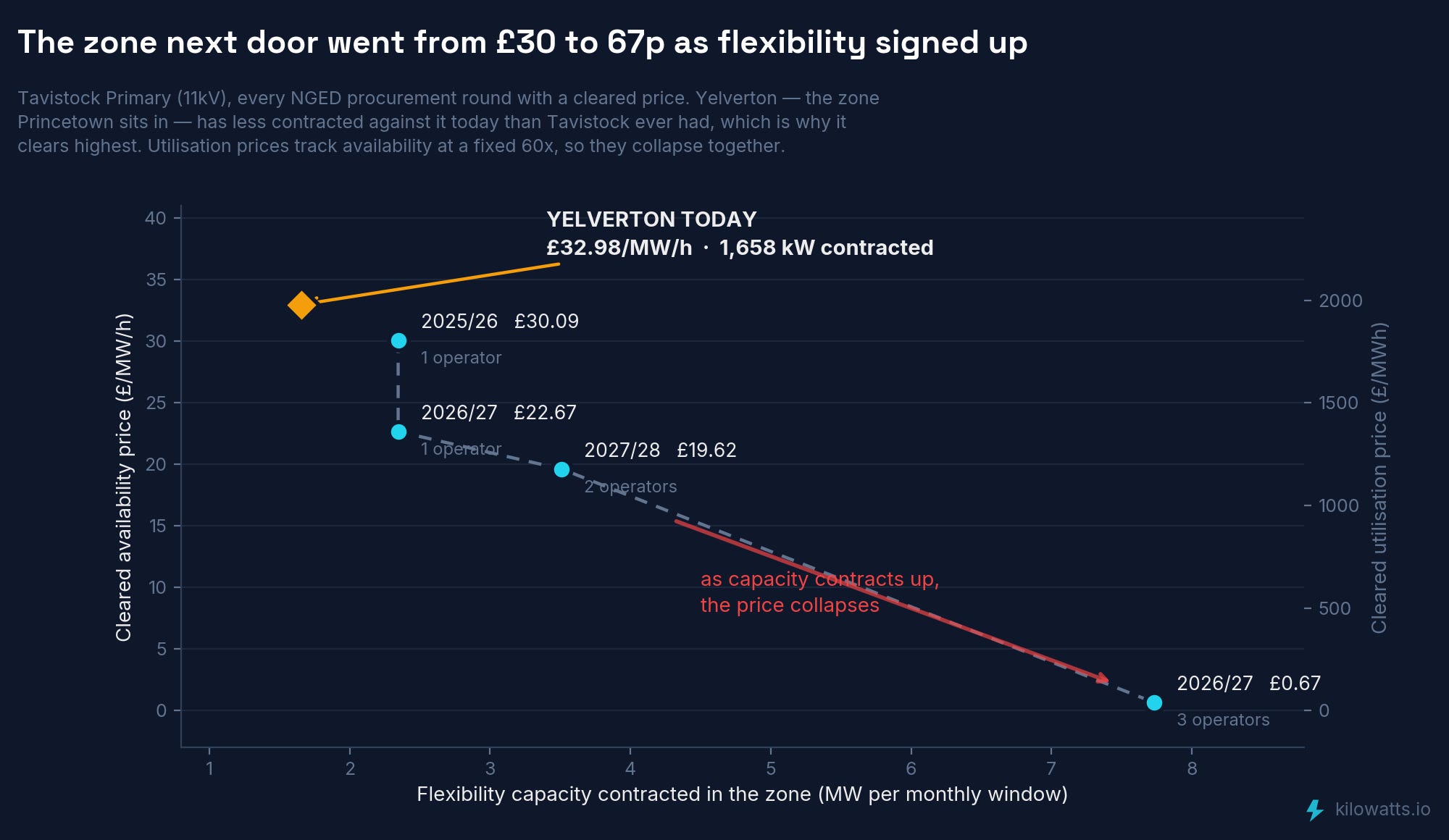
That is a 98% fall in one zone, one year, visible in published auction data. The £2,000 exists because nobody has built anything there yet, and it disappears the moment somebody does. Which makes it a strange thing to underwrite a twenty-five year asset with. A battery bought on this winter's prices might look very silly by 2030 — or it might be the only thing in the scheme that pays for itself, if enough of the rest holds up. I genuinely do not know, and the honest version of the sum is that a small battery here earns a few hundred pounds a winter from flexibility, not thousands. The price per megawatt-hour is extraordinary. The volume a village hall can deliver is not.
I did ask somebody
Before publishing this I emailed the South West Net Zero Hub — the regional body for exactly this sort of thing — to ask whether an independent survey of the building was something they could offer. Not a feasibility study from a standing start; I have done the modelling. Just somebody independent to look at the roof and the incoming supply, because a £40,000 application backed by an independent assessment reads very differently from one backed by a resident's spreadsheet.
They replied within five hours, politely, and said it was not a service they provide — and, more tellingly, that they did not know of any organisation that could. They suggested two advice websites.
I do not think that reflects badly on them. They were quick and they were straight with me, which is more than I expected, and they pointed me at two other organisations that might know more.
Which is rather the point. There is no shortage of organisations. Working through this I have encountered the Net Zero Hubs, Community Energy GO, Community Energy England, Great British Energy, DESNZ, Devon Communities Together, the Devon Community Energy Network, Plymouth Energy Community, Regen, two tiers of local authority, a national park authority and a distribution network operator. Several of them do excellent work and I have had helpful replies from some. Between them they offer advice, guidance, toolkits, webinars, funding portals, readiness support and — as of this week — grants.
What none of them appears to offer is somebody who will come and look at the roof.
So who should I be asking? That is a genuine question and possibly the easiest one in this piece to answer, because the answer is presumably a name. If the regional net zero body does not know who does independent assessments for community buildings, somebody reading this does. I would be glad of it — and so, I suspect, would a number of other village halls.
One last thing, which makes this bigger than a village hall
The Duchy of Cornwall owns a great deal of Princetown. It is the freeholder of the community centre, it held the land the Cornish Units were built on, and much of the village sits on its ground. It has also published a target of 100 MW of renewables across its roofs and land by 2035, against roughly 3 MW installed today — and a stated intention to take solar beyond farms and onto residential and commercial property. Alongside that sits an estate-wide net zero target for the end of 2032 which it says, in its own reporting, it is not yet on track for. And it has just put £250,000 into this village.
So the hall roof may be the small version of a much larger question. Here is a landowner that needs 97 MW in nine years. Here is a village of 865 people with a great deal of roof, more wind than almost anywhere in England, a grid that pays handsomely for flexibility, no charging worth the name, a gas network that has lost its anchor customer, and a housing stock in the worst 1.4% in the country. Somebody ought to be able to make something of that combination.
I cannot work out what. Which is the whole reason for what follows.
Five questions
Here is where I ran out of road. These are real gaps, not rhetorical ones.
1. Who should own the charger — and does it need to be a public-grade rapid at all?
This turns out to decide almost everything else, which I did not expect. Hand it to an operator under the council's procurement and they fund it, build it, maintain it, and — the part I keep returning to — under Devon's concession the grid connection reverts to the landowner at nil cost when the term ends. Against a rural connection that could run to five or six figures, that reversion may be worth more than the entire revenue share. The catch is the queue: one operator added 464 sockets last year against an awarded pipeline north of 40,000. Concede it and it might never get built.
Own it, and four things open up that the operator route forecloses. VAT: public charging is standard-rated at 20%, the threshold is £90,000, and a hall turning over £23,000 stays comfortably underneath — so it could price a fifth below any commercial operator on the same margin. Pricing freedom: the rule that a reseller of electricity may only pass through cost is disapplied for EV charging, so you can set any tariff you like, for anyone — a resident discount that deepens when the sun is out and the roof next door is generating. Lancaster's council-owned hub already does something like it; a national operator working from a national tariff never will. The levies: roughly 40% of a commercial electricity price is network charges and policy costs, and none of it applies to an electron that goes from a roof to a car forty metres away without touching the distribution network. And the hardware: a 50kW public CCS rapid is about £42,000, much of which is what makes it public — payment terminal, back office, roaming, a cabinet somebody can kick. DC-coupled charging is arriving in homes and offices at a fraction of that, hanging off the same bus as the inverter and the battery.
That last one matters most, because a DC-coupled charger you own removes the question that has stumped me throughout: whether a site can sell its own generation into somebody else's charger. Physically supplying the kWh rather than sleeving it, and being paid something nearer a retail price than an export price — I could not find a single UK example of anyone doing it. If you own both ends there is nothing to sell. The electrons never leave your own DC bus.
And there is a reason to want the slower machine that has nothing to do with money. We want the dwell time. A forty-minute charge gets somebody back on the road; an hour and a half gets them onto a high street that has lost a great deal and would like the trade. A commercial operator wants the opposite — throughput, plugged in and gone — which is why the industry keeps going faster. So: is the answer 25kW of something much cheaper, wired straight to the roof, deliberately slow?
2. Would you build the battery — and if so, which one?
I would not underwrite a twenty-five year asset on this winter's flexibility prices, not with Tavistock sitting there at £40 as a warning. But there is a smaller, duller case that does not need them: a battery sized to nothing more than the building's own evening demand, shifting the afternoon's generation forward a few hours. On my numbers that pays for itself on self-consumption alone, without a penny from the network, and the flexibility becomes upside rather than the premise. Better still DC-coupled to the chargers — one bus, no conversion losses either way, nothing crossing a meter boundary. Which is the configuration a standard operator arrangement forecloses. So the battery question and the ownership question turn out to be the same question.
Related, and it puzzles me: has an Energy Local club ever run alongside a battery? None that I can find publishes one. Half-hourly matching and a storage asset seem like they ought to combine, and the fact that they apparently never have suggests I am missing something.
3. What about heat — and is a shared ground loop across two public buildings a thing anyone does?
The hall was built in 2009, so the fabric is decent: this is not one of the houses. Next to it is a football pitch, which is several thousand square metres of somewhere to put a horizontal ground loop. Next to that is the primary school, oil-heated, with far more to gain from getting off its fuel than we have. The Boiler Upgrade Scheme explicitly contemplates shared ground loop systems up to 300 kWth, so two buildings on one loop is a configuration the rules were written for, and the trenching is the expensive part.
I had assumed seasonal performance here would be poor and modelled a heat pump costing more to run than the gas it replaced. My own house says I was too pessimistic — but my house has been insulated and the hall has not. I have not found anyone who has run a shared loop across two organisations' buildings. Has anybody?
4. What does an independent gas transporter actually want, twenty years out, once its network has lost its anchor load?
Ours brought gas into the village about twenty years ago, and the prison was 55% of what flowed through it. That has gone, leaving 226 domestic meters and a set of fixed costs that did not shrink with the demand. So which way does its interest point? Does it want to keep operating a contracting network, spreading those costs over the customers who remain? Or is there a point at which it would rather get the village off gas altogether and walk away — pay for the electrification rather than maintain the pipes, the way American utilities occasionally fund a non-pipeline alternative instead of replacing a main? I do not know whether that is a real option in Great Britain, a thing that only happens in other people's regulatory filings, or an idea somebody has already tried and abandoned for reasons I would find obvious if I knew them.
5. And the one I expect to be hardest: how do you take something like this to a village that is sceptical of it?
Our councillor is now from Reform. I mention that not as a complaint but as a fact about the ground I am standing on — the national framing of energy policy does not play well here, and the people it does not play well with are my neighbours, who have watched a great many things sold badly and are not wrong to be wary of the next one.
What strikes me is that almost nothing in this piece needs anybody to care about carbon. It is about a village that used to have a petrol station and now has an abandoned forecourt; about residents paying ten times their neighbours to charge a car; about a hall with £23,000 of income and a roof doing nothing; about who takes the margin on every unit sold and whether any of it stays here. Those are arguments about ownership and about not being taken for a ride. I think that is the honest case rather than a tactical one — but I have never had to make it in a village hall on a wet Tuesday, and I would much rather hear from people who have.
Two I have left out because I think I know the answers, and would like to be told I am wrong. Small wind: Princetown averages 7.0 m/s and is one of the most exposed inhabited places in England, and a 3.7kW turbine here would still yield about 11% of what the roof does, on a 15-to-30 year payback, after a full planning application in a conservation area inside a national park — there is no permitted development route for a non-domestic turbine anywhere in England. If it does not work here, where does it? And the Valuation Office's treatment of a private wire from rooftop PV to a co-located commercial charger, on which I can find no guidance at all, and which looks like it could quietly create a separate rateable hereditament.
If any of that is your area, I would be glad of a reply, a correction, or a war story. I am especially interested in being told that something here is wrong — I would rather find out now than in front of the committee in December.
And please pass it on. This is free and there is no paywall on any of it. If you know somebody who has built a community charger, run an Energy Local club, put a battery behind a village hall, argued a private wire past the Valuation Office, or simply stood up in a parish meeting and won a room round — I would like to hear from them, and the only way I will is if this reaches them.
There are, apparently, a thousand communities about to face a version of this question. I am starting from the position that I do not know the answer.
Ben Watts — kilowatts.io