


Last week I asked whether it is time to slam the brakes on Britain's dash for solar. Britain has 22 GW of panels, England has another 26.6 GW consented or under construction, and in parts of Devon the local wires are already full at midday.
This piece is the sequel. If everyone builds solar, what happens to the price of a midday kWh? And should the next panel point somewhere else?
Ask any installer which way a panel should face and you will get the same answer: south, tilted at about 35-40°. That is the direction that makes the most kWh. But a panel is not paid by the kWh. It is paid by the hour, and the hours it is best at are now the cheapest hours of the day in much of Europe.
So I modelled every direction a panel could face, from due east to due west and from flat to vertical, in 5° steps, against hourly prices in eight markets since 2015: Britain, Ireland, Germany, the Netherlands, France, Spain, northern Italy and Hungary. Each year's weather is matched with the same year's prices, so a cloudy afternoon in a given July meets the price it actually had. The method is at the end.
The answers come as a chain of questions, and most of them are not what I expected.
Is solar eating its own lunch in Britain yet?
The simplest measure is the capture rate: what a south-facing panel earns per MWh, divided by the average price across all hours. A panel generating evenly round the clock would score 1.0. Below 1.0, its own output, and everyone else's, is pushing down the price of the hours it sells in.
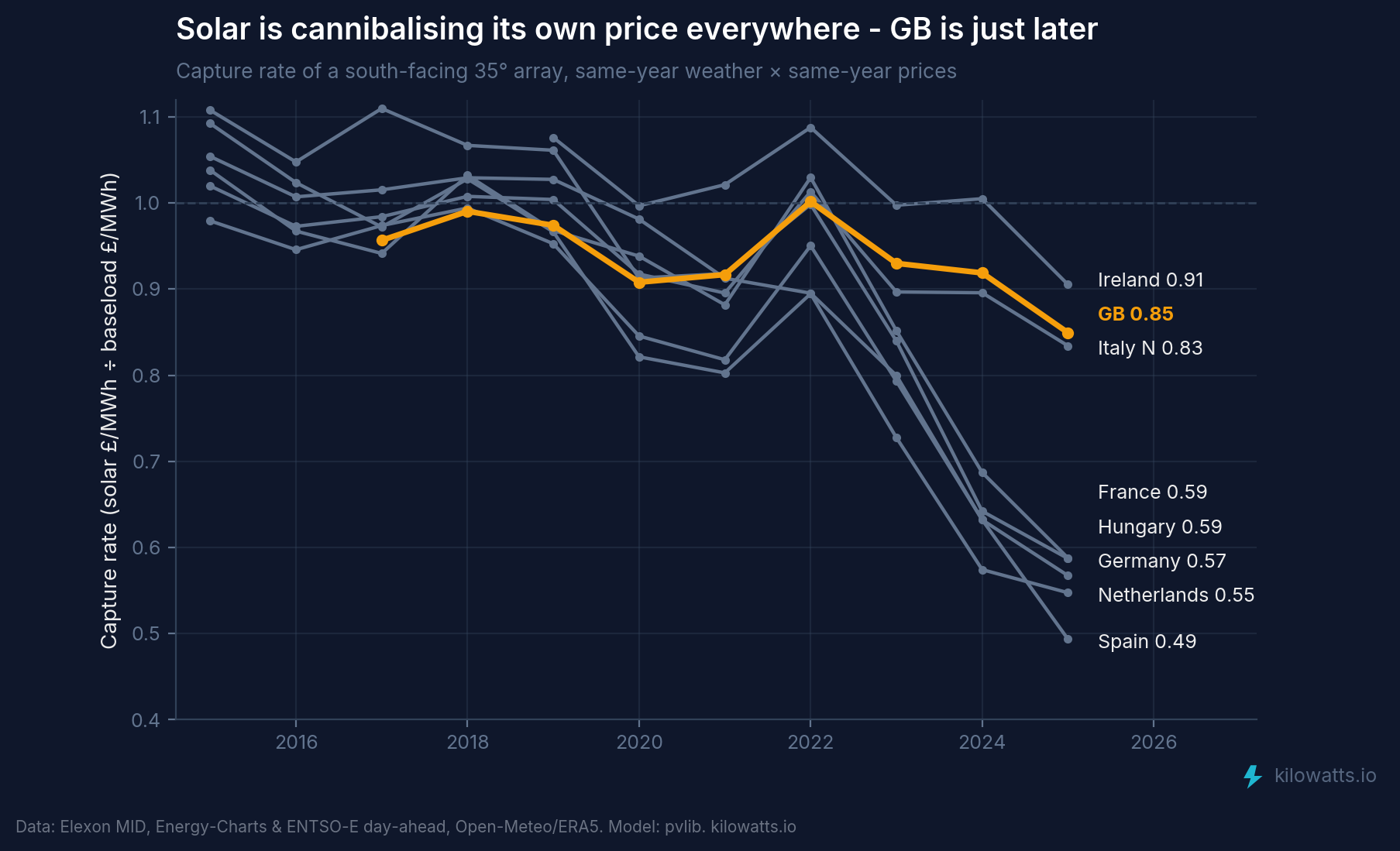
Spain has fallen furthest. A south-facing panel there earned 105% of the average price in 2015, 49% in 2025, and 40% in the twelve months to October. Germany, the Netherlands, France and Hungary have all landed at 55-59%. This is the fading I described in May, when I wrote that PV ages like Beaujolais Nouveau.
Britain is a long way behind. Its capture rate was 99% in 2018, 85% in 2025, and has recovered a little to 88% this year. That is why, as I wrote in May, a solar MW in the UK now earns more than one in Spain: Spain has roughly twice the sun but sells it at under half the relative price. It is also why the newest solar farms on contracts for difference have been paying money back this year.
The two controls help explain why. Ireland (91%) has its prices set mostly by the wind. Northern Italy (83%) has plenty of solar, but gas still sets the price in most hours, so it sits next to Britain. Britain's midday price is still mostly a gas price, which is the point I made in The Solar Cliff: there is a long way to go before solar sets it.
So the markets line up on a spectrum: wind-led (Ireland), gas-led (Italy North, Britain), solar-saturated (Germany, the Netherlands, France, Hungary), and then Spain on its own.
So should panels turn away from the midday sun?
This was the first surprise: barely.
If midday power is worth less, you might expect the best panel to swing east, to catch the morning, or west, for the evening peak. In every market and every year, the best single direction stayed within about 20° of south. The most re-angling ever earned was 3.5%, in France in 2025, and usually it was 1-3%.
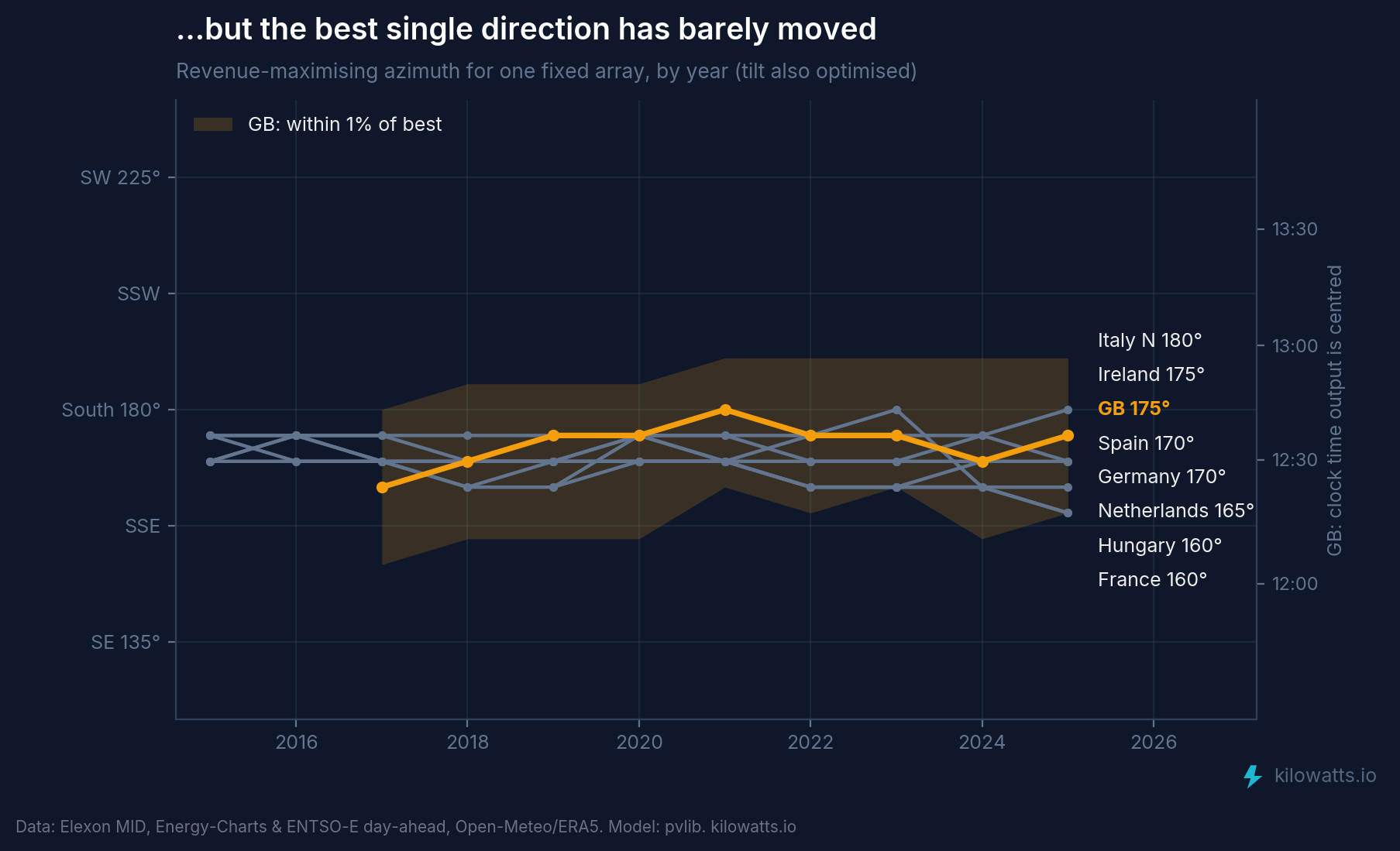
The reason is that the peak is flat. Turn a panel 45° away from south and it loses more kWh than better timing wins back. The right-hand axis shows what the turn buys in time: in Britain, swinging from due south to south-west moves the middle of the panel's output from about 12:45 to about 13:45 on the clock. An hour is not much against a price dip that lasts most of the afternoon.
What did move was the tilt. In France, the Netherlands and Spain the best tilt has crept up from 35° to 45-50° since 2024. A steeper panel gives up summer midday kWh, which is where the price has collapsed, in exchange for winter and spring kWh, which are still worth something.
Britain's best panel is the same as it was in 2017: roughly south, at 40-45°.
Then why has Spain's peak split in two?
The yearly answer hides how the whole landscape has changed shape. The animation below shows it for six markets. Each frame is a rolling twelve months, stepped forward a week at a time from 2018. The colour is the value of each direction, from east on the left to west on the right, with tilt going up. The star is the best direction, and the strip underneath each map shows that year's average price by hour of the day against the shape of a south panel's output.
The shapes tell a story in three stages:
An oval. Britain, Ireland and northern Italy still have one peak centred on south. Re-angling gains 0-0.3%.
A bean. In Germany and Hungary the peak has stretched east-west into a flat ridge. A south-east or south-west panel now earns almost as much as a south one, and the best direction wanders along the ridge from year to year.
Two peaks. In Spain the ridge has split. Over the last twelve months the two best directions, south-east (130°) and south-west (225°), are tied, and due south sits in the dip between them, 1.3% behind.
The strips underneath explain why, and the answer is the clock, not the sun.
Spain, Germany and Hungary all run on Central European Time, and their power markets are coupled, so the price moves together. The cheapest hour of the day is 13:00 on the clock in all three. But the sun does not keep Central European Time. A south panel's output is centred at 12:19 in Hungary, 13:04 in Germany and 13:50 in Spain (14:08 in summer), because Spain is a long way west for its time zone.
So Hungary's sun runs ahead of the price trough, and its panels pull east, to sell into the morning before the trough arrives; its best direction is now 145°. Spain's sun runs late, into a trough that is now very wide (prices from 11:00 to 16:00 average about 30% of the daily mean) and then into an evening peak at about 1.7 times the mean. A south-west panel catches the evening. A south-east panel catches the morning. A south panel catches the worst of both.
(A caveat on 2026: Iberia's reservoirs are at decade highs this year, as I wrote in Europe's hydro drought has moved north, and plentiful hydro will have deepened the midday dip. The split was already visible before the wet year.)
Britain's clock and sun are well matched: a south panel's output centres at about 12:45 local time, and Britain's midday dip is still shallow. It is the oval.
What if you can't export everything you generate?
Everything so far assumes a panel can sell every kWh it makes. In Britain that is increasingly not the case, and it is where the question changes.