


In a pub outside Plymouth recently, I overheard a conversation lubricated by pints of Rattler between two tradesman talking about expensive energy bills, and wondering if it was possible to just “go off grid”. They were no eco zealots; one was at pains to point he “agreed with Nigel” on many things; something he seemed to repeat more frequently with more Rattler. They both confessed to liking EVs, knew that it was possible to heavily insulate timber frame new builds, realised that solar PV was great for “most” of the year and that heating requirements were modest in any case in the coastal south-west. Generators are noisy, smelly and break all the time. Log fires burn offcuts from work, but in a well insulated home, are more likely to overheat the place unless you open the windows.
I didn’t join in; I was there with my young son and was in cycling lycra. But the conversation got me thinking. How feasible is going off grid? And when, if ever might it be worth it?
The October price cap is £1,723 for a typical home, and January's is shaping up to be worse. Ofgem sets it from wholesale prices over a three-month window, and 27 days in (as of 27 September), the gas feeding January's cap is running 39% above what set October's, and electricity 18% above, according to electricitybills.uk's wholesale tracker. Pass that straight through and a typical bill heads towards £1,950. Petrol is 180p a litre. And a roof full of solar panels has never been cheaper.
So why not cut the wire altogether? Cover the roof, buy a battery, put in a heat pump, and never see another bill or standing charge again. The standing charge alone is now £200 a year, the price of 760 kWh of electricity, paid before you've boiled a kettle. Could your home really do it? Would you need a generator? Does it matter whether you live in Cornwall or the Cairngorms? And would it actually save you anything?
I built a model to find out: hour by hour, for 18 years of real weather, in 20 towns from Bodmin to Aviemore. Some of the answers surprised me. The biggest one: for the first time, a home in Britain can realistically get through winter without the grid or a generator. It isn't the panels or the batteries that changed. It's the car.
What does an ordinary home actually need?
Start with a household that isn't unusual. It uses 2,500 kWh a year on appliances, lighting and cooking — Ofgem's typical domestic consumption value, which it cut from 2,700 in July — with the half-hourly shape of Elexon's standard domestic load profile. It has three people who each shower every day. Heating and hot water come from an air-source heat pump.
The showers matter more than you'd think. Three eight-minute showers a day, plus the kitchen sink and the cylinder's standing losses, come to about 3,300 kWh of heat a year. In a Passivhaus that is several times the space heating.
I put that household in three shapes of home (a 75 m² bungalow, a 90 m² semi and a 140 m² detached house) and three standards of construction:
Passivhaus, needing about 5–10 kWh of space heat per square metre a year;
a 2010s new build, about 60–70 kWh/m²;
an unimproved 1930s home, about 140–170 kWh/m² — roughly what an uninsulated semi burns in gas today.
The heat pump's seasonal efficiency comes out at 3.0–3.5 including hot water, in line with what UK field trials measure. Then I covered every usable square metre of roof in panels — both pitches, north and south, because an off-grid house needs every winter kilowatt-hour it can get. That's 8.5 kWp on the semi, 13 kWp on the detached house and 14 kWp on the bungalow.
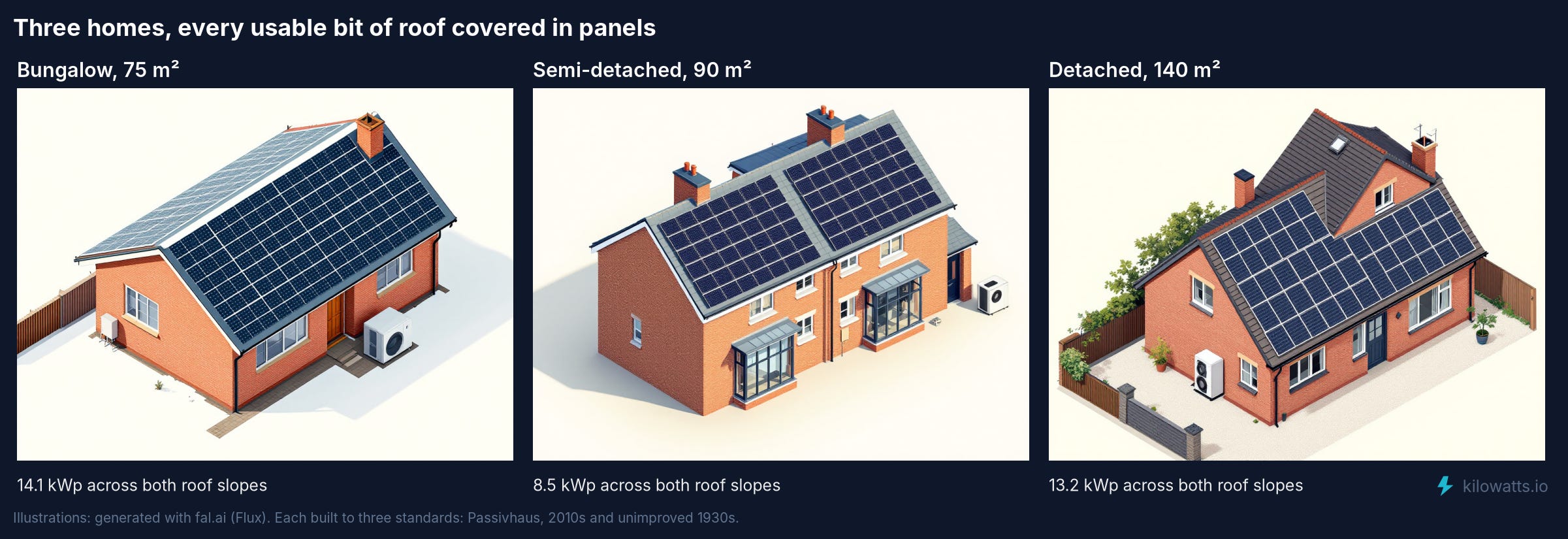
Would my roof cover my house?
Over a year, probably yes. The 2010s semi in Birmingham uses about 5,100 kWh of electricity a year, heat pump included. Its roof produces 6,200.
That summer surplus is the core premise — not only for cutting the wire, but for the zero-bills homes now being built, which pair the same oversized roof and battery with enough flexibility to be worth something to a supplier. The difference is that those homes keep the wire, and use it to balance one season against another.
The trouble is when.
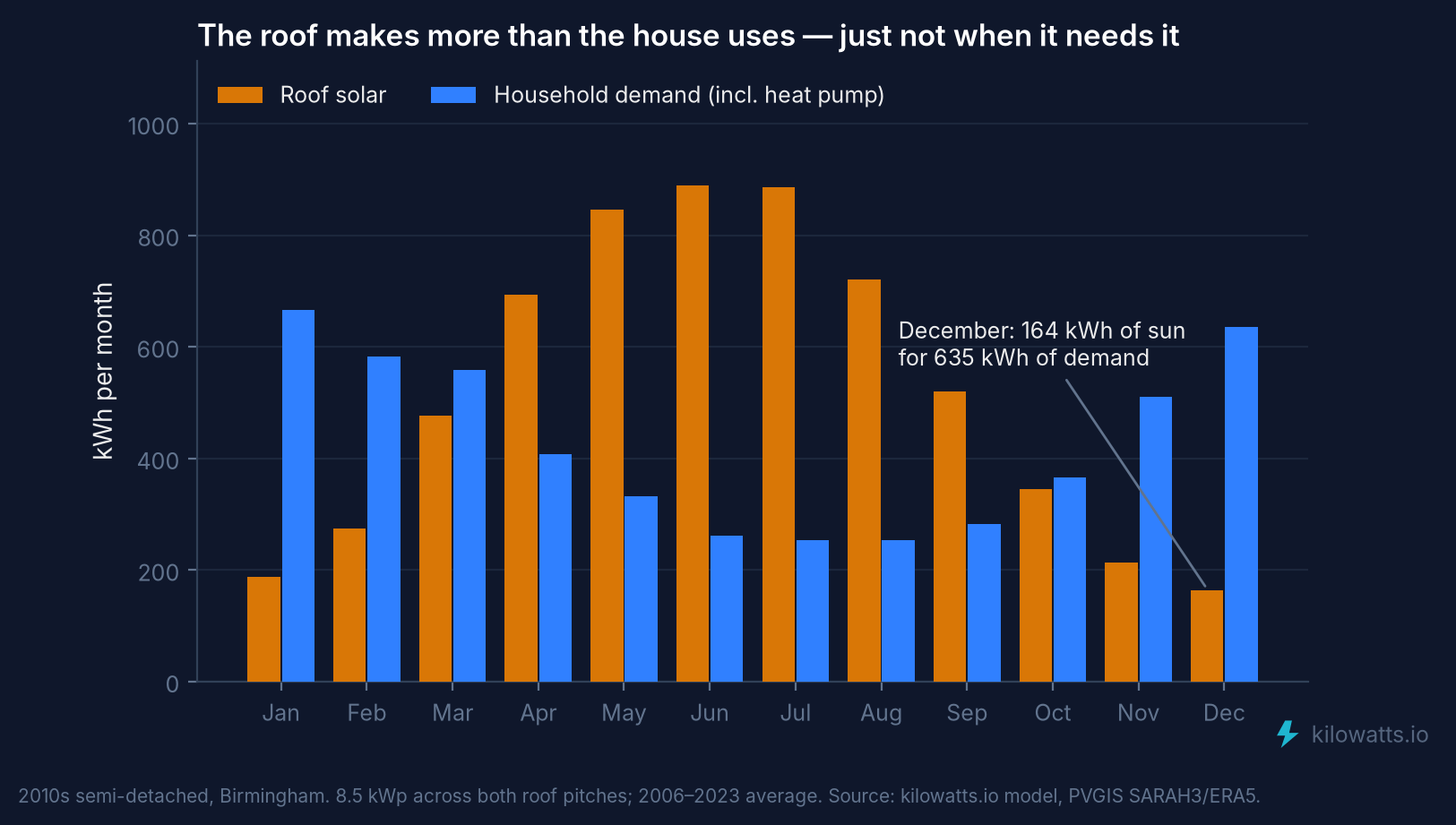
In June the roof produces more than three times what the house needs. In December it produces 164 kWh against a demand of 635. The shortfall arrives exactly when the heat pump is working hardest, and it lasts for months.
Couldn't a big battery fix that? A battery can move energy from afternoon to evening; but it’s not big enough to move it from July to January. To run the Birmingham semi with no backup at all, the battery would need to hold about 2.9 MWh — over 200 Tesla Powerwalls. Even a Passivhaus needs 1.3–2.6 MWh, depending on where it is. For a 2010s home in six of our 20 towns, and for the 1930s home in all of them, no battery would do: over a year, the roof simply doesn't make enough.
So everyone going off-grid in Britain needs a backup. The only question is what kind, and how often it runs.
Does it matter where I live?
More than you'd think. Give each home a generous 20 kWh battery and ask how much of the year's electricity can come from the roof. North to south, it’s quite a range.
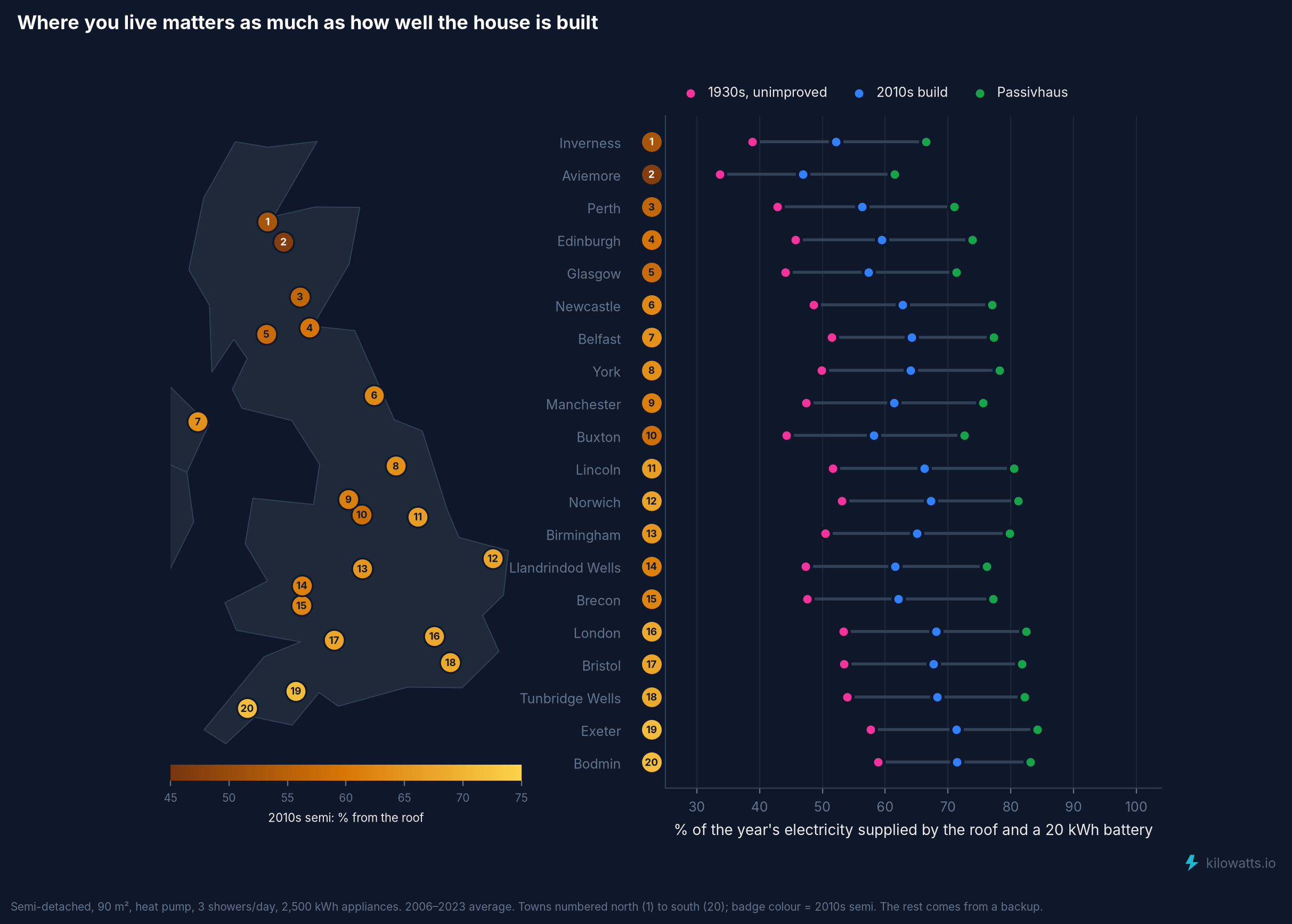
A 2010s semi in Bodmin or Exeter gets 71% of its electricity from its own roof. In Birmingham it's 65%, in Glasgow 57%, and in Aviemore 47%. Moving from the south-west to the Highlands costs more self-sufficiency than moving from a 2010s house into a 1930s one.
The annual figure hides the real pattern. Month by month, every home in every town runs almost entirely on its own roof from May to September. The differences are all in winter.
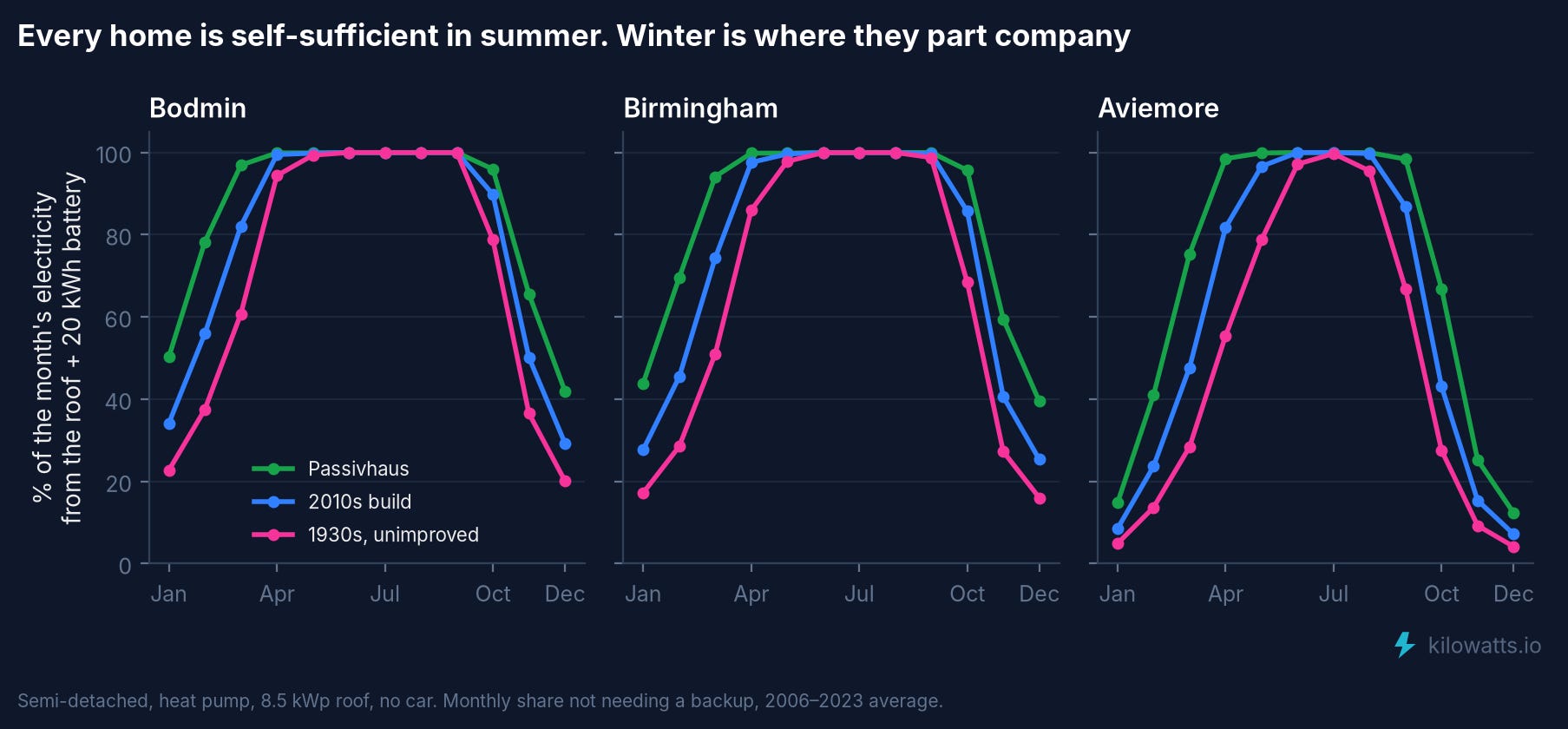
In December a Passivhaus semi in Bodmin still gets about 40% of its electricity from the roof. A 1930s semi in Aviemore gets 4%. Good insulation and a southern location both buy winter months, and the two effects add up. And one winter matters more than the rest: in 57 of the 60 town-and-fabric combinations, the cold, still, dark winter of 2010 was the worst of the eighteen. Anyone designing an off-grid home needs to design for 2010, not for an average year.
So what fills the gap?
Traditionally, a petrol or diesel generator. I've modelled petrol: cheap to buy and dear to run, a small one turns a litre at 180p into about 2.2 kWh, so each kilowatt-hour costs around 81p, three times the capped grid price. A bigger diesel set is more efficient, closer to 60–65p a kilowatt-hour, but it runs just as often.
Worse is how often it runs. Our 2010s semi with its 20 kWh battery needs the generator on about 140 days a year in Bodmin, 150 in Birmingham and over 200 in Aviemore. That's most of the winter, most evenings, starting a petrol engine in the garden to keep the heat pump going. When I let an optimiser choose the battery size on cost alone, it makes matters worse: with petrol as the backup, the cost-optimal battery is only 3–8 kWh, and the generator runs on 150–300 days a year.
The optimiser is PyPSA, the free, open-source model I spent two days learning at Birmingham a fortnight ago. It is built to plan national power systems — the kind of work that used to need six-figure software. Here it is pointed at one house: the same linear programme, deciding how many kilowatt-hours of battery and kilowatts of panel to build, against eighteen years of weather, for a semi in Birmingham rather than a country.
A year's total hides what it feels like to live with. Here are three homes, day by day, over six winters: the best case (a Passivhaus bungalow in Cornwall), the Birmingham semi, and the worst (a 1930s semi in the Highlands).
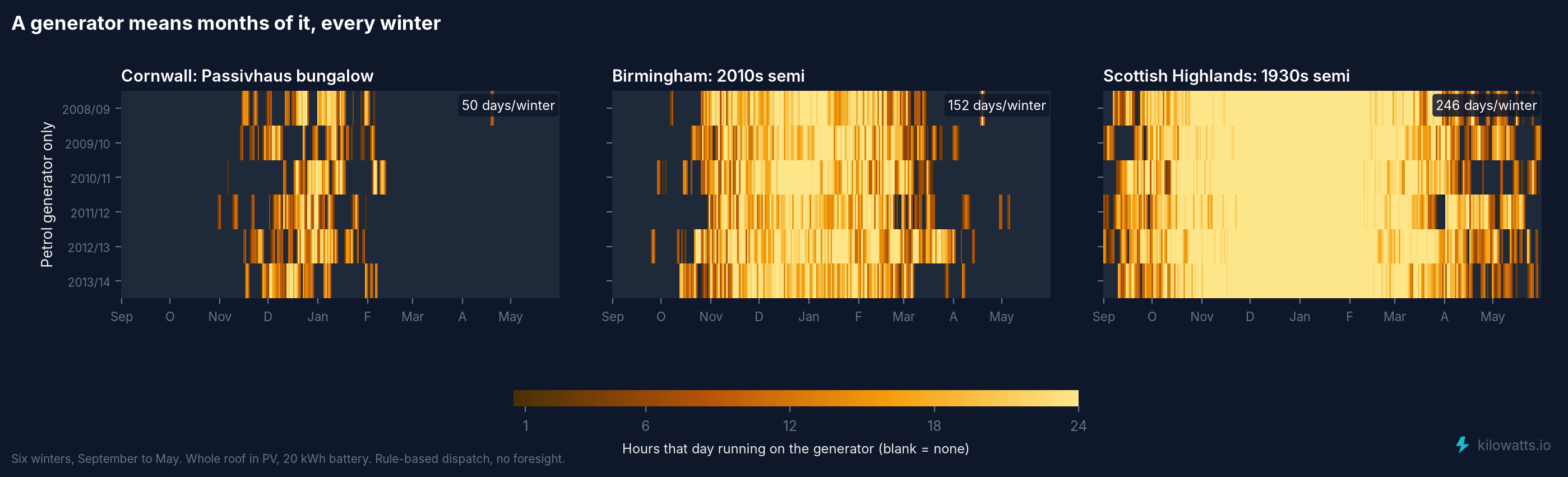
The Cornish bungalow gets away with about 50 days a winter, patchy and mostly around the solstice. The Birmingham semi runs it on about 150, nearly every day from November to February and often for most of the day. The Highland 1930s semi runs it on about 250, flat out from October to March. In between, the shoulder seasons are almost worse to plan around: a few hours one evening, nothing for a week, then a dull spell and it's back. You can never put it away.
This is why off-grid living in Britain has been a lifestyle choice rather than an economic one. It works, but it's noisy, smelly and relentless.
What about the car on my drive?
This is where it gets interesting. Give the household a car — a 75 kWh electric car with a bidirectional charger, so it can power the house as well as charge from it. The car is at home on half of days. On the other half it drives to work and back, 5,000 miles a year in total.
The car changes the maths because it is a large battery that can leave the house and come back full. In summer it charges from the roof's surplus. In winter, on days away, it tops up at a public charger at 45p/kWh and comes home with about 40 kWh more than it needs for the next trip, which it then feeds into the house overnight. The house battery gets you through the day; the car carries the winter.
Here is the same calendar again, now with the car added in the bottom row.
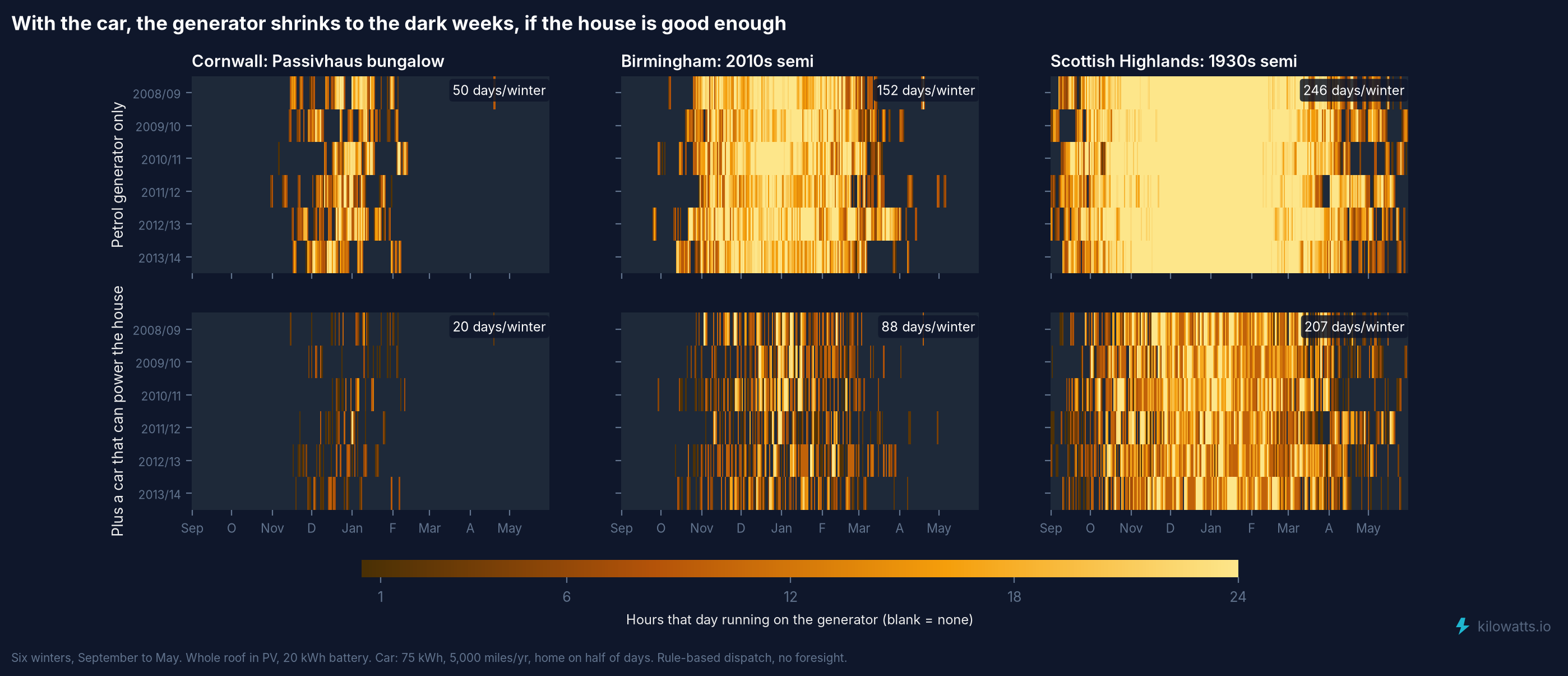
The Cornish bungalow is down to about 20 scattered days a winter. The Birmingham semi's solid block breaks up into about 90 days, with October and April nearly clear. The Highland 1930s semi barely changes (250 days to 210), because its winter demand is too big for a car to carry. Across all 20 towns, the car cuts the generator's output by 55–78% in 2010s and Passivhaus homes.
Go further and remove the generator entirely. With the car as the only backup, the optimiser sizes the house battery at 8–12 kWh for a Passivhaus and 13–20 kWh for a 2010s home, and it keeps the lights on through the 2009–2011 design period, including the 2010 winter. The occasional extra trip to a charger replaces the generator.
That's the change. Until recently the only backup that could carry a British winter was a petrol engine. Now it's the car most households own anyway.
In a way it's obvious. For most rural households the car is already what lets them live beyond the reach of the bus and the train. It turns out it can do the same for the wire.
One honest caveat: this is off-wire, not self-sufficient. A good share of the winter electricity still comes from the grid; the car just brings it home. It's grid power, bought at a public charger and carried a few miles. The same was always true of the car and public transport: it frees you from the timetable, not from the forecourt.
And if you'd rather keep a generator? As a rule of thumb, swapping the car for a petrol generator raises the cost of the off-grid backup by roughly a third, and puts the generator back on for 150–250 days a year.
What would I do with all that summer sun?
The flip side of December is June. Once the house, the battery and the car are full, an off-grid home simply throws the rest away: about 7,200 kWh a year for the Cornish Passivhaus bungalow, 2,700 for the Birmingham semi, and even 950 for the Highland 1930s semi. A connected home would sell it. Off-grid, you'd better find a use for it.
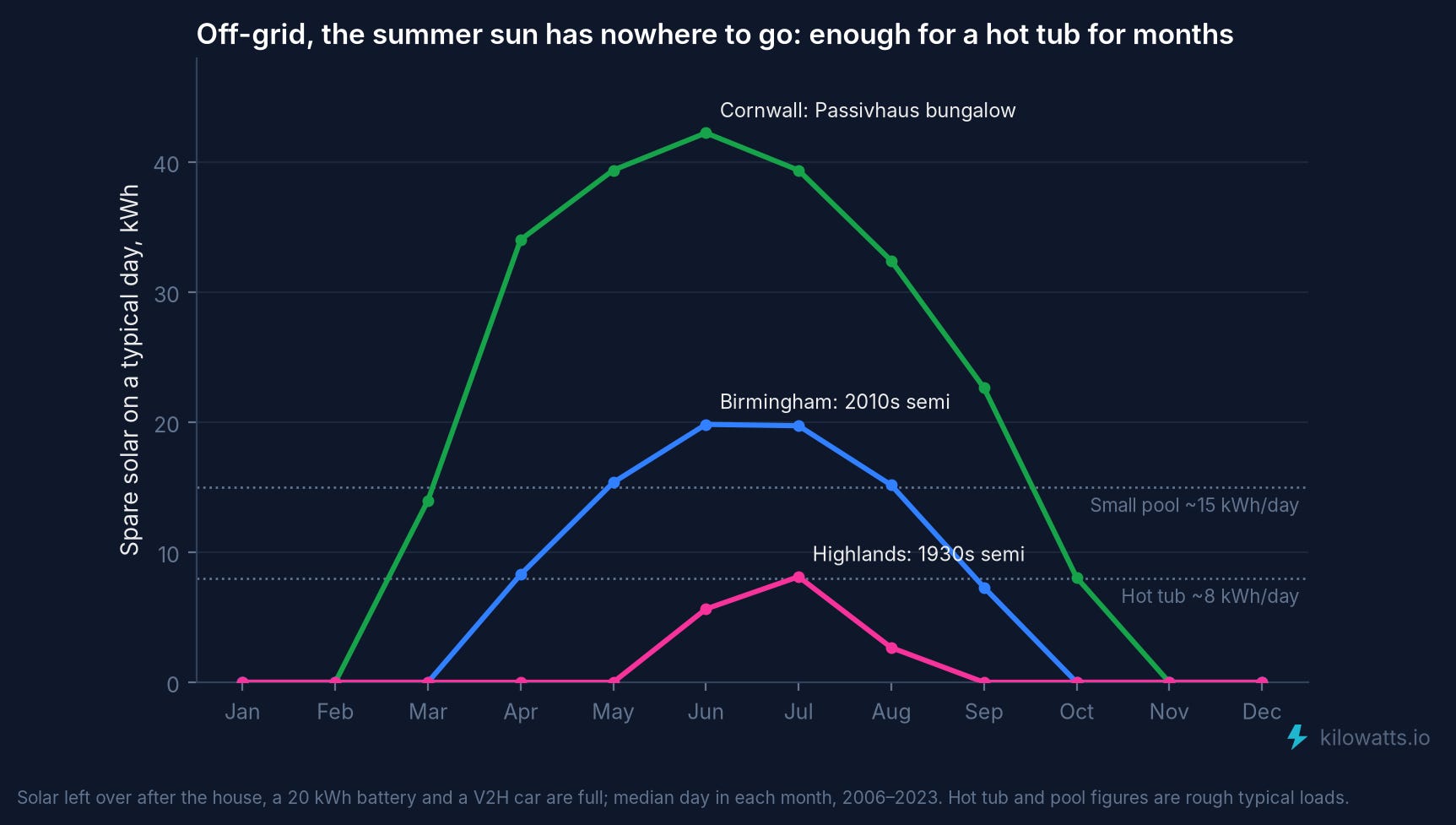
A covered hot tub needs roughly 8 kWh a day to stay at 38°C. The Cornish bungalow has that much going spare on about 215 days a year: nearly every day from April to August, most of September and March, and half of October. That's a free hot tub for seven months. The Birmingham semi manages about 130 days, most days from May to August. Even the Highland 1930s semi gets about 45, mostly in June and July.
A small covered outdoor pool is hungrier, perhaps 15 kWh a day with a pool heat pump and filter. That's about 180 days a year for the Cornish bungalow, a proper swimming season, and about 85 in Birmingham.
The less glamorous options work too: running the heat pump in reverse to cool the house on a hot afternoon, drying laundry, heating a garden office, filling the car to the brim. What you can't do is keep it for winter, which is the whole problem.
Which leaves the questions that actually decide whether you should do it:
I already have a connection. Should I cut it? The answer holds across all 480 combinations I modelled.
What would it cost me, compared with staying connected? And where does the money go? (It's not where you'd guess.)
Would panels in the garden, a log stove or a wind turbine help? One of them is a lifeline in a leaky house and a mistake in a good one.
What if export tariffs keep falling? Every penny off the export price moves the answer by £40–70 a year. For a well insulated home, the grid connection is an asset, not a liability.
I'm building a new home. Is a £10,000 connection quote worth paying?
Below, the full numbers for each.