


You asked
In May I argued that plug-in solar is a red herring. That piece has found a second audience over the past few weeks, and the questions in my inbox have converged on one: should I buy a kit when the law changes?
The law changes on Thursday 27 August. The bank holiday falls on Monday the 31st. Four days — and you already know how it will look: a boxed kit in the supermarket middle aisle, wedged between the pressure washers and the padded ski jackets, at a price pitched to feel like now-or-never.
So here is the direct answer, and it is not the one the retailers want: don't. Partly because, as you'll see, there is nothing yet to buy. But mostly because the thing they'll eventually sell you is the wrong half of the story — and the right half is sitting in a regulatory waiting room.
The shelf is empty
Start with the fact that makes "rushing" impossible. A compliant plug-in kit has to appear on the ENA's public type-test register before it can be sold, and the register has a filter for exactly this product. Set the Type field to "Plug-in Solar" and here is what you get today, five weeks out:
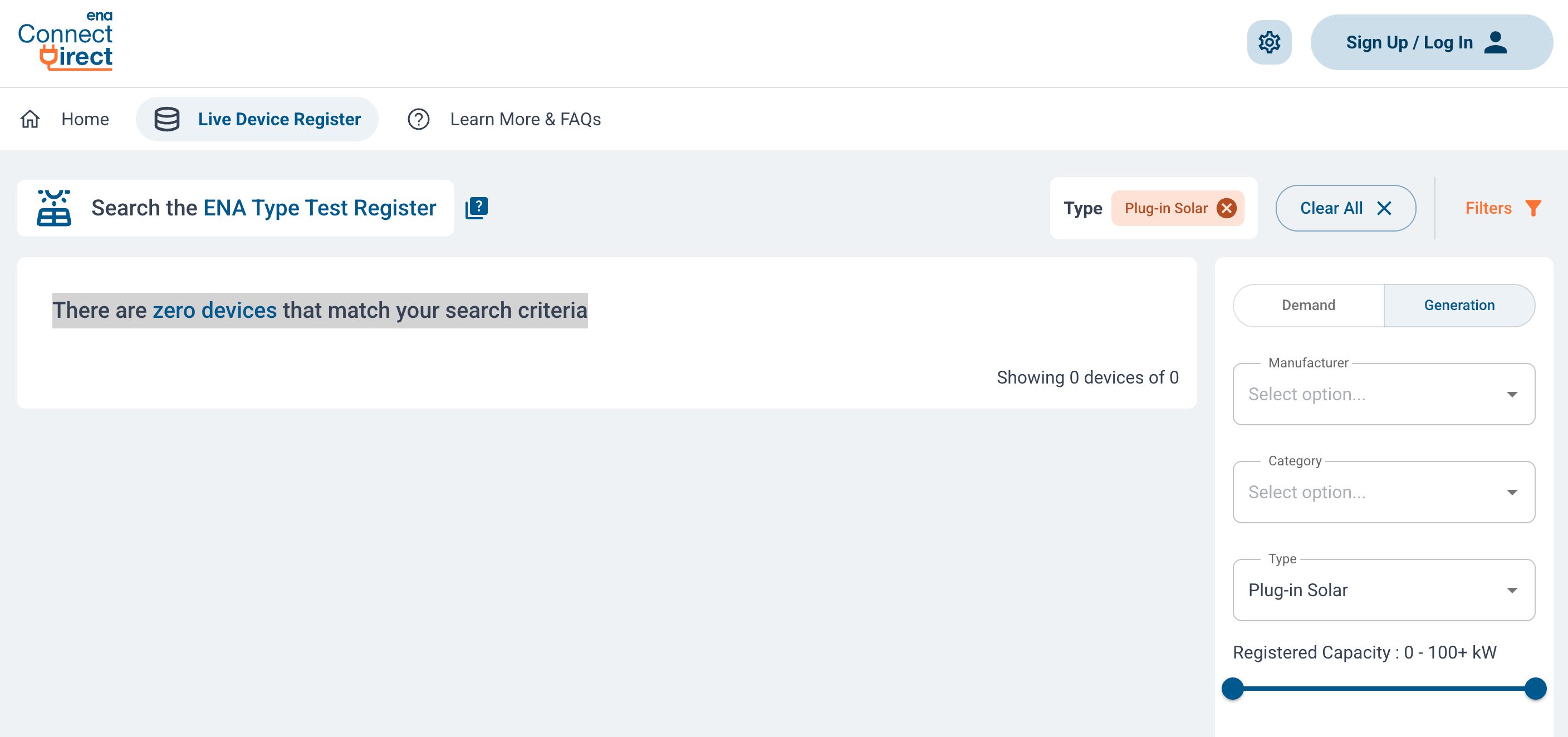
Zero devices of zero. The shelf is built, labelled and empty.
It has been coming for months, in the loosest sense of the word. The government announced its intention to legalise plug-in solar on 16 March, in a post-Iran energy-security package. The instrument that did it, SI 2026/848, was made on 16 July and comes into force on 27 August — 122 days from announcement to signature, for a document of 1,103 words. That's nine words a day; the law is shorter than this article. It was also finished in a hurry at the very end: DESNZ published its consultation response six days ahead of schedule and made the regulations the same day, 16 July — four days before Keir Starmer handed the premiership to Andy Burnham. Whether by chance or design, plug-in solar was got over the line just as the government changed leader.
But the drafting pace isn't really the story, and it would be lazy to pretend it is. The March announcement wasn't a launch, it was a statement of intent — and it was made for a season the scheme was never going to be ready for. Nobody who heard it was ever generating this summer, because five months on there is still nothing certified to buy. You trail a product at the start of the season that sells it, then spend that whole season not shipping it. The first plug-in summer that actually exists is 2027.
Even once it's stocked, the panel is the wrong buy
Say you wait for the register to fill. What are you buying? Less than the marketing implies, and here the May argument only hardens.
It earns almost nothing, because it can't sell anything back. A plug-in kit can't be MCS-certified, and without MCS there is no Smart Export Guarantee. So every kilowatt-hour you generate and don't use in the same moment is a gift to your supplier. Anchored to my four years of measured wall-mounted yield and modelled against real half-hourly household demand, a typical home self-consumes about 64% of what a small kit makes and spills the rest. Value it at the price cap and an 800 VA kit is worth roughly £75 a year — against the £130–150 I casually put in the May piece by valuing every kilowatt-hour at retail. The no-export rule lops about a third off the top, and it bites hardest in the bright spring and autumn months, when the panel makes most and the house soaks up least:
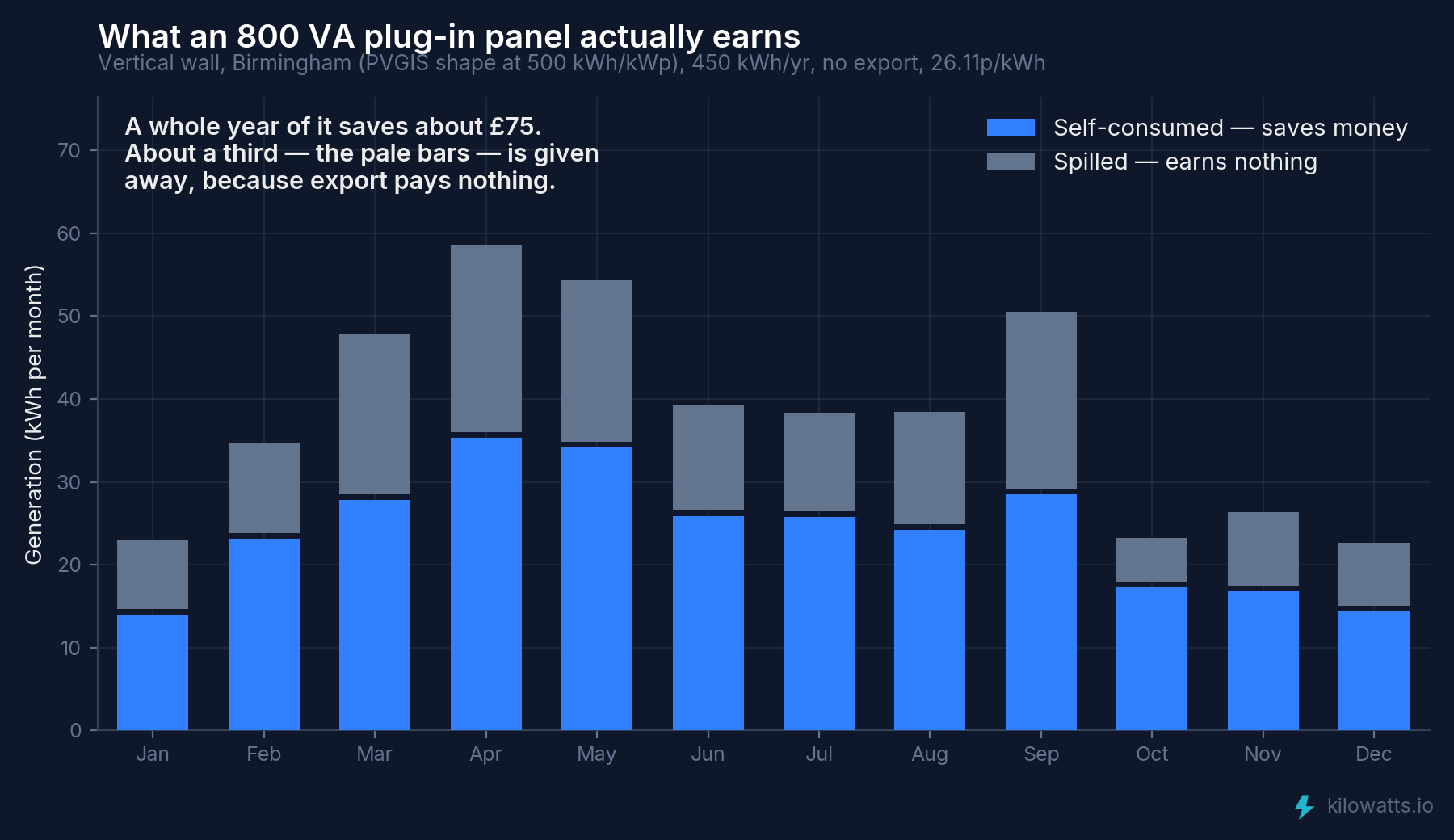
To put that in perspective: a whole winter's generation from one of these — September to February — is worth about £24. So even once there is finally something to buy, the month you choose to buy it barely moves the needle. The thing itself is cheap; the timing of it is a rounding error.
So what should you actually pay? Work it backwards, and treat this as the discretionary purchase it is: demand a 25% return a year — a four-year payback — which is about right once you allow for the cost of the money, the kit ageing and dating, and the fair chance that you (a renter especially) move before it clears. On that hurdle the most you should hand over is roughly four times what it saves you in a year. At the £75 a typical wall kit earns, that's £300; a perfectly-sited, always-occupied home earning nearer £120 might stretch to £480. Either way, the kits on sale today — £499 and climbing — are already above the ceiling a clear-eyed buyer would set. And that is a rule that ages better than any single figure of mine: whatever a kit ends up costing, ask whether it will save you a quarter of it, every year. If not, it's too dear.
One honest exception, and it's the nice one. That sum values your time at nothing, and installing a kit isn't nothing: budget a few hours to mount it, fit the plug, notify your network operator, and nudge the angle across a few weekends to find where it likes to sit. If that sounds like a good rainy-Sunday project — and it genuinely can be — call the labour a hobby and forget it. If it sounds like a chore, add it to the bill, and the case gets thinner still.
And if what moves you is carbon rather than cash, the comparison is crueller. On today's grid — about 120 grams of CO₂ a kilowatt-hour, and falling fast — that kit's 450-odd kilowatt-hours a year displace roughly 55 kg of CO₂, shrinking a little every year as the grid itself cleans up, and shrinking again once you count the carbon it took to build the panels. Call it well under a tonne across the kit's entire life. Now take the same £300 — or £500 — and spend it instead on UK or EU carbon allowances, and cancel them: at 2026 prices near £70 a tonne, you lift four to seven tonnes straight out of the emissions cap, today. Pound for pound, tearing up carbon permits abates several times more than bolting a panel to a wall, and it does it now rather than dribbled across twenty years. Be as generous to the panel as the physics will allow — credit it with displacing marginal gas rather than the average grid mix, which roughly triples its lifetime saving to a couple of tonnes — and the permits still come out ahead, and still sooner. And sooner counts for far more than it sounds. What warms the planet is the running total of everything ever emitted, so a tonne kept out of the air this year is worth more than the same tonne kept out twenty years from now: it is cut for longer, and it holds the peak lower while the tipping points are closest. The panel delivers its carbon the slowest way imaginable — a thin trickle over two decades — exactly when the atmosphere would most value it up front. That is a deflating thing to know about a product sold on its greenness. A cancelled permit doesn't glint on the balcony, granted, and it won't teach you a thing about your own demand — but if the ledger you care about is tonnes of carbon, the wall is not where the money goes furthest.
The cap tops it out. 800 VA is a ceiling on generation, and it clips every sunny day, so a plug-in panel makes a few hundred kilowatt-hours a year no matter how much silicon you bolt to the wall. The spec lets you hang 2,000 W of panel behind that 800 VA inverter — a 2.5-to-1 ratio where a rooftop system runs 1.1 or 1.2 — but with no export payment and no battery allowed, every watt above what you're using in the moment is simply thrown away. You are permitted to buy panel capacity that is structurally unable to earn.
And Britain made it dear at the bottom. Not at the top: EcoFlow's STREAM kit is about £499 here and near enough the same on its German store, so the branded mid-market is level. The difference is the floor. In Germany the cheapest option isn't a £499 branded set — it's a €249 own-brand kit from Lidl, or a self-assembled build for less again. That long cheap tail is what made balcony solar a mass-market object there. Britain's rules abolish it by construction: complete certified kits only, so no self-assembly; whole-kit certification and a register-before-sale gate, so the discounter's €249 box can't clear the bar the way a self-declared German product does. The premium isn't that any given kit costs more here — it's that the £150 and £250 options that dominate Germany can't legally exist, so the market starts at the branded price and stays there.
So ignore the German paybacks. You'll see two-and-three-year figures quoted at British readers; they describe a different planet. Germany's smart-meter rollout has all but failed — 5.5% of homes — so roughly half the country still runs an old spinning-disc Ferraris meter, and since 2024 the law lets that disc run backward until the operator swaps it. That's free net metering at the retail rate, read once a year, often by the householder. And the same missing smart meter that hands them free export also locks them out of dynamic tariffs, so for most Germans a panel is the only way to touch cheap solar at all. A British buyer has neither problem and neither perk: a smart meter that reports every half-hour, no export payment to collect — and, crucially, the ability to just switch to a tariff like Agile and buy the grid's cheap midday solar without bolting a thing to the wall.
And there is a safety case worth taking seriously, because it came from the one expert quarter that dissented. When the government consulted, 88% of the public waved plug-in solar through — but the bodies who actually understand home wiring did not join the cheer. The ECA, Electrical Safety First, the IET, NICEIC and SELECT issued a joint warning, and NAPIT another: not against plug-in solar, but against rushing it. Their central worry is backfeed — a generator pushing power the wrong way into a ring main, past protective devices that a tired 1970s installation was never fitted to handle.
Follow that worry to its end, though, and it points away from the panel and toward the battery. A solar panel is an uncontrolled source: it pushes out whatever the sun gives and exports whatever you can't use, in the moment, whether the house is ready or not. A plug-in battery is a controlled one — it can meter itself to your own load and needn't spill a watt back to the grid, sitting as a buffer between your house and the network rather than a tap plumbed straight into it. It answers the very concern the panel raises. The people warning loudest about plug-in solar are, without quite meaning to, making the case for plug-in storage.
That's the whole case against the panel, and it's the May case with the numbers filled in. But it's only half the piece, because the interesting product isn't the panel at all.