


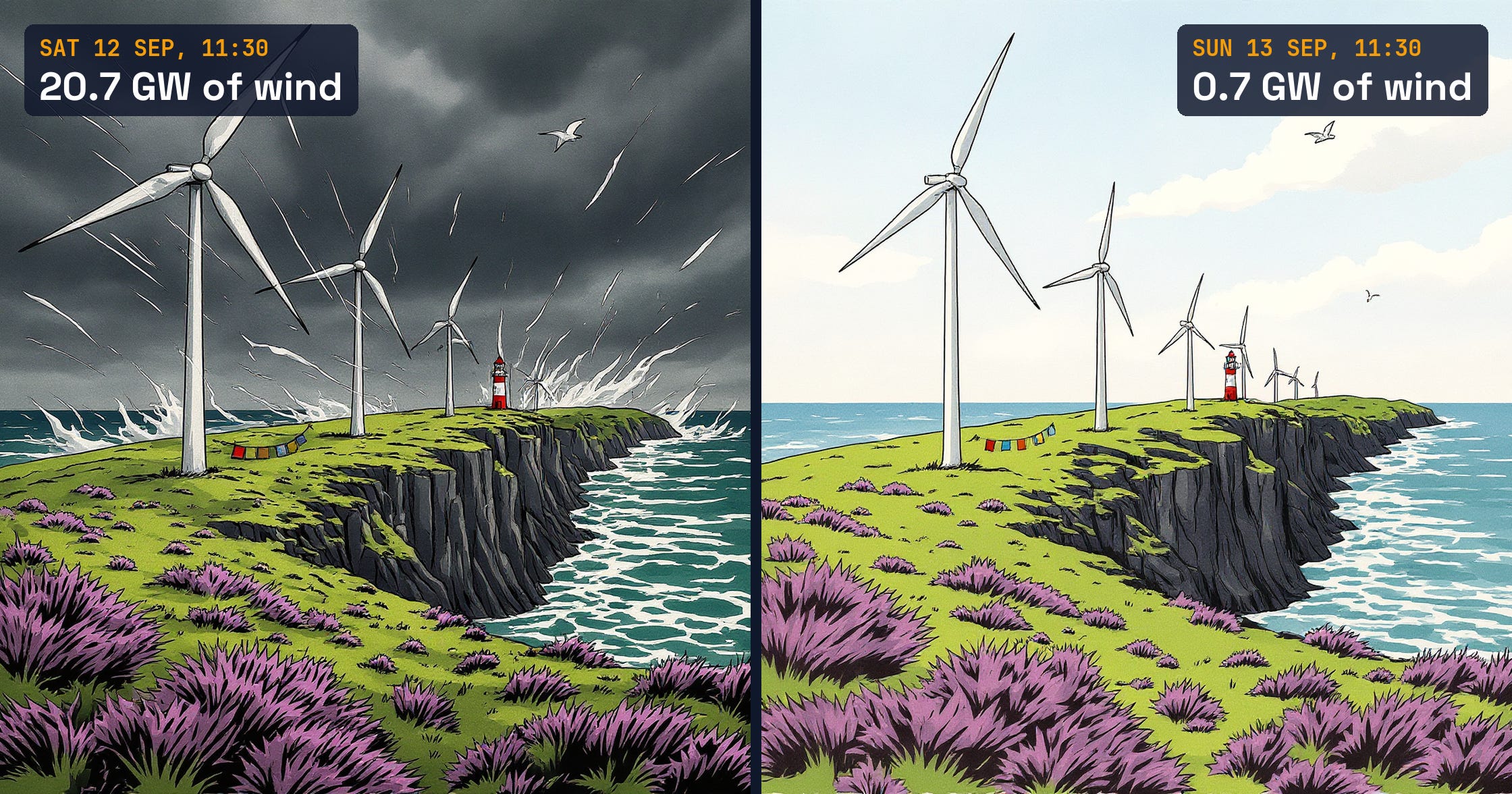
At 11:30 on Saturday 12 September, Britain's transmission-connected wind farms had 20.7 GW of wind available to them. NESO was paying some of the Scottish ones to switch off. Twenty-four hours later the fleet was producing 0.7 GW. That is the biggest 24-hour collapse of wind in the record.
It wasn't a one-off. Since 1 September there have been five collapses of 10 GW or more: on the 1st, 4th, 8th, 10th and 12th. What sets September apart is how deep they went. Three took out more than 70% of installed capacity, and no September since 2018 had even one of those.
The Germans gave us Dunkelflaute for the long, dark calm. There is no word for the sudden fall into one, so here is a proposal: Sturzflaute, a flash lull, by analogy with Sturzflut, a flash flood. A Dunkelflaute is about how long the calm lasts. A Sturzflaute is about how fast you fall into it.
I hadn't intended to write about wind again this month. Last week's piece, Are we about to set a record for curtailment costs?, was about what it costs when there is too much wind in the wrong place. Before that, How Long Is a Dunkelflaute? argued that firmness depends on how long you're prepared to wait. The feedback on both kept circling one question: is this getting worse? Then the wind produced its biggest collapse on record, and it felt sensible to take the question seriously.
Britain's wind fleet is about fifteen years old, and it is having mood swings. The data says three things about its Sturzflauten. They are much bigger. The temperament behind them hasn't changed. And someone has been covering for it.