


If you grew up with the Chuckle Brothers, you'll know the routine: two men, one wardrobe, and a lot of "to me, to you" until nobody is sure which way it's meant to go.
Tuesday 23 June had two of those moments. First, NESO bought power across the Channel, only for the market to sell more of it straight back to France, where it fetched twice the price. Then, at 16:15, NESO tried to tell RTE (the French grid operator) that Britain could no longer offer France emergency help. According to NESO, the message reached Paris the other way round: that France would no longer be helping Britain. To me, to you.
Paul and Barry could at least point at the wardrobe. At 16:15, NESO had to describe it down a phone line: which way, from when, until when, and in the right order. Get one word the wrong way round and France thinks you're cancelling its help rather than yours.
Here's the evening, from NESO's own timeline. Six messages about emergency help, in a little over four hours:
16:15, NESO to RTE. NESO meant to say it could no longer offer France help from 4:30 to 6:30pm, because of network constraints in the South East. According to NESO, it came across the other way round: help from France to Britain.
16:46, RTE to NESO. France withdraws its emergency help to Britain for 7 to 8pm. Whether that was a reply to the first message, none of the reports says.
18:30, NESO to RTE. Britain can send France 500 MW of help, 8 to 11pm. To you.
19:48, NESO to RTE. Scrap that. Could France send Britain 500 MW, 8 to 9pm, instead? To me.
20:00. France delivers. Exports to France drop by 500 MW, and Britain's frequency, low for more than an hour, recovers.
About 20:30, RTE to NESO. No more help until 1am. The hour Britain asked for is honoured, and that's it.
Nobody dropped the wardrobe. But it went up and down the stairs a few times.
In fairness to NESO, the French have long found the British hard to follow even when we say things the right way round. There's a well-worn guide to what Britons say and what they mean: "quite good" means disappointing, "I'll bear it in mind" means it's already forgotten, and "with the greatest respect" means something unprintable. Grid operators have their own dialect. "Margins are a little tight this evening" means please send help. "We may be able to offer some assistance" means please don't ask. RTE, to its credit, needed no translation at 20:30: no more help until 1am.
The price of help
Phil Hewitt put his finger on the market side of Tuesday evening. Reading NESO's timeline, he noticed that NESO thought it had secured the system by buying power over the interconnectors, "only to find that it is all traded away because the French market was willing to pay twice as much for power as GB": about £1,200/MWh in France against £600 in Britain. By 17:45 the plan for the 19:00 hour had swung from importing 3,528 MW from France to exporting 1,500 MW.
NESO spent the evening carrying the wardrobe upstairs. The market kept sliding it back down. It wasn't sabotage. It's just which way the stairs went. Defying gravity makes a great musical. It's a wicked way to balance a grid.
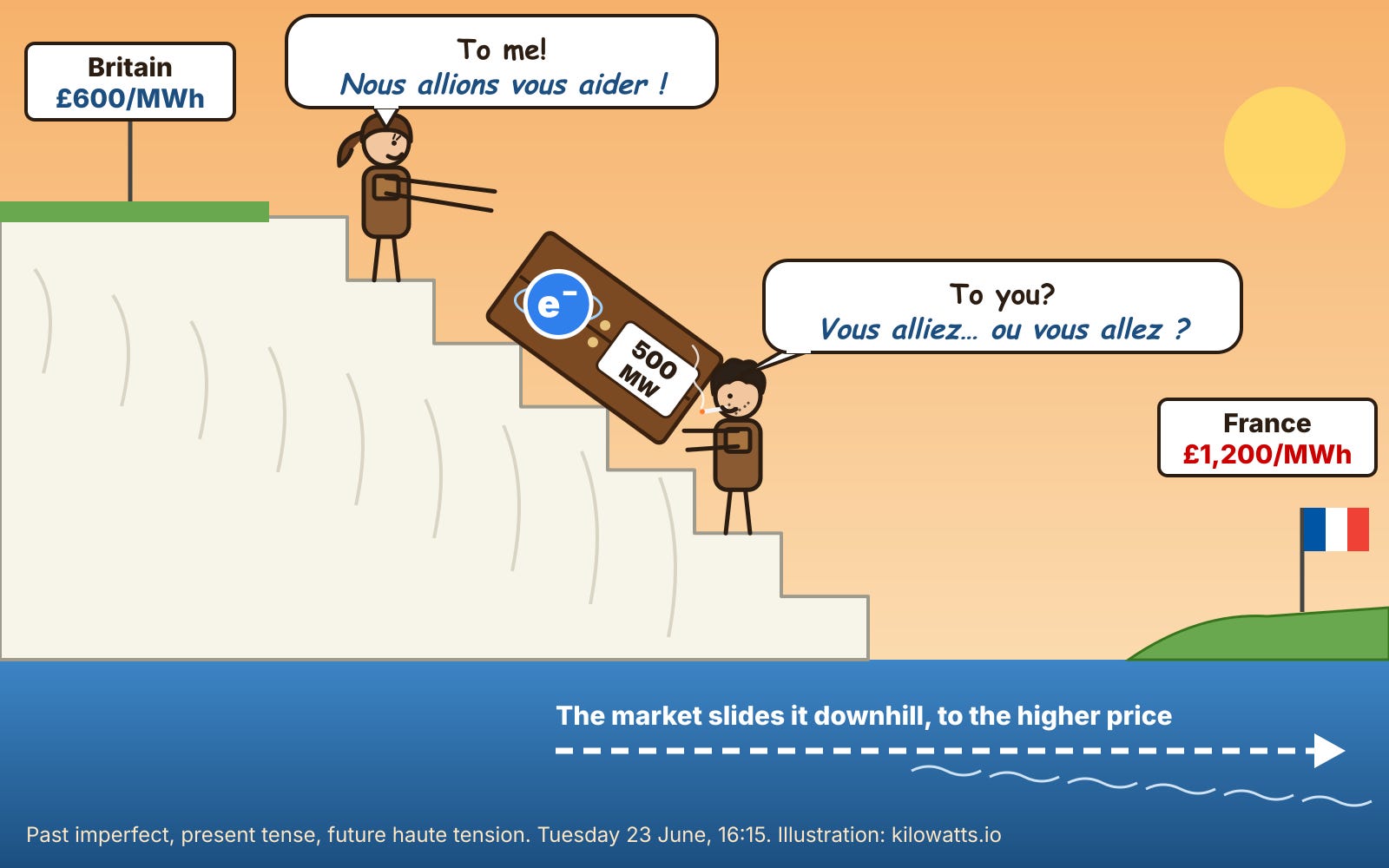
I can't help chuckling at the imperfect. At 16:15 NESO meant nous allions vous aider, "we were going to help you", as in, we won't now. What reached Paris was the other way round. Lost in the Channel. Past imperfect, present tense, future haute tension, which is what the French call high voltage.
France, it turned out, had something up its sleeve. Fittingly, the French call the Channel la Manche: "the sleeve". At 20:00 it played its cards: reactors at Gravelines and on the Rhône already climbing back from the heat, then pumped storage at Grand'Maison and Montézic and reservoir stations across the Alps and the Massif Central, switched on in waves at 20:01, 20:06 and 20:17. About 2.25 GW of French plant came up within the hour, and Britain's frequency recovered in 191 seconds. (I told that story in The Night France Saved the British Grid.)