


It started with a listing. A three-bedroom Passivhaus on Rightmove — the gold standard of low-energy building: triple-glazed, airtight, heat-recovery ventilation, heating bills that round to nothing. It sat near Totnes, in the South Hams, on the market for just under £600,000. And I looked at three numbers. The floor area: 127 m² — a modest three-bed, smaller than plenty of the older houses around it. The energy rating: EPC 104 — an A, off the top of the scale, a home that barely needs heating at all. And the council tax band: E — roughly £3,000 a year.
And I thought what I suspect a lot of people think: whatever this house saves you on energy, it hands straight back to the council.
I was half right — and you don't have to take the anomaly on faith, because the neighbours make it concrete. A few streets away, a conventional 1960s bungalow of much the same size sits in band C. Down the hill, a four-bedroom gas-heated semi — a bigger house — is band C too. The three-bedroom Passivhaus, with the smallest bills of the three, is band E: two rungs above the four-bed. Fewer bedrooms, near-zero heating, more council tax. And in this part of Devon those two bands are worth about £820 a year — roughly what a Passivhaus saves on energy against a gas home. On the running costs, in other words, the tax very nearly eats the saving. My eye had done the arithmetic correctly.
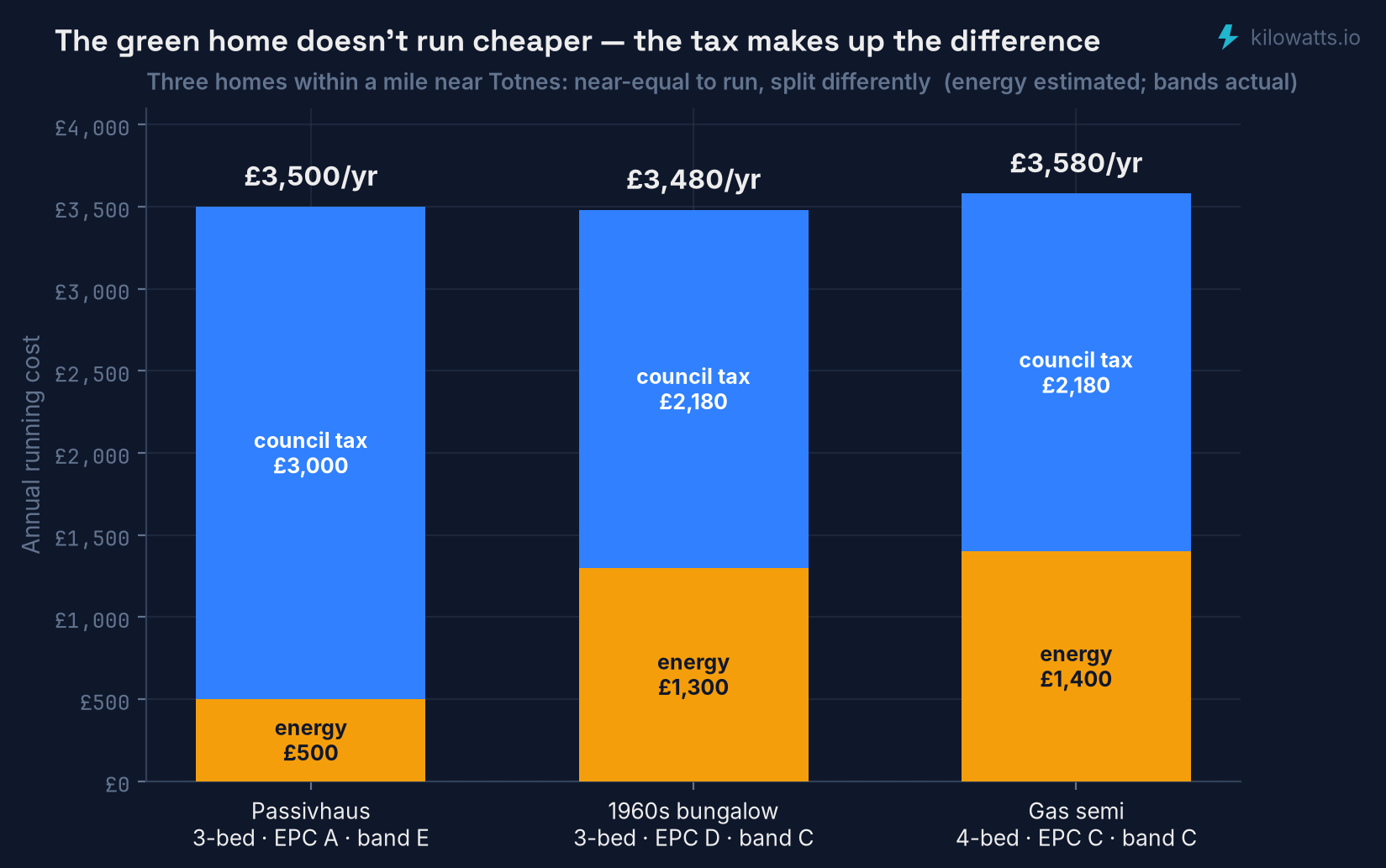
But it had drawn the wrong lesson. The band isn't high because the house is big — it's small. It's high because council tax is a tax on value, and a premium eco-build is worth more per square metre than the tired stock around it. The council tax is real, and on the running costs it genuinely bites — but set against what that house costs to own, it's a rounding error. The number that makes it expensive isn't the band. It's the one I'd glanced past: the £595,000 price.