


Over the summer I kept noticing the same thing in the data: Britain's day-ahead solar forecast expecting more evening sunshine than turned up. That jarred. Earlier in the year, looking at NESO's demand forecasts, I'd seen the opposite. At lunchtime the forecast had been expecting too little sun.
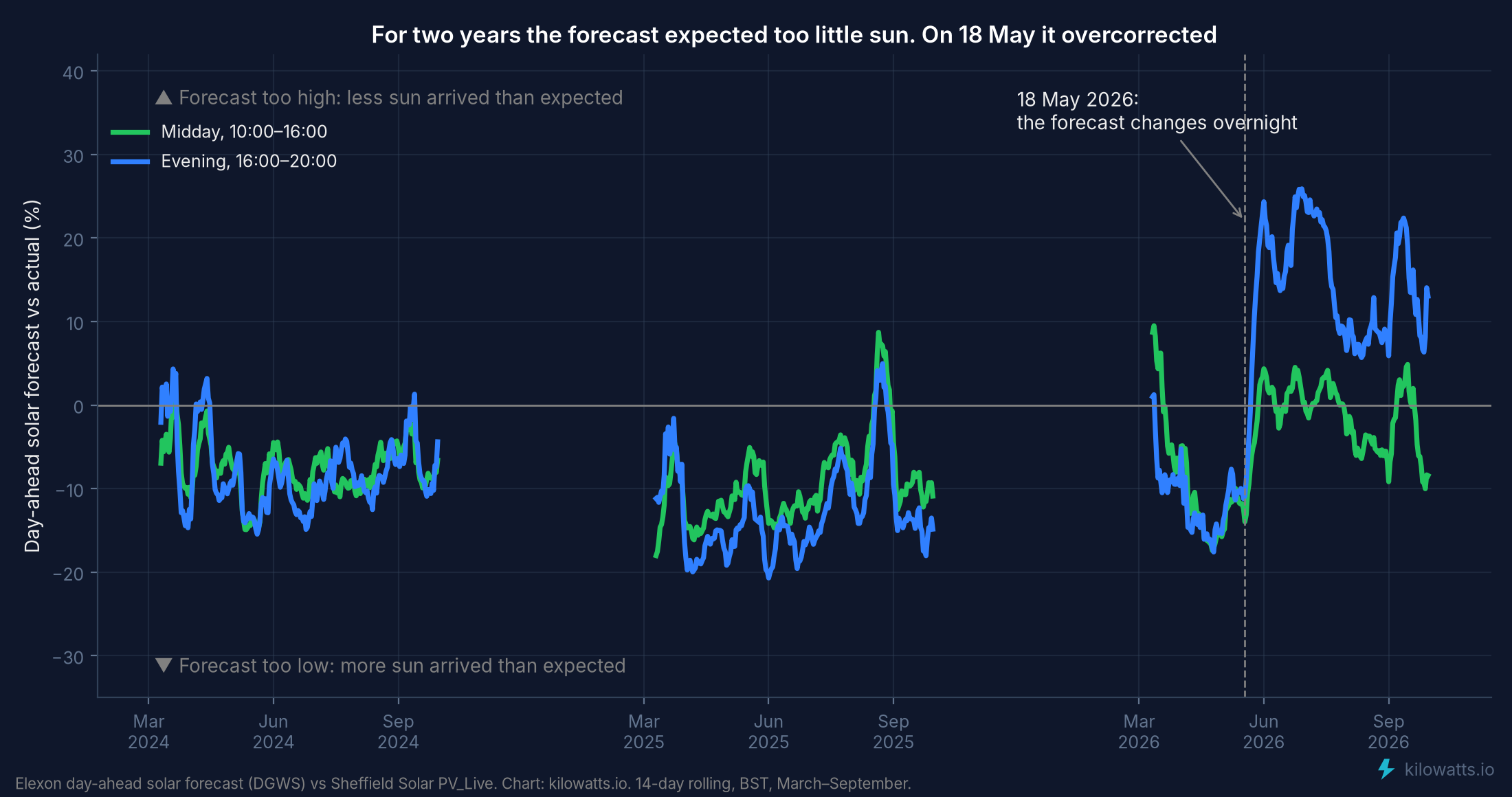
A forecast that leans one way in spring and the other way in summer is worth a second look. So I went back to find out when it had flipped. It hadn't drifted. It changed overnight, on 18 May.
Two years of too little sun
Britain's official day-ahead forecast of solar output is published on Elexon's BMRS, alongside wind. The obvious thing to check it against is Sheffield Solar's PV_Live, which estimates what Britain's panels actually produced, and which NESO itself uses as its measure of solar outturn.
For two years the forecast was cautious. Across 2024 and 2025 it came in below what arrived in every month from March to September, typically by 5–15% over the day as a whole, and usually by most in the evening.
That caution showed up somewhere else, too. National demand, as NESO measures it, is what the transmission grid has to supply, so every rooftop panel shows up as demand that isn't there. Expect too little sun and you expect too much demand. Half-hour by half-hour at lunchtime, NESO's demand forecast missed in step with the solar forecast: for every gigawatt of sunshine the solar forecast failed to expect, demand came in between two-thirds and nine-tenths of a gigawatt below NESO's forecast. That's the lunchtime lean I'd seen in spring.
Overnight
Then, on 18 May, the forecast changed shape.
In the four weeks before, it was simply a bit low all day, by about the same amount morning, noon and evening. In the four weeks after, midday was spot on. The lunchtime shortfall had gone. But the curve had spread out at both ends: 14% too high between 6 and 10am, and 19% too high between 4 and 8pm. Over the whole day it went from about 11% too low to about 8% too high.