


Two dates this week (GTA6 definitely isn’t my poison!). On Thursday, le Beaujolais Nouveau est arrivé ! The new vintage goes on sale at midnight, and wine bars from Lyon to Tokyo pretend it is an event. On Friday, Andy Burnham goes to Brussels for the UK–EU summit, where one of the things still on the table is whether young Britons will be allowed to do what I did at nineteen: turn up in France and pick grapes.
This year's grapes were picked in August. The harvest began on 13 August, the earliest start on record, a day ahead of the heatwave summer of 2003.
I want to be clear about how much that floored me. Le Beaujolais nouveau est arrivé; en Beaujolais, j'ai vendangé. I picked grapes there as a student, in 2008 and 2009. In 2008 the harvest opened on 15 September, which felt about right: September was harvest month. In 2009 it opened on 27 August, and everyone treated that as freakish. It was a hot year, a celebrated vintage, the kind of thing the old hands said they'd never seen. This year's harvest opened two weeks earlier than that, and a full month earlier than my first.
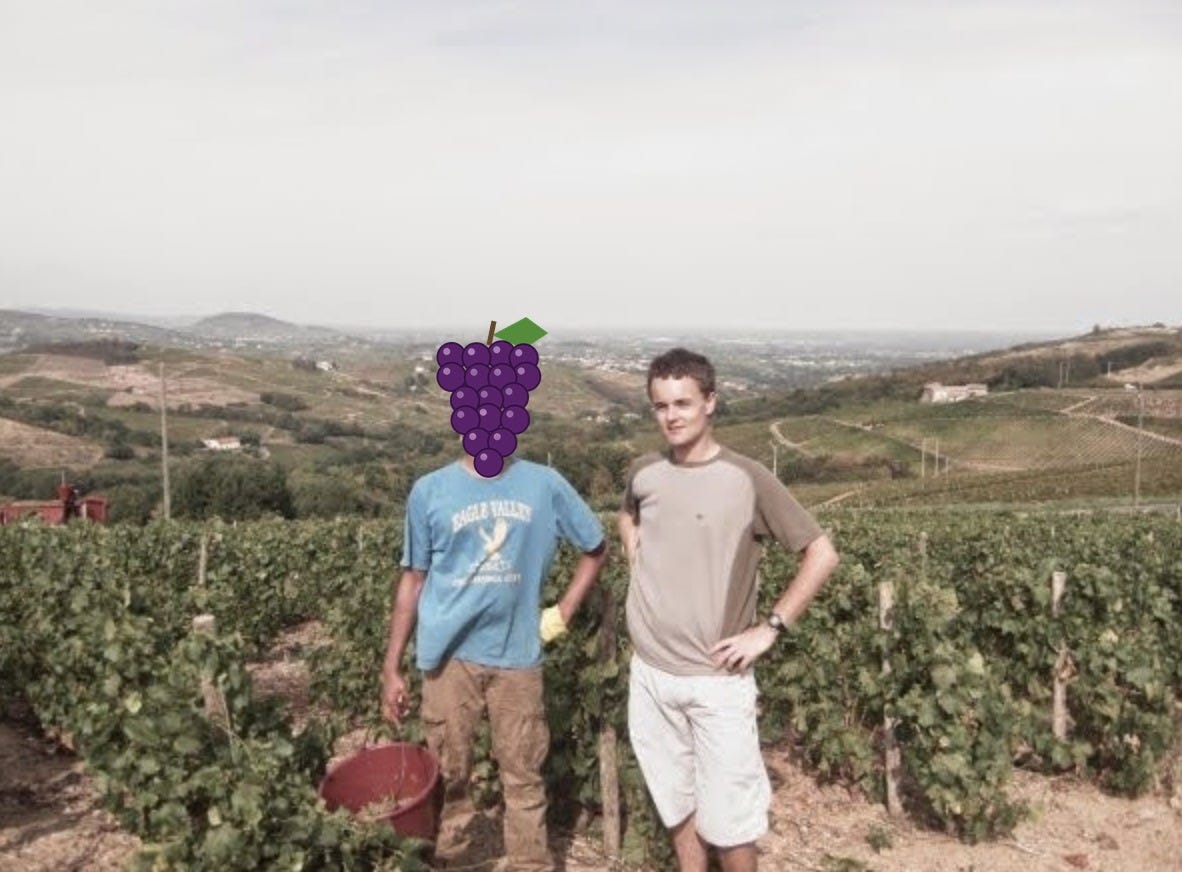
That I was there at all was thanks to the European Union. In 2008 a British student could pitch up at a French vineyard with a passport and start work the next morning: no visa, no permit, no sponsor. Free movement made the vendange a rite of passage for thousands of us. Brexit ended it. Today the vineyard would first have to get me a French work permit, which takes two to four months. Friday's summit is about whether some version of the old freedom comes back.
I had planned to mark the occasion properly, with an electric revival of the old Beaujolais Run, the 1970s race to get the first bottles back to London. The charging network was ready. Brittany Ferries was not: no sailings from Plymouth until March. Quel dommage.
So instead I did what any self-respecting energy analyst does with a free weekend: I downloaded 75 years of weather. I wanted to answer two questions for my son, who is five. Will he be allowed to pick grapes in France when he's twenty? That's Brussels's call. And will he need to? That one, it turns out, is the weather's.
Three weeks earlier
The Beaujolais harvest has records going back centuries. For the modern era I've combined the long historical series compiled by Daux and colleagues with official start dates, and filled the gaps with a simple model that converts the warmth of each growing season into a picking date. It tracks the official dates closely (r = 0.85).
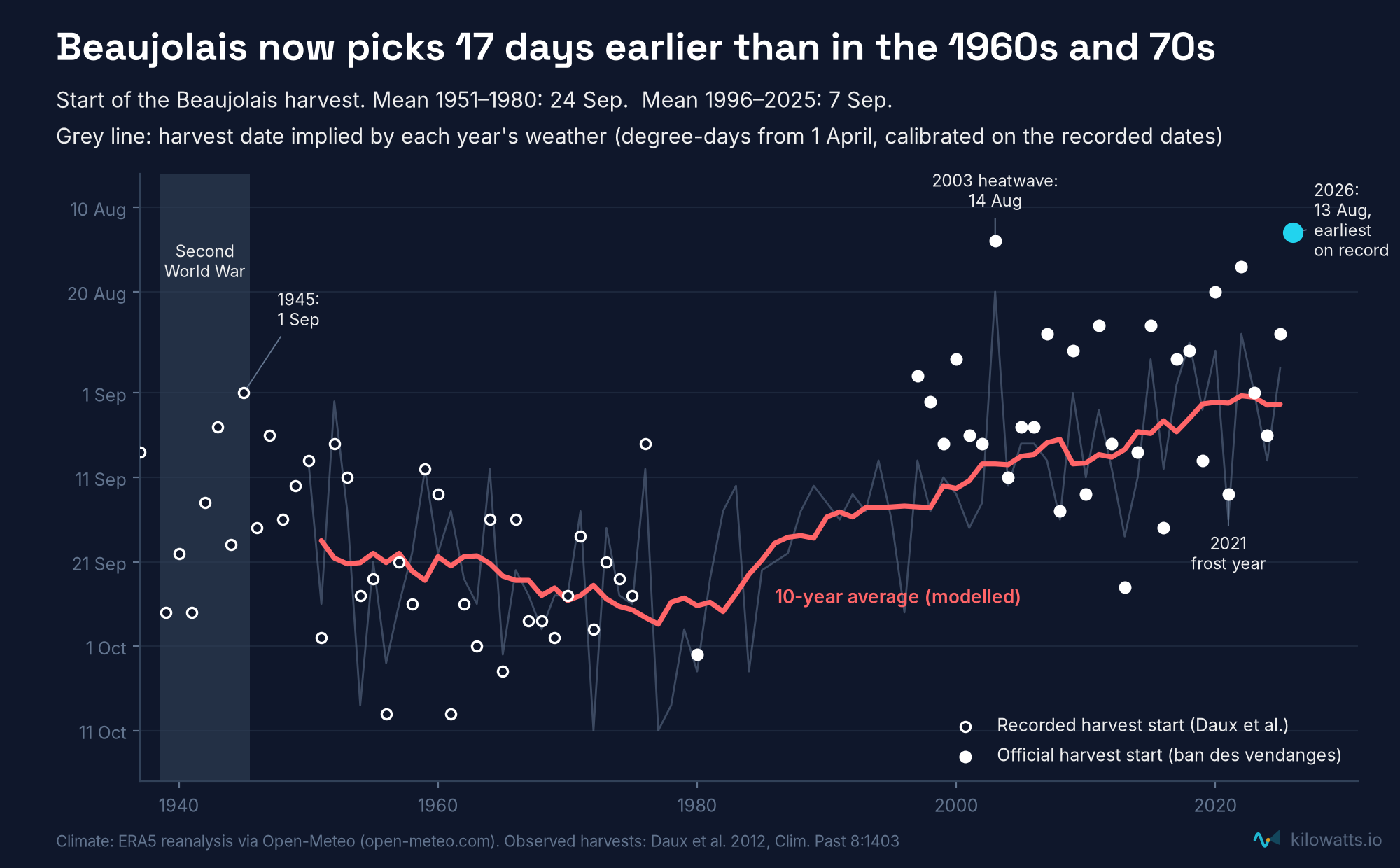
In 1951–80 the Beaujolais harvest started, on average, around 24 September. Over the past thirty years it has been around 7 September, and over the past decade around 2 September. That's three weeks in a generation. In 2020, 2022, 2025 and now 2026 it began in August.
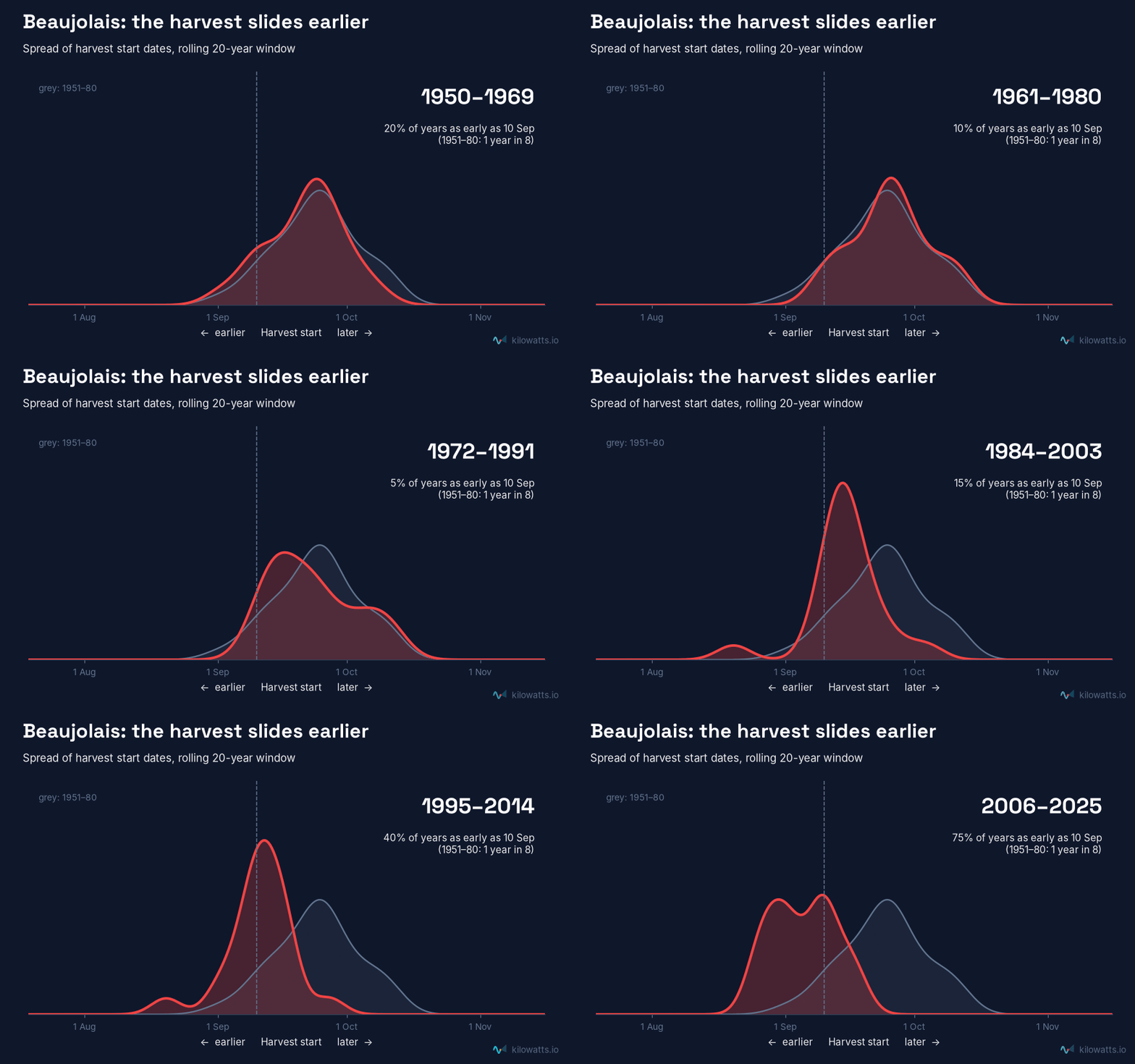
The shift in the average is only half the story. What used to be a freak is now the norm. An early harvest, the kind that came about one year in eight in the 1950s–70s, now comes in roughly three years out of four.
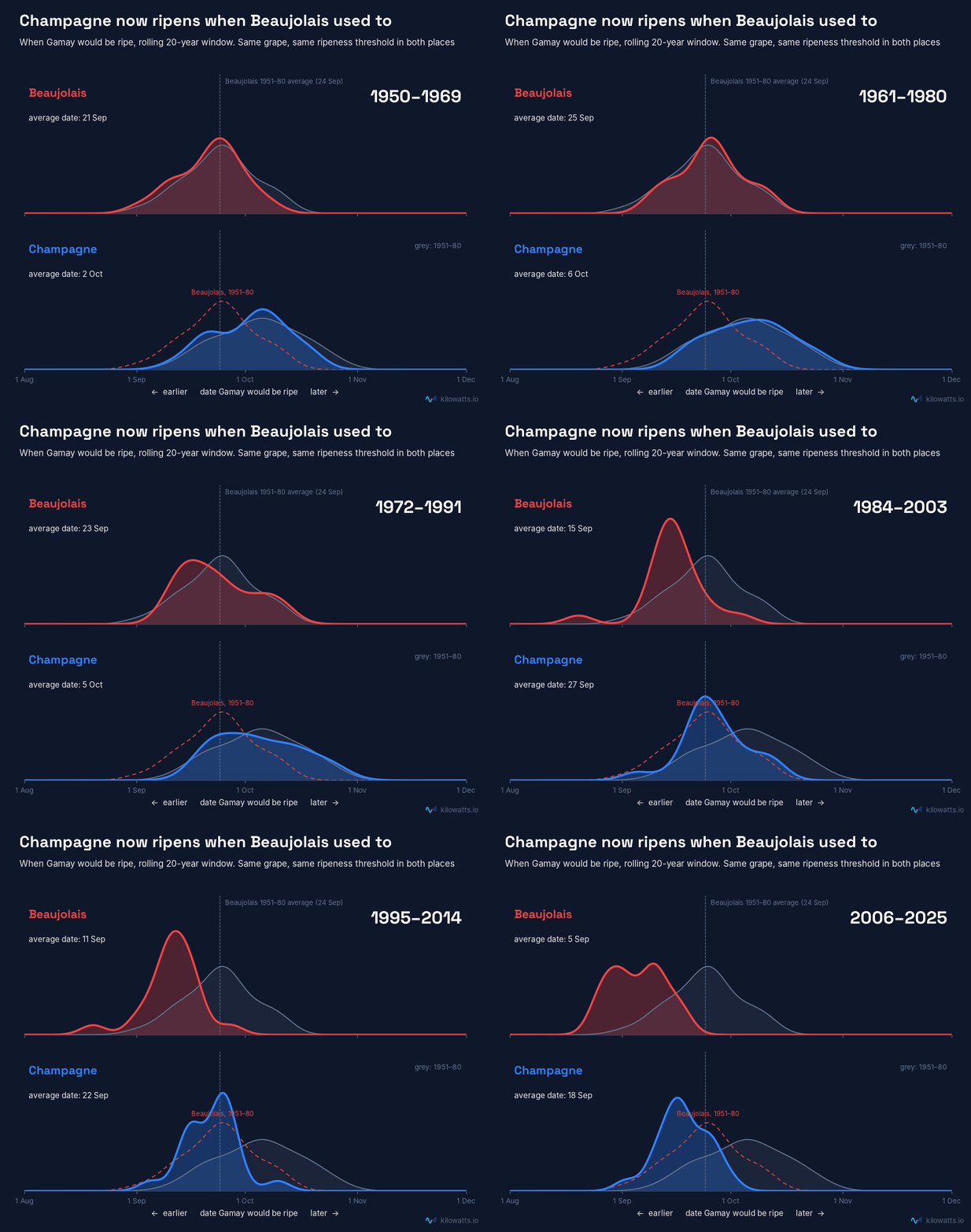
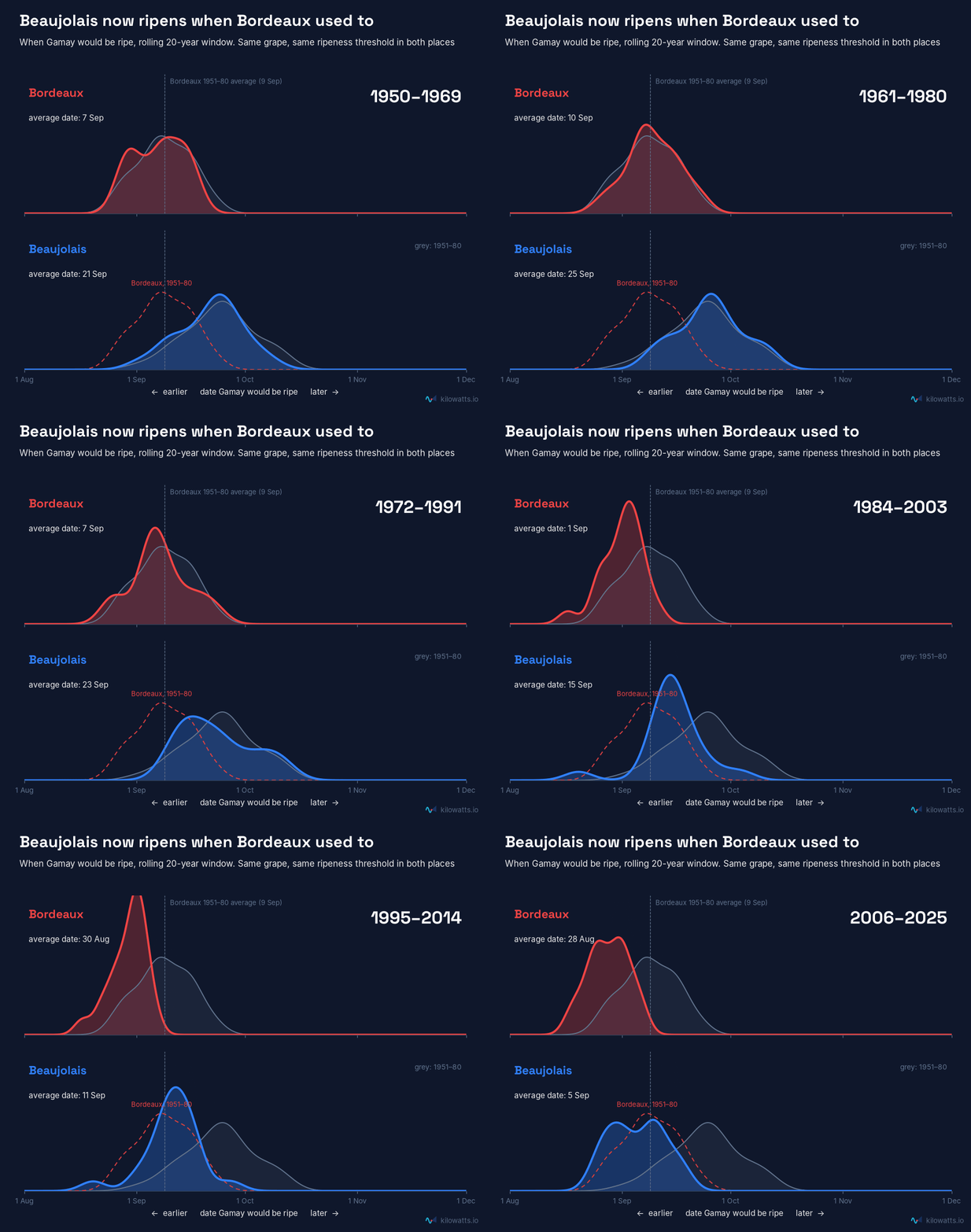
The animation below shows it happening. Each frame is a rolling 20-year window, and the curve shows how likely the harvest is to start on each date. The dashed outline is the 1950s–70s. Watch the hump slide left, into August.
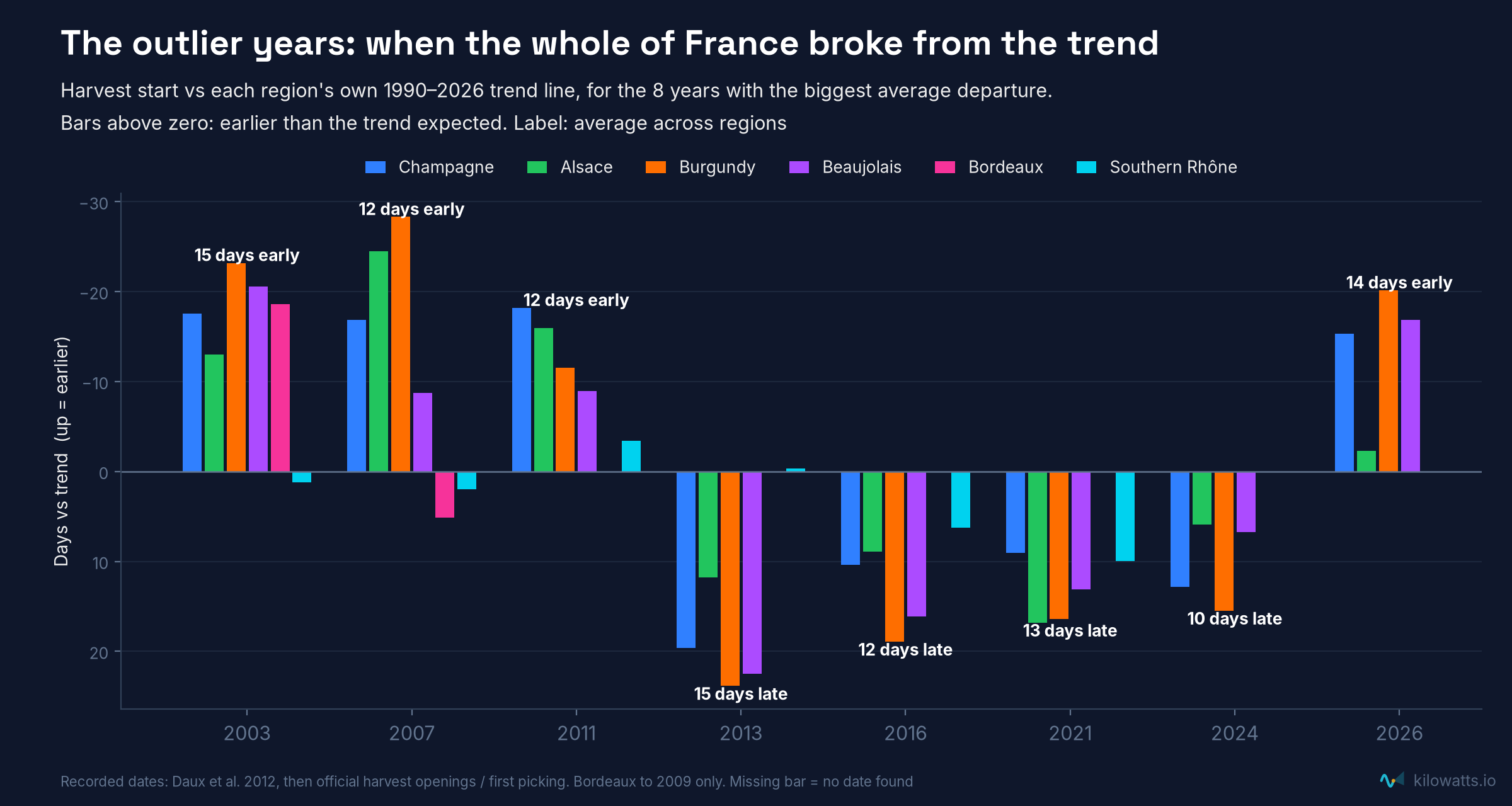
And when a freak year comes, it hits the whole country at once. Measured against each region's own trend, this year was almost as far out as the heatwave of 2003: about two weeks early on average.
Why I chose the Beaujolais
Free movement meant I could pick anywhere in France, so the choice came down to the calendar, not the wine. Go south, to the Rhône or the Languedoc, and the harvest was in August, in heat that was punishing even then. Go north, to Champagne, and you'd be picking in October in the rain, and missing the start of the university term. The Beaujolais sat in the middle: September, just right.
That north–south ladder still exists, but every rung has slipped. Across France the harvest now starts about 16 days earlier than in 1951–80, from 13 days in Bordeaux to 22 in Alsace.
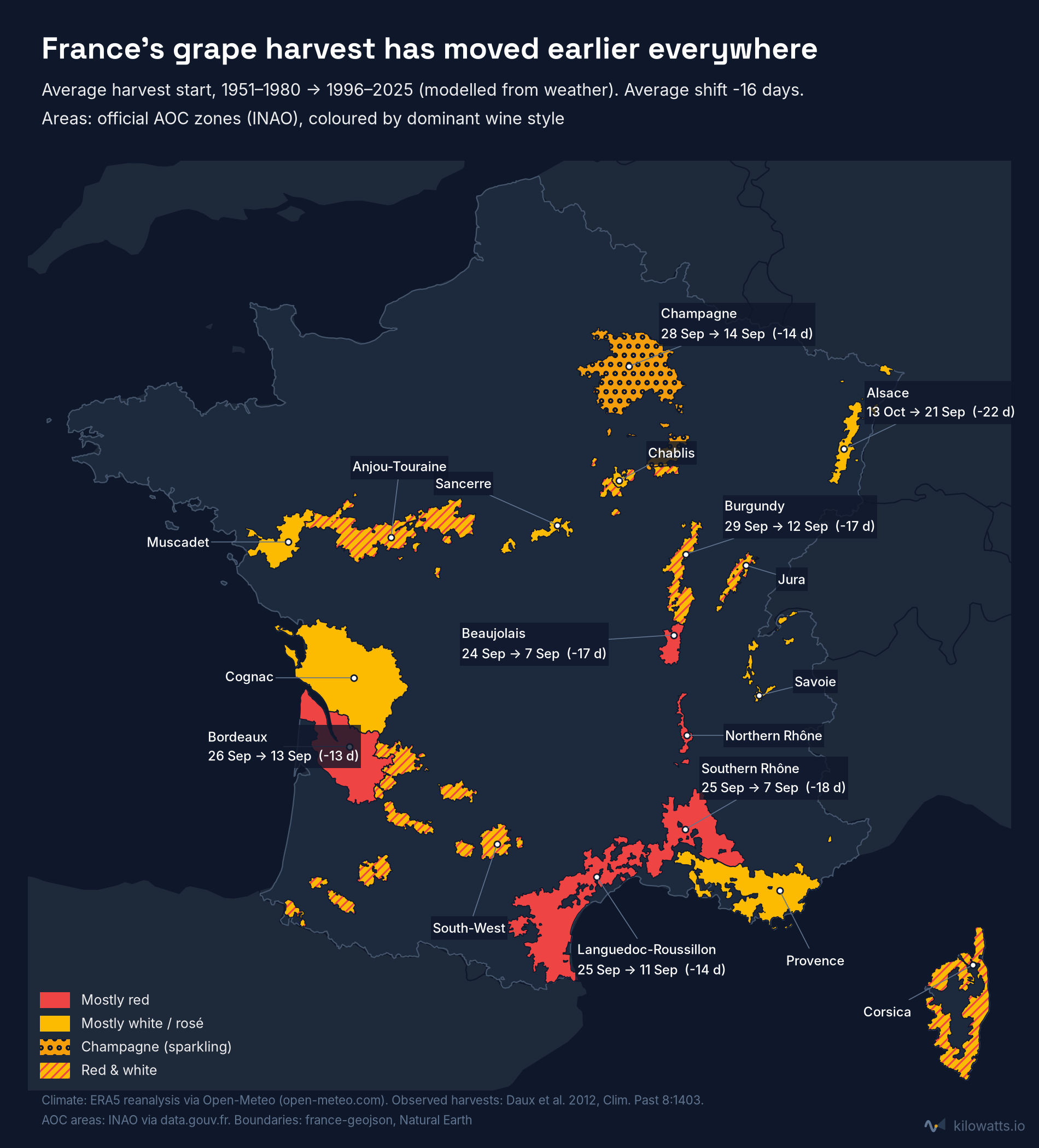
That option has gone. This year Champagne opened on 8 August, its earliest ever and five days before the Beaujolais. In Bordeaux the first grapes were in by 6 August. In the Languedoc, one Fitou estate picked its first Muscat on 15 July. A student today could pick in Champagne and be home with weeks to spare before term.
Run the same ripening clock in both places and you can watch it happen. Champagne's grapes now ripen when the Beaujolais's used to, a week earlier in fact.
And the Beaujolais has moved into the slot that used to belong to the south-west. It now ripens on the calendar Bordeaux kept in the 1950s–70s.
It's the same picture in every region. Burgundy, Alsace, the Southern Rhône and the Languedoc have all slid the same way.
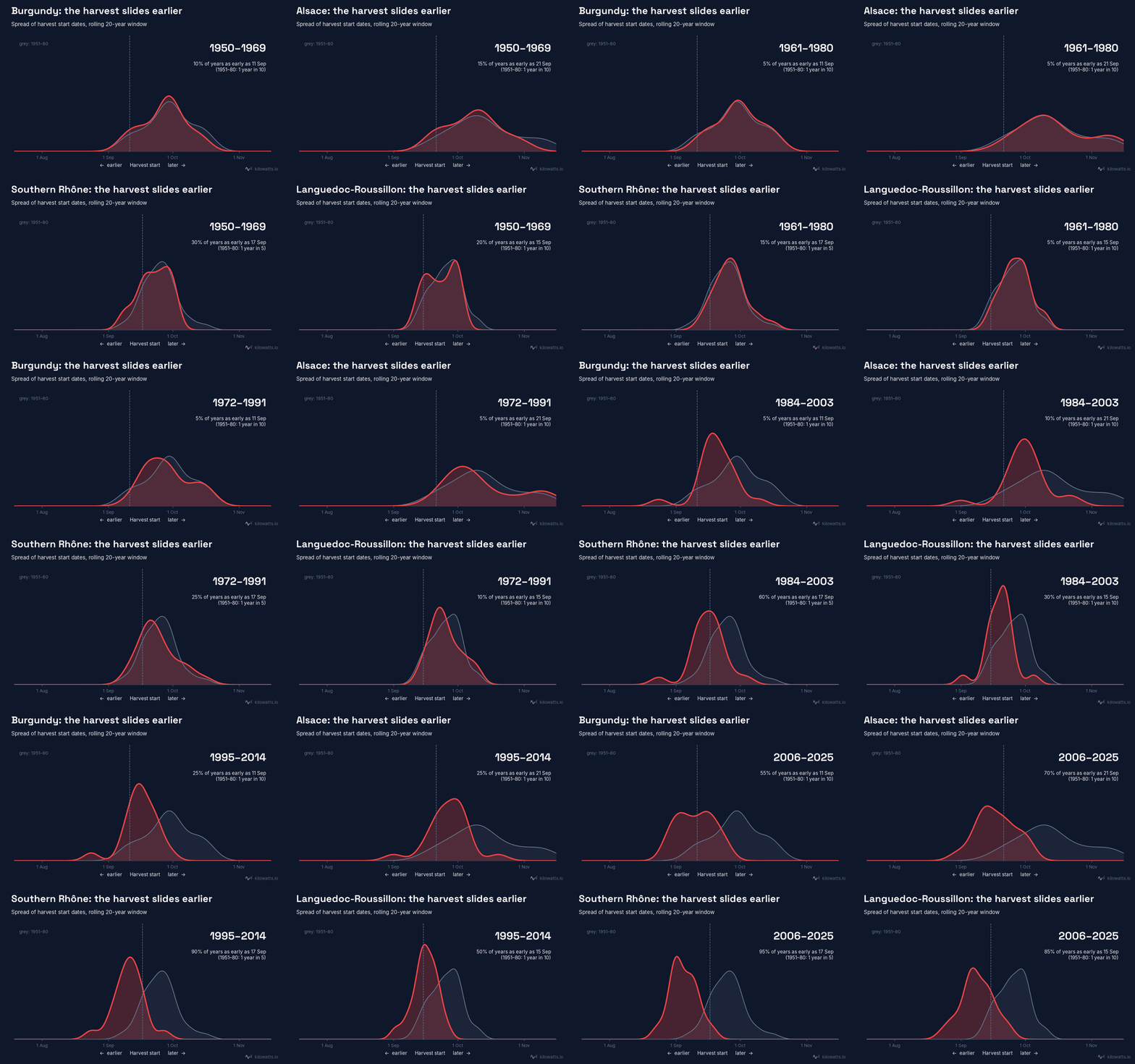
Those animations use a model. The recorded dates, region by region, tell the same story.
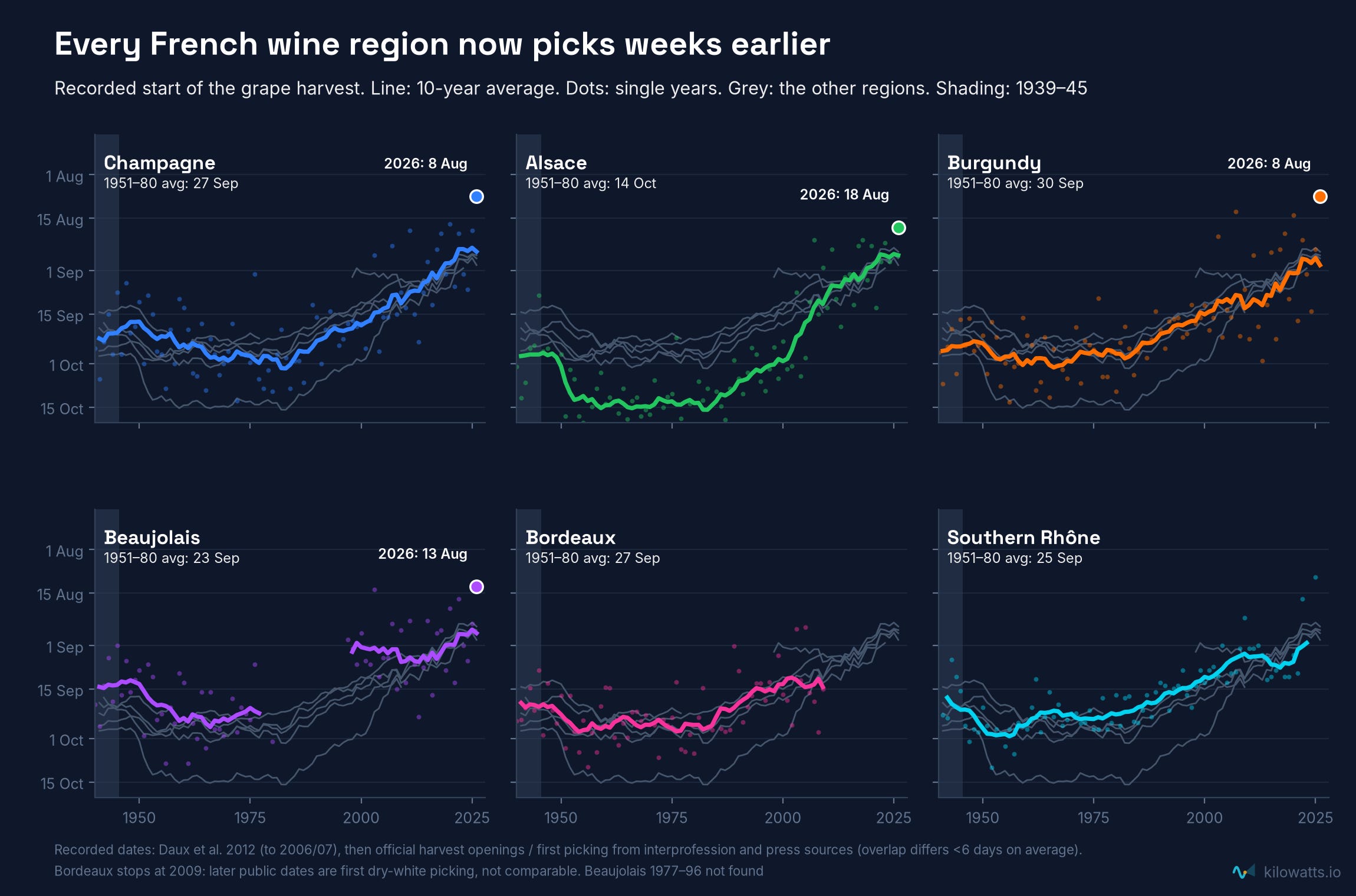
It isn't only France. In 2026 Penedès, where most Cava is made, started picking on 22 July, its earliest ever. Franciacorta, Italy's answer to Champagne, had its first July start. Ribera del Duero began on 18 August, its earliest on record; in 2007 it began on 27 September.
The harvest she hid
I nearly didn't make it to the end of my own harvest. Early on the pickers invited me to a cuite. I assumed this was some cousin of cueillette, the picking, a harvest gathering of some kind. It is in fact French for getting thoroughly drunk, which I learned by doing it. I was given the next morning off to recover, which in practice meant peeling onions with the family's grandmother in the workers' kitchen while she fed me something sugary as a cure. I recommend it. I've used it ever since.
I'd also lost my phone. My parents had recently divorced and I couldn't remember either of their new numbers, so I rang the one number I did know by heart: my grandmother's. She took it all in her stride. And when the grandmother of the vineyard heard I'd been speaking to mine, she started talking about the war.
What I remember most is a refrain. Whatever the story, rationing, hiding the harvest, Jews hidden nearby, Allied airmen passed along towards Switzerland, it kept coming back to the same line: « Les Allemands sont encore venus au domaine, et ils ont encore pris du vin. » The Germans came to the estate again, and they took more wine. And she talked about the shortage of hands: the men were away or in camps, the people left were exhausted and underfed, and rows of grapes were simply left on the vine.
(To be fair to the 1940s, they were a warm decade, warmer than the 1960s and 70s that make the usual baseline. Against the war years, today's harvest is about two weeks earlier, not three.)
A vine is a degree-day meter
If you work in energy, you already know the unit that explains all this.
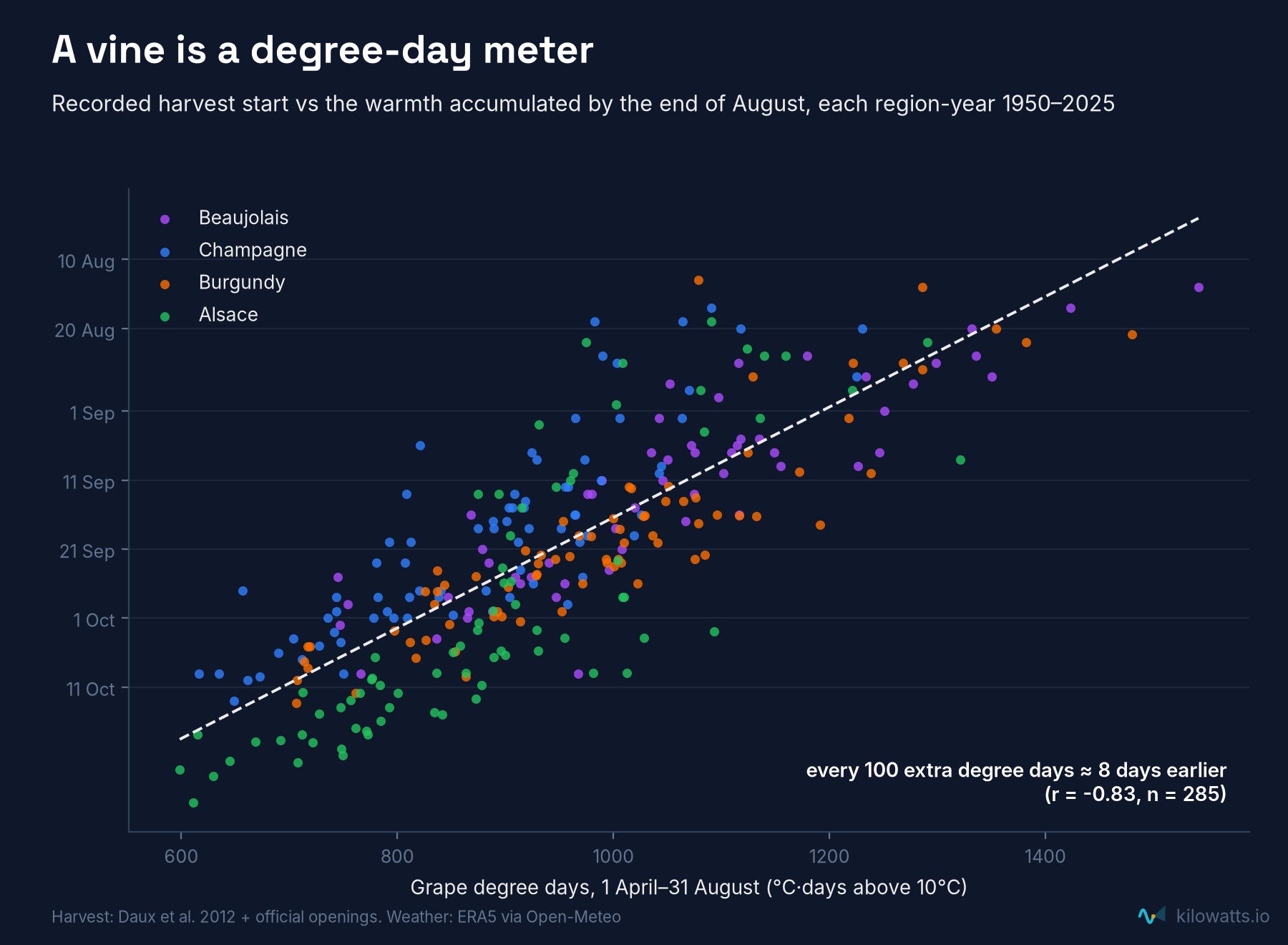
Heating engineers count degree days: how many degrees, for how many days, the weather sits below a comfortable indoor temperature. That's how much heating a building needs. Viticulturists count exactly the same thing in the other direction: how many degrees, for how many days, the weather sits above 10°C, the temperature at which a vine gets going. A vine is, in effect, a cooling-degree-day meter that pays out in sugar.
And it is a remarkably good meter. Plot the recorded harvest date against the degree days accumulated by the end of August, across the Beaujolais, Champagne, Burgundy and Alsace since 1950, and the relationship is tight: every extra 100 degree days brings the harvest about 8 days earlier.
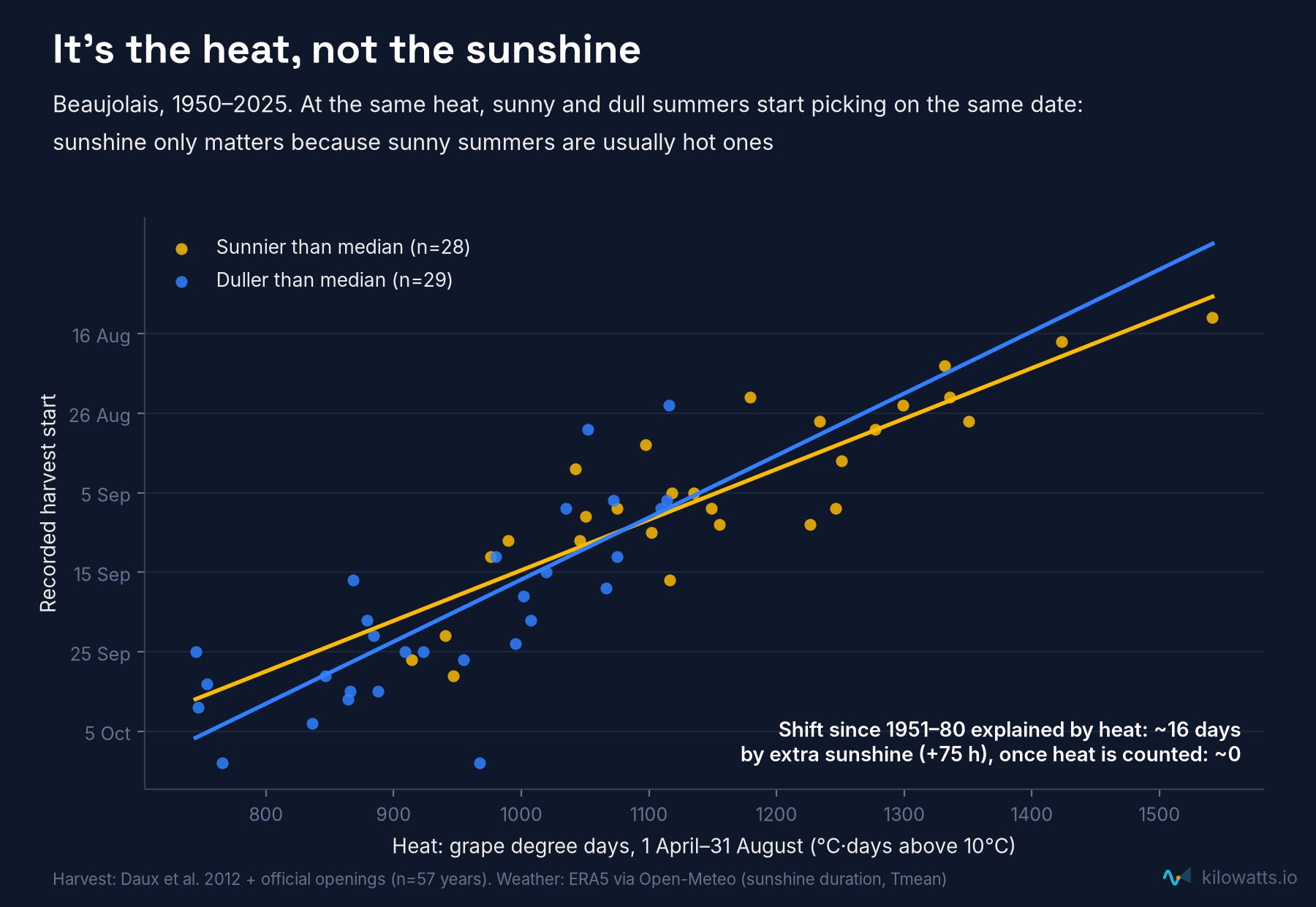
So is it the heat or the sunshine? Solar people will know that Europe has got sunnier since the 1980s, as cleaner air let more light through, and the Beaujolais growing season now gets about 75 more hours of sun than it did in the 1950s–70s. It's tempting to credit that. But split the years into sunny and dull summers and line them up by heat, and they fall on the same line. At the same warmth, a sunny summer and a dull one start picking on the same date. Sunshine matters only because sunny summers are usually hot ones. Heat alone accounts for essentially all of the 16-day shift. The vine is a thermometer, not a solar panel.
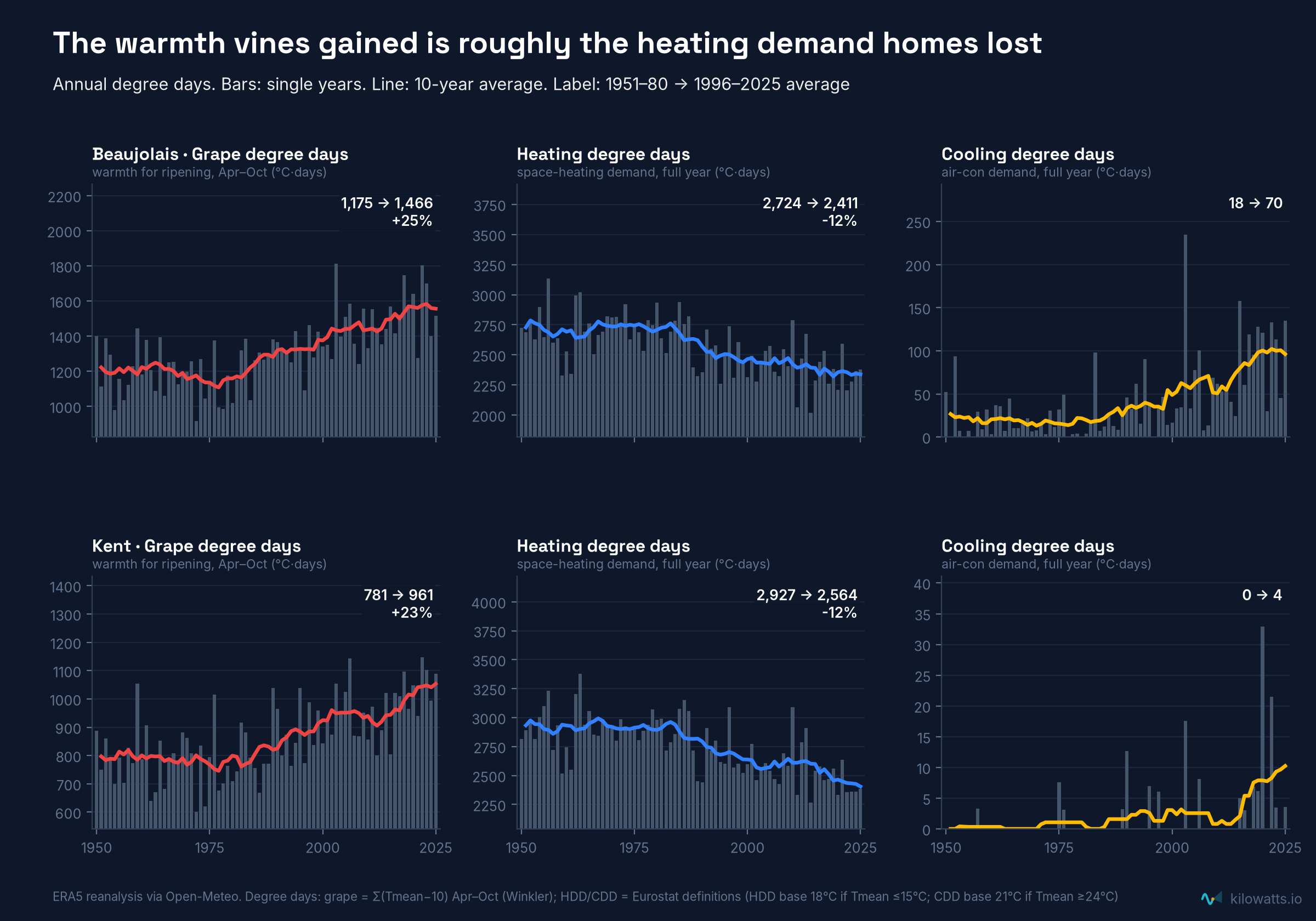
The same warming shows up on the other side of the energy ledger. Between 1951–80 and 1996–2025, the grape degree days in the Beaujolais rose by a quarter, and the heating degree days, the measure of space-heating demand, fell by about 12%. In Kent the pattern is almost identical: grape warmth up 23%, heating demand down 12%. Kent's cooling demand is still close to zero. There, warming shows up as less heating, not more air-conditioning, and as riper grapes.
Earlier, and smaller
Earlier doesn't mean more. The Beaujolais has roughly halved in a generation, from about 24,000 hectares of vines in 2004 to 12,093 in 2024. Most of that is the market, not the weather: the Nouveau craze faded, and growers pulled up vines, some of them with public money. But yields have fallen too, from 52–58 hectolitres per hectare in the 1970s to about 40 now. Weather drives the swings: 58 hectolitres per hectare in 2018, 40 in 2024.
This year brought the earliest start on record and a short crop. Hail, wind and downpours on 28 June and 16 July damaged around 4,000 hectares, and in September the official estimate put the harvest a third below average.
My instinct was that it hails more than it used to. The evidence is more interesting. France's hail-pad network, mostly in the south-west, doesn't show more hailstorms; if anything, slightly fewer. What it does show is bigger hail: stones of 3–4 cm are up about a third. And insured losses have soared: hail and storms in the summer of 2022 alone cost French insurers €6.4bn. Hail isn't getting more frequent. It's getting bigger, and more expensive.
Move Nouveau Day
Here's a rule that hasn't kept up. Nouveau has been released on 15 November since 1967, and on the third Thursday of November since 1985. When the date was set, picking began in late September, so the wine waited about eight weeks between the first grapes and the first glass. In the past decade it has waited about eleven weeks.
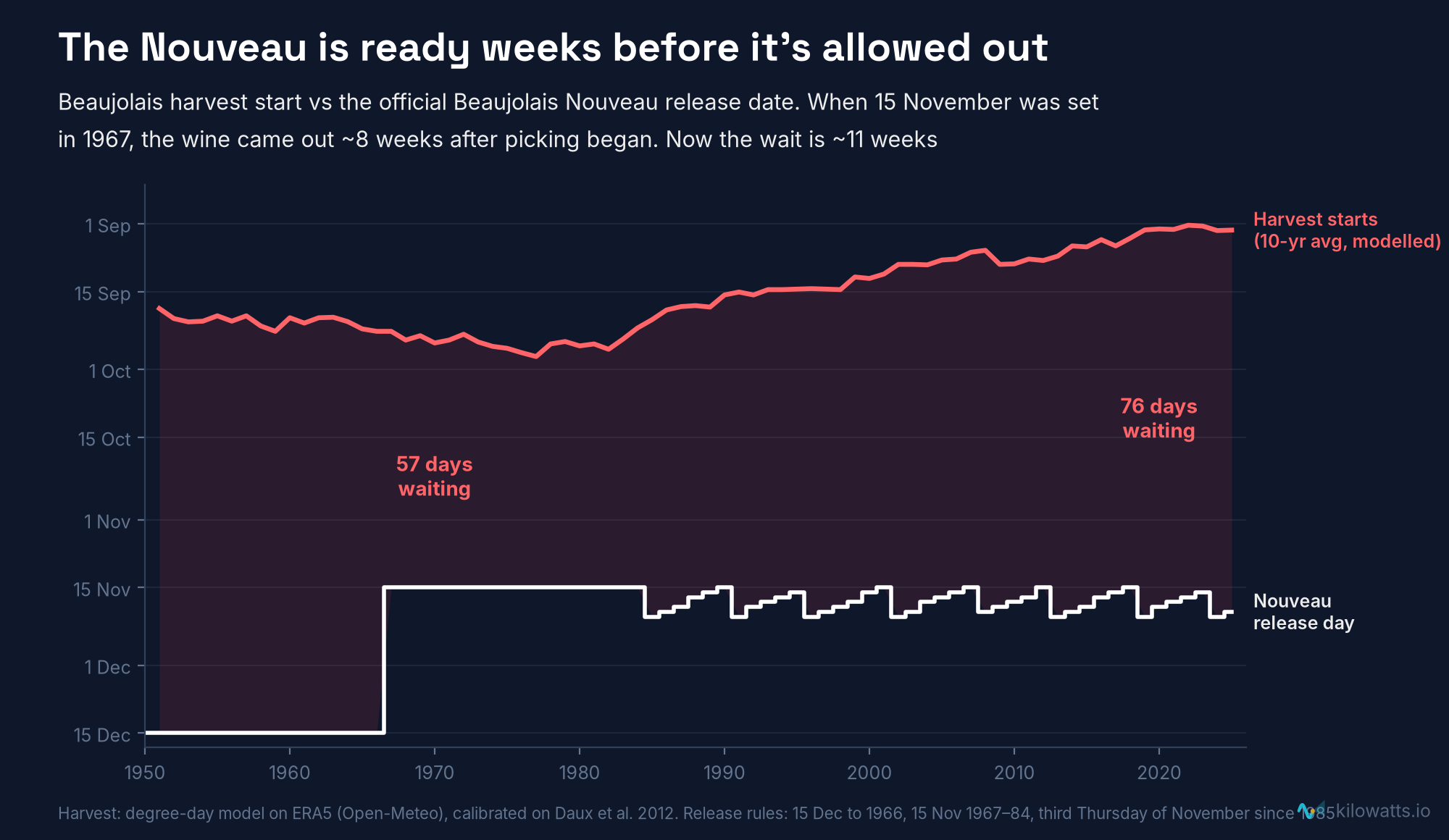
If you wanted to keep the original eight-week gap, the release would move to the fourth Thursday of October. That's always the Thursday before the clocks go back, which gives it a slogan: Nouveau ends summer time.
The 1996–2025 average harvest puts the equivalent release date at 28 October, which is very nearly 31 October: Halloween.
Then again, a cynic would say: leave it alone. Every year the harvest creeps earlier and the release date stays put, so every vintage of Nouveau gets a little older before anyone drinks it. Critics have spent decades sneering that Nouveau isn't proper wine. Climate change may be quietly fixing that, turning nouveau into something more like ancien by stealth. The one wine designed not to age is being aged by the weather.
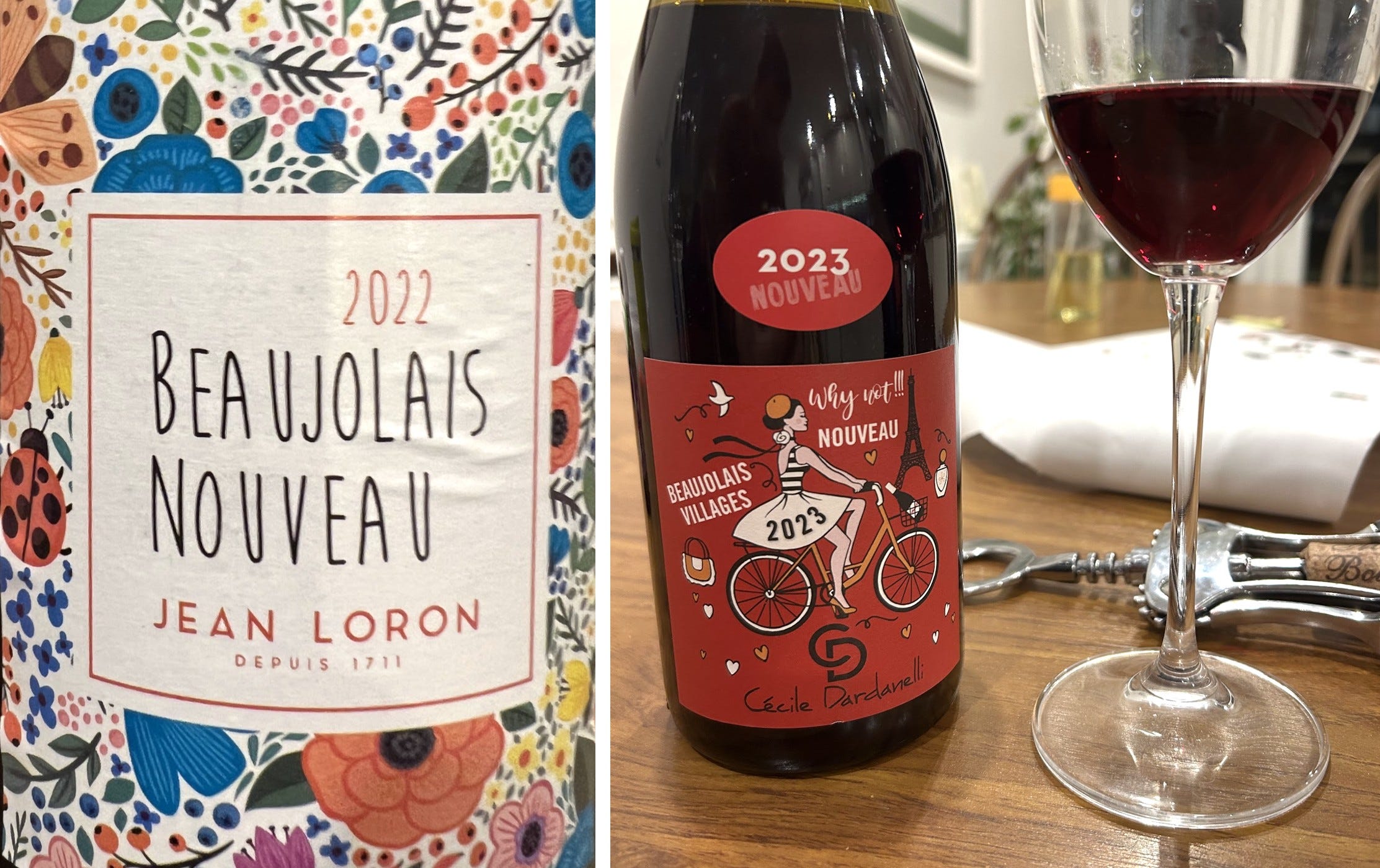
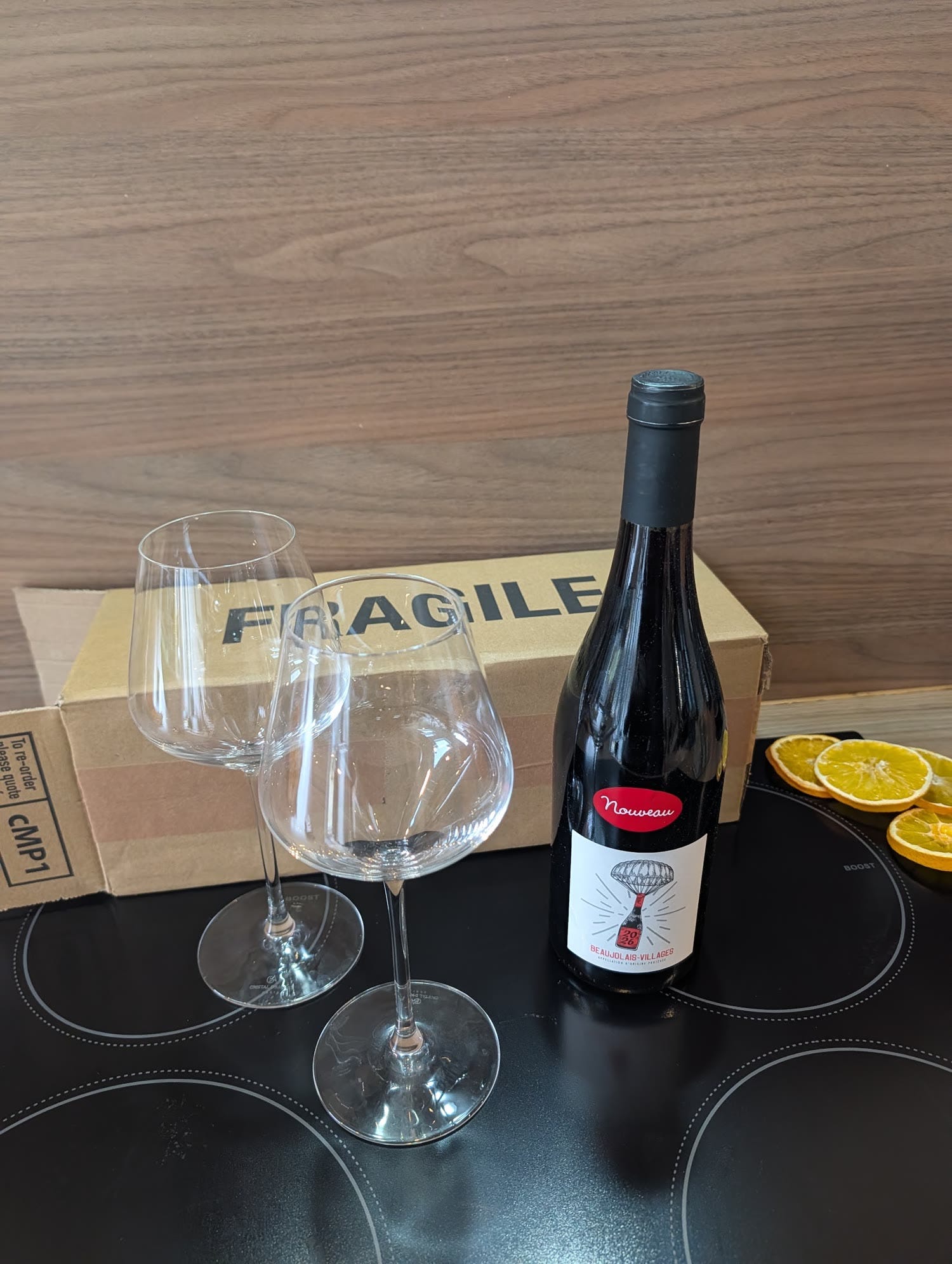
And the 2026? Mine is already here. It turned up on Wednesday, a full day before anyone is allowed to sell it, so for a few hours I have contraband on the kitchen counter. Its grapes started coming in on 13 August and it goes on sale on 19 November: fourteen weeks to the day. The early word from France is that it's a sunny one: ripe, generous, full of red fruit, and there isn't much of it. I'll report back. After midnight, obviously.
Kent is the new Beaujolais
My wife's family is from Kent, and I like to tell my in-laws that Kent is basically France. The data is starting to back me up.
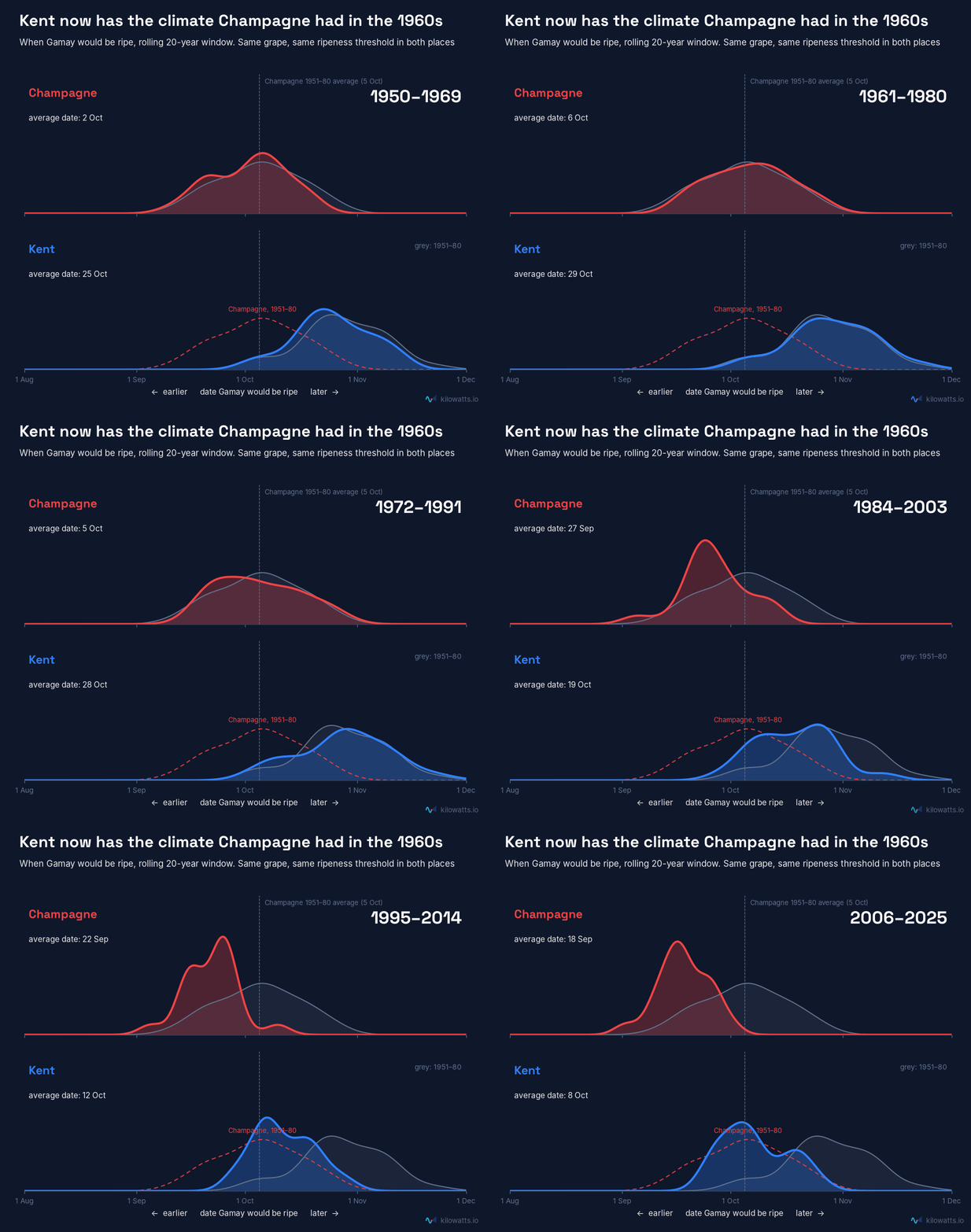
You've probably heard that Kent is the new Champagne. That's already true, and not just because Taittinger, the Champagne house, has planted vines there. Run the same ripening model for Kent and Champagne, and Kent's climate over the past two decades is a near-perfect match for Champagne's in the 1950s–70s. In the 1950s–70s, a Beaujolais grape planted in Kent would only have ripened before Halloween in three years out of five. Over the past decade it would have managed it every year. This year Gusbourne, in Kent, began picking on 26 August.
It isn't only Kent. West Sussex, home to many of England's best-known sparkling wine estates, has followed the same path.
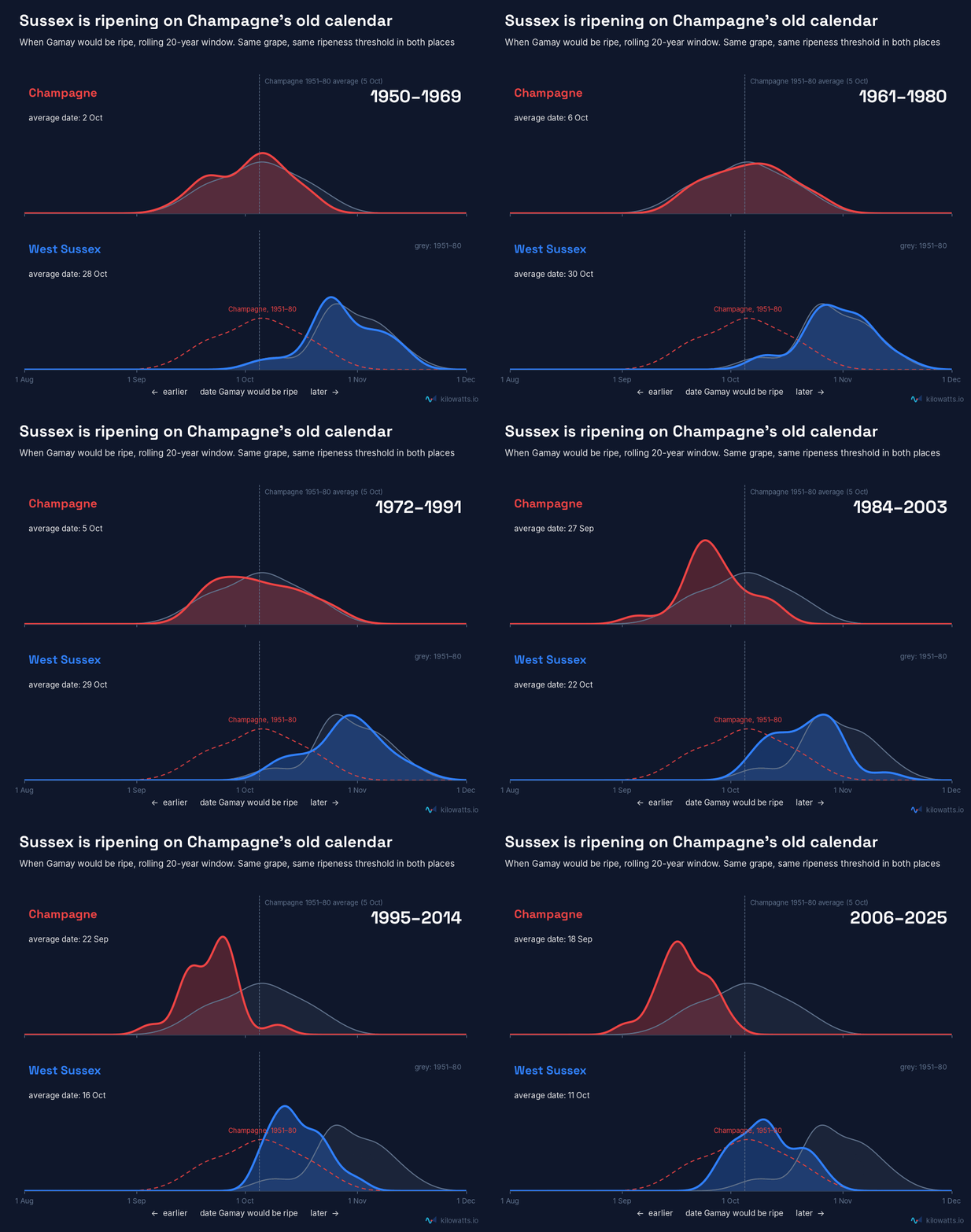
So the new Champagne is old news. The real stretch is the next step: the Beaujolais, about 600 km further south. Kent isn't there yet. No year since 2015 has been as warm as an average Beaujolais year was in the 1950s–70s, and Kent's typical ripening date is still about nine days behind. But on current trends it gets there somewhere between the late 2030s and the late 2040s. That's around 2041, when my son turns twenty.
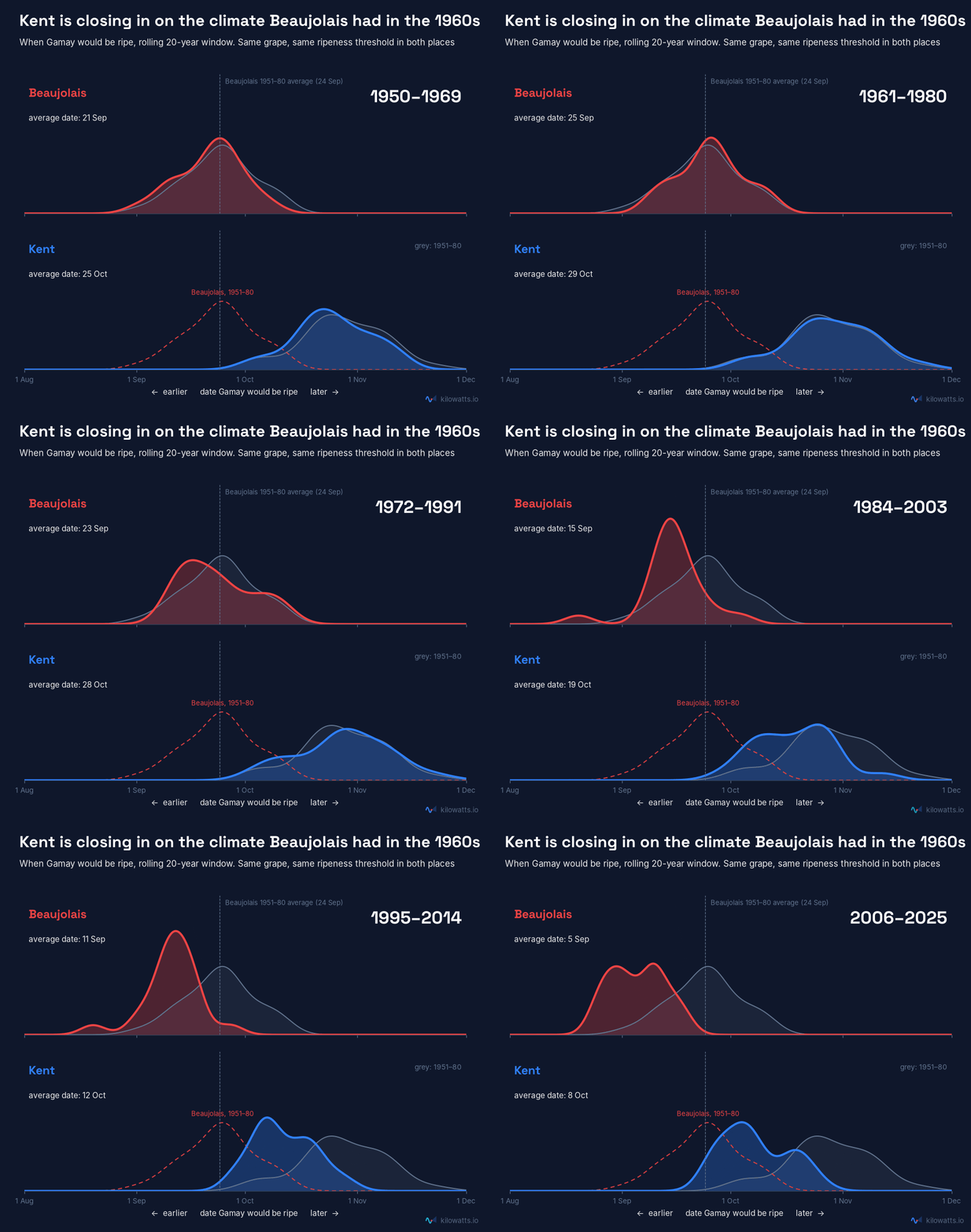
Kent is the new Beaujolais, then. Except it's white, not red. Mostly it's sparkling, made from Chardonnay plus two red grapes, Pinot noir and Pinot Meunier, pressed pale. So give it time.
The vineyards are moving too. England and Wales had 761 hectares of vines in 2004 and 4,841 in 2024, while the Beaujolais shrank. If both trends simply continued, which they won't exactly, England's vineyard area would pass the Beaujolais's in the early 2030s.
Kent has done this before. For about a century, until the machines took over in the 1950s and 60s, tens of thousands of families from east and south London decamped to the Kent hop gardens every late summer for "hopping": a working holiday of picking by day and sing-songs by night. My wife's forebears almost certainly did it. But the September picking holiday in Kent might just stage a comeback, with grapes instead of hops.
Which brings me back to Friday. The fix on the table in Brussels is a UK–EU youth experience scheme, letting 18-to-30-year-olds live and work in each other's countries. In May last year the two sides agreed to work towards one. This month's reports say a deal is close and could be announced at the summit, with tuition fees, a cap on numbers and the NHS surcharge the last sticking points. If it fails, the Beaujolais harvest stays off limits to my son's generation, whatever the weather does. If it succeeds, he'll have the choice I had.
Either way, when my son is old enough to go picking, he may not need to go to France at all. He can go to Kent, where his mother's family comes from, and be back before term starts. And by then the electric Beaujolais Run will be easy: drive to Kent, and stop before Dover.
Quel ramassage.
Method: daily weather from the ERA5 reanalysis via Open-Meteo, 1950–2025. Historical harvest dates from Daux et al. (2012), extended with official and producer-reported start dates. The harvest model accumulates degree days above 0°C from 1 April and is calibrated for each region against recorded dates. Kent and other regions without long records use the Beaujolais calibration, which asks when a Gamay vine would ripen there. Degree days for buildings use Eurostat definitions. Production data from French customs harvest declarations and Agreste; hail trends from the ANELFA hail-pad network. European brightening: Wild (2009), Journal of Geophysical Research 114, D00D16.
I was excited to have my first Pinot Noir from Kent. Got it home and it was corked. :(