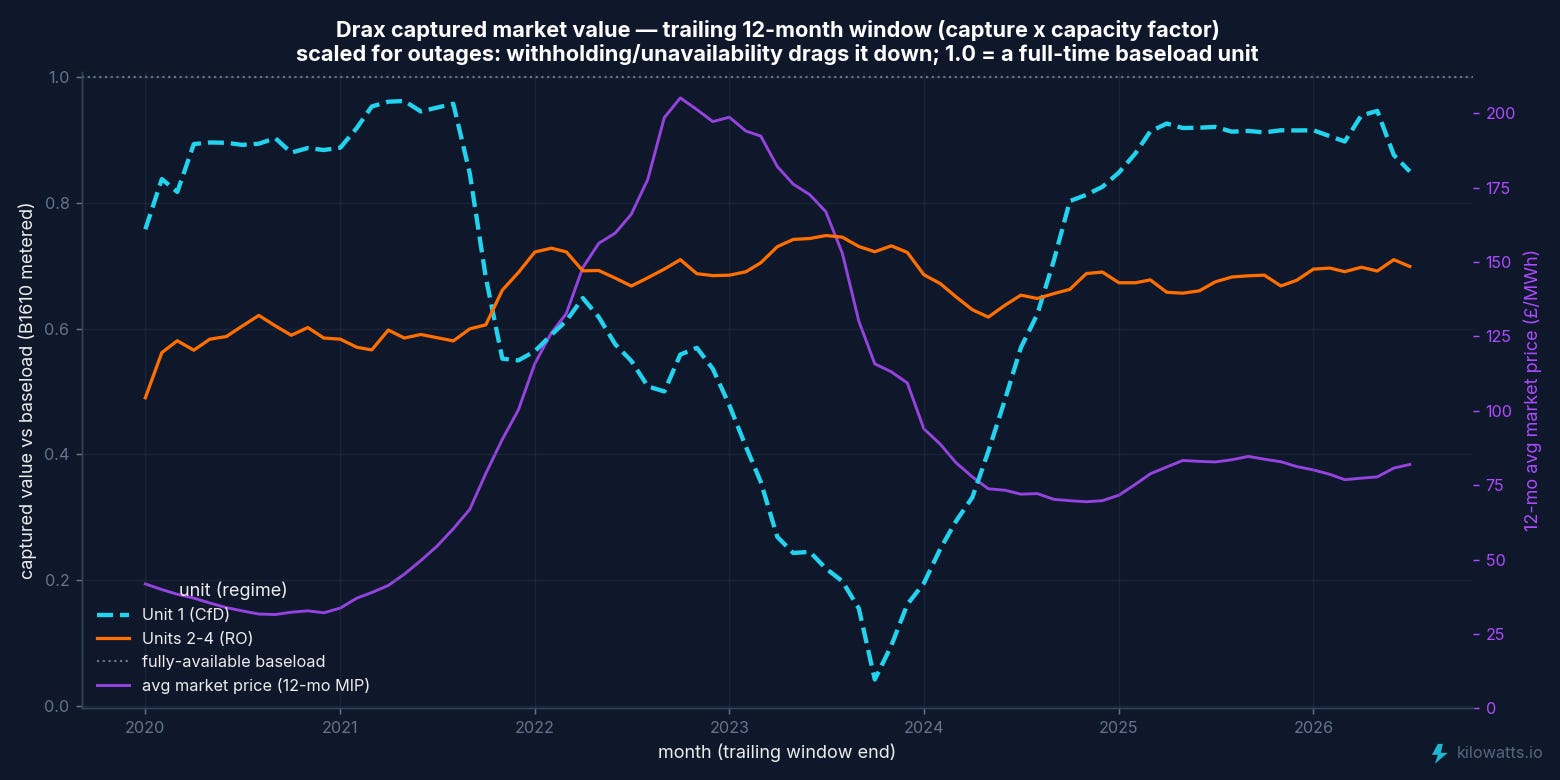
The Government has just agreed the third generation of subsidy support for Drax's biomass conversion. Ever controversial, and questioned by those in favour and against net-zero, is there a chance Government have finally cracked how to best subsidise it?
1. Price signals have a purpose
The 4 Biomass units at Drax are a perfect natural experiment for different ways of subsidising renewables. Unit 1 already has a Contract for Difference (CfD) and gets a fixed strike price (inflation indexed) for its output. Units 2-4 earn the wholesale price plus a Renewable Obligation Certificate (ROC) for each unit they generate.
ROCs are very much out of fashion because how expensive the overall scheme has become, most significantly because until April this year, it was uprated by the flawed and overgenerous RPI measure of inflation. They've also been criticised a great deal for over-rewarding zero marginal cost renewable producers of power (wind and solar), who are not able to dispatch on demand, but are instead entirely weather dependent.
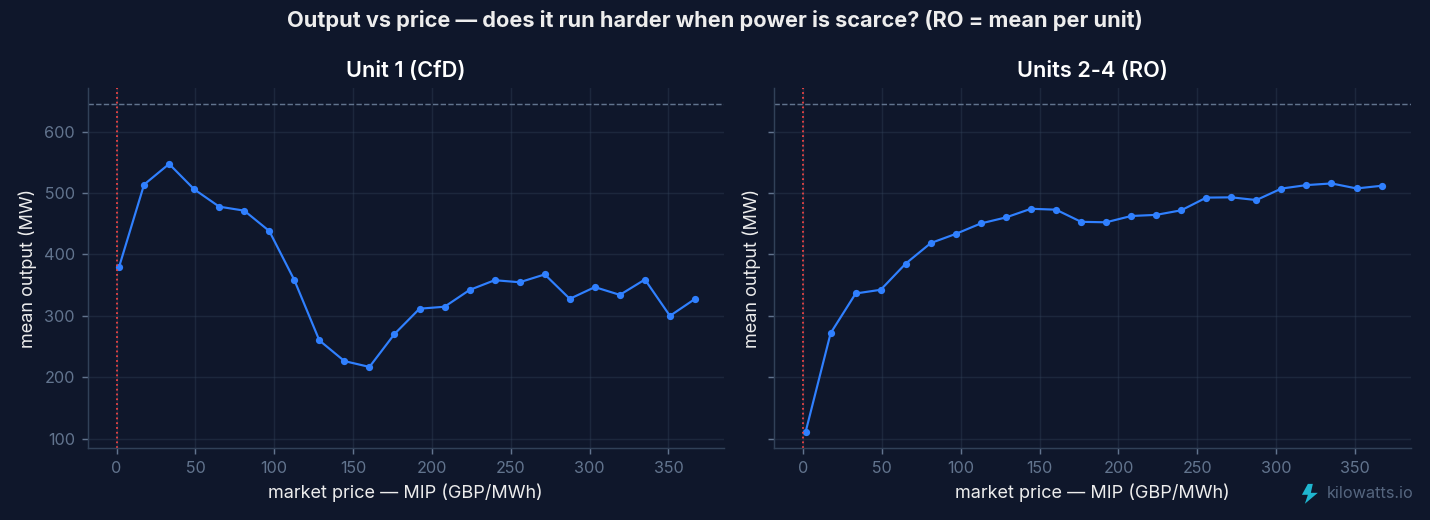
Drax is different to wind and solar because it is dispatchable. Its owners stockpile woodpellets in the yard and can wait for the wholesale price to exceed the cost of fuel; much like a traditional gas (or coal) power plant.
If you look at Units 2-4 at Drax on ROCs, it's very clear that they have dispatched more when wholesale prices have been higher — a classic upward-sloping supply curve. In contrast, the CfD unit (number 1) has a much more ambiguous relationship.
2. The 2022 crisis highlighted key deficiencies with the existing Unit 1's CfD
In 2022, energy prices, especially European gas spiked to eye-watering levels following Russia's invasion of Ukraine. Wholesale electricity prices in Britain rose too; as gas plant sets the marginal price most of the time. The revenue on offer to Units 2-4 at Drax went up, and perhaps not unsurprisingly, their generation rose to levels not seen before or since.
The CfD unit saw no benefit at all — and worse. Its subsidy is a top-up to a fixed strike price, measured against a seasonal average wholesale price; so when that seasonal price climbed above the strike, the top-up didn't just vanish, it went negative. Every unit Unit 1 generated now meant paying money back to the Government. With wood pellets also surging and Drax not yet self-sufficient in fuel, the choice was stark: far better to feed scarce, expensive pellets to Units 2-4, earning the full market price plus a ROC, than to Unit 1, now loss-making on every megawatt-hour. So Drax wound Unit 1 down.
As it turned out, there was also a substantial unplanned outage for Unit 1 in 2022, and I guess there was little urgency given its loss-making status to prioritise its repair.