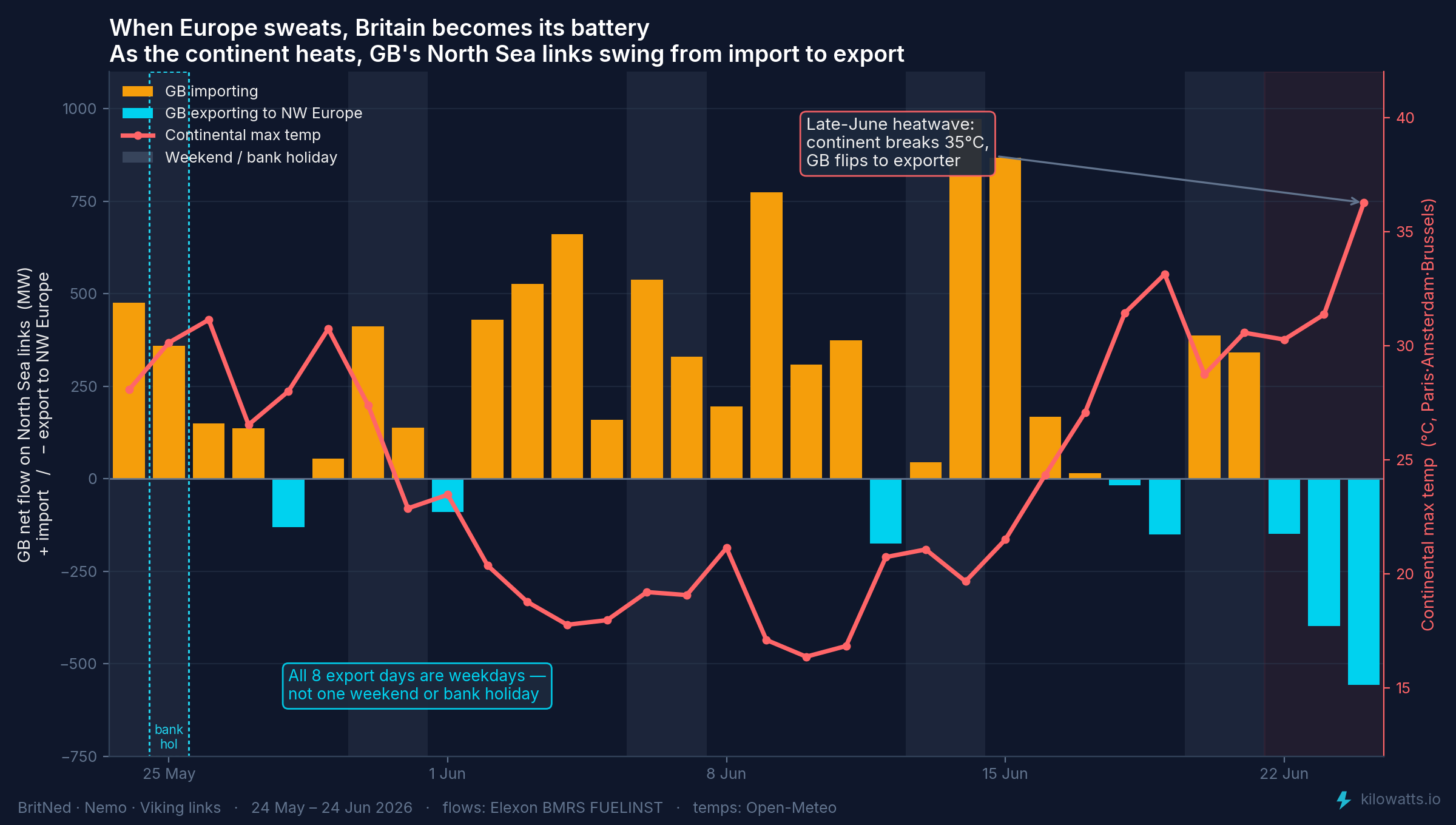
On the evening of 23 June 2026, in a yard behind Willesden in north London, a gas turbine built in the 1970s spun up at seven o'clock and ran for the next three and a half hours, selling power at £990 a megawatt-hour. By the time England kicked off at nine, it had been going for two. It was the hottest day of the year. And it was, to the day, ten years since the Brexit vote.
Three anniversaries, one tight evening. On the night Britain's grid looked its most antique — hauling half-century-old peakers off the bench to keep the lights on for the football — it was quietly doing something brand new: exporting flexibility into a sweltering continent. This is the story of that evening, read straight off the half-hourly data — what the grid did, who got paid, and why the ending is more hopeful than the start.
How continental flows differ
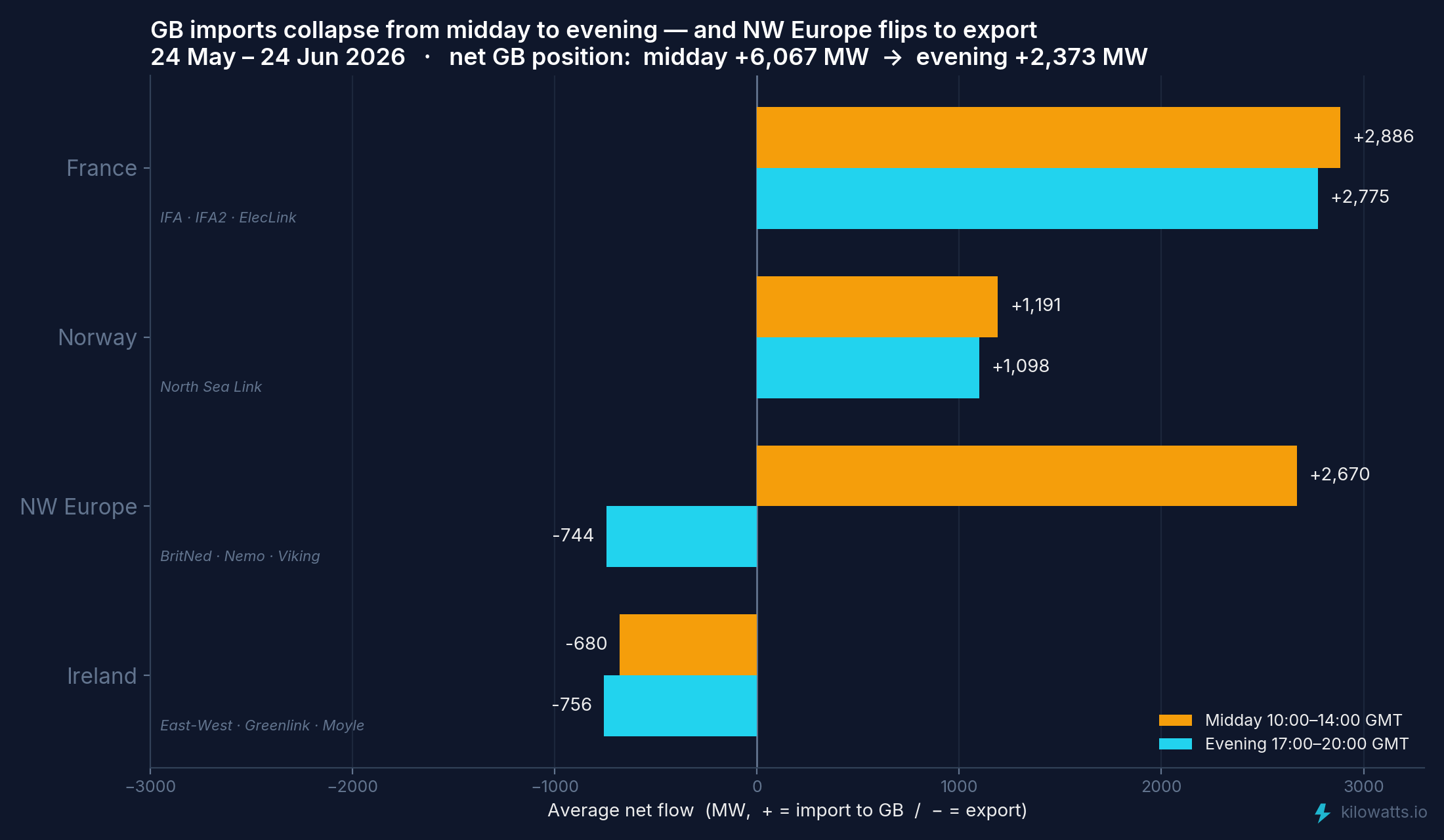
Conventional wisdom says the evening peak is when Britain leans hardest on its neighbours — demand up, solar gone, imports maxed. The data for the month to 24 June 2026 says the opposite. GB pulled +6.1 GW net across the interconnectors at midday and only +2.4 GW at the evening peak.
Where the swing actually lives
Split the links into four blocs and the puzzle dissolves. France (IFA · IFA2 · ElecLink) sits pinned at ~+2.8 GW in both windows. Norway's North Sea Link barely moves. Ireland stays a steady GB export. The entire midday-to-evening collapse is one bloc:
NW Europe — BritNed, Nemo, Viking — goes from +2.7 GW to −0.7 GW. A 3.4 GW reversal.
These are the Dutch, Belgian and Danish links: short, price-responsive, and wired into markets whose evening peak is steeper than ours. When their prices climb into the evening, the arbitrage flips and British electrons head east.
The heatwave tell
Why do those three links matter for a heat story? Because they are the ones that respond to continental conditions — and the month ended in a heatwave.