


In April 2007 the chief executive of EDF Energy told the Financial Times that "EDF will turn on its first nuclear plant in Britain before Christmas 2017 because it will be the right time". Vincent de Rivaz left the company on 31 October 2017, seven weeks before that Christmas, with no electricity and the first concrete poured only that year.
The press had by then rendered his promise as a pledge that Britain would be cooking its Christmas turkeys on nuclear power. He never said it. The turkey is a journalists' elaboration of "before Christmas 2017" that hardened into a quasi-quotation, and the versions in circulation all differ from one another, which is the tell. The Telegraph profiled him in September 2016 observing that the surest way to irritate him was to mention Christmas turkeys. The campaign group Stop Hinkley has delivered a cold turkey to the site every December since; last year's sign read "It's 2025 EDeF. Where is the lecce for the HPC Turkey?"
Three years after that promise, Nick Clegg — then leader of the Liberal Democrats, answering questions from Reddit users on video — said that "by the most optimistic scenarios from the government itself, there's no way they are going to have new nuclear come on stream until 2021, 2022. So it's just not even an answer."
He has been mocked for it ever since. A Chancellor of the Exchequer, two free-market think tanks, a Telegraph leader, UnHerd calling it "not just wrong, but irresponsible", The Times twice this year. All of them citing it as proof that he was wrong, and that Britain should have started sooner.
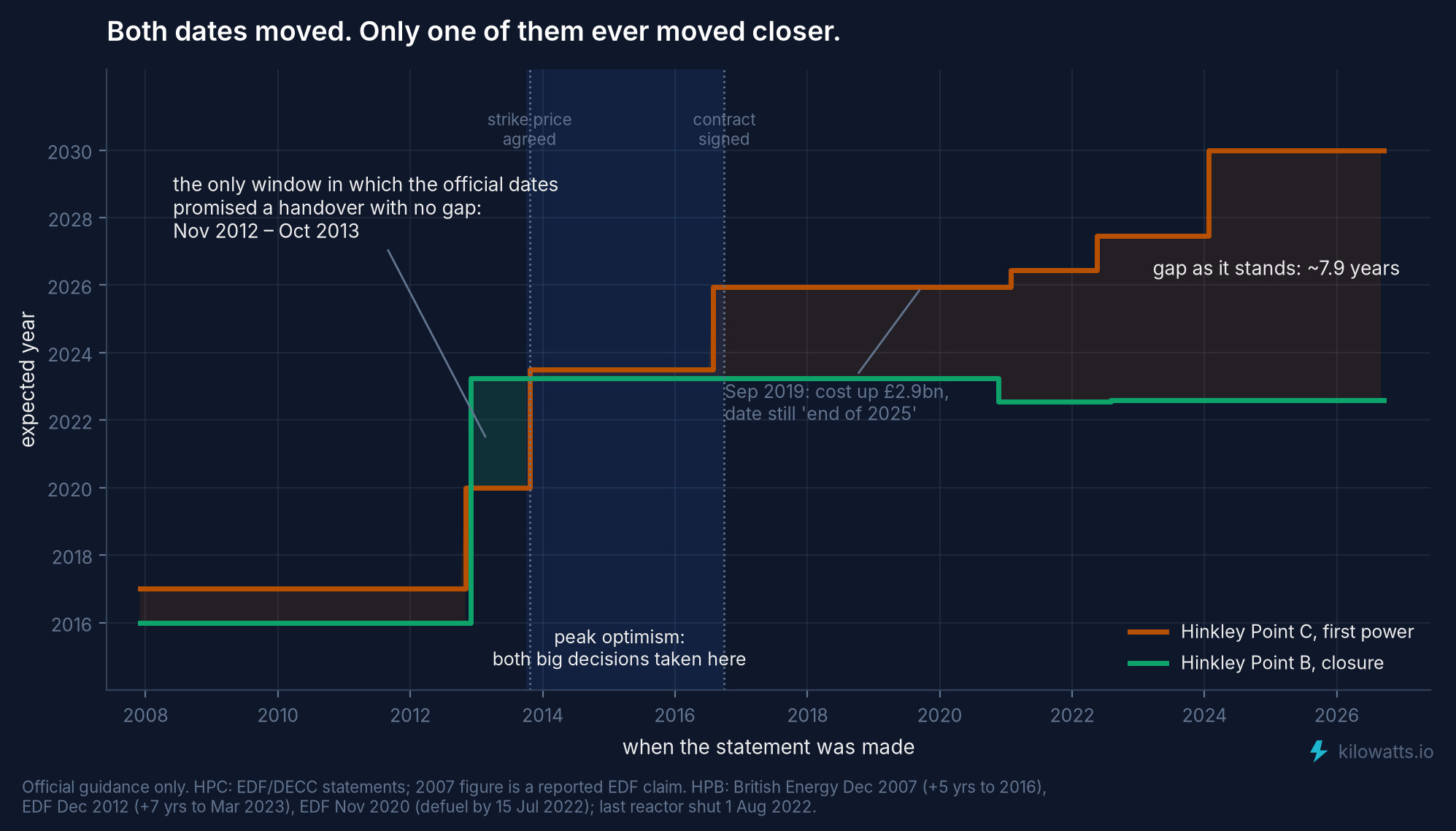
Current guidance for Hinkley Point C is 2030.
Clegg was not wrong. He was about a decade too generous. And he has never said so — he has never publicly commented on the Hinkley deal at all, which is its own small mystery, given the strike price was struck in October 2013 while he was Deputy Prime Minister.
One man put a date on it and was wrong. The other put a date on it and was right. Neither outcome had any consequence for anyone, because the British state never put a date on anything it could be held to.
Why this is not the obvious question
Thirteen years late — measuring from the 2007 promise, the most generous baseline available to anyone attacking the project — sounds like it can only be bad. Most people will assume so, and stop there.
Inside the industry the instinct runs the other way, and it is worth being honest about why. There is a common, though not universal, view that Hinkley's strike price is expensive. If that is right, then every year the plant doesn't generate is a year consumers don't pay the difference, and the delay is good for electricity bills. Which is a genuinely counter-intuitive thing to say about a baseload generator with almost no marginal cost — normally the case for running nuclear is that once it exists, it is nearly free to operate. Here the argument is about the contract, not the physics.