


Grid engineers have a name for what happens when a big football match ends: the TV pickup. Millions of people get up at the same moment. Kettles go on, fridge doors open, lights come on and toilets flush, which sets the water companies' pumps running, while pubs pull a rush of pints through their cellar coolers. Demand jumps faster than generation can follow. Grid frequency dips while the system catches up. It's the most famous demand spike in British energy, and NESO plans for every major match.
At the 2022 World Cup, an England full-time whistle pulled GB frequency down by 57 mHz on average over the following ten minutes.
On a winter night now, midnight pulls it down by about 60 mHz more than the half-hours just before it. It does it every night, not once a tournament. Midnight and 00:30 are when Britain's cheap-rate tariffs start, for EV charging and for Economy 7 heating alike. At 00:30 the extra drop reaches 90 mHz.
Grid control engineers in several countries have told me they can see the EV tariffs start on their screens. I wanted to know whether the public data shows it in Britain, so I went through twelve years of GB frequency data, the Balancing Mechanism and my own smart meter. It does. The EV part has grown with the car fleet, it shows up on its own in summer when the GMT-based clocks shift an hour later, and a 2022 charger law has left its fingerprint on the shape of the dip.
But this isn't an "EVs break the grid" story. The tools to handle it are already working, and the way they work tells you what's going to happen to your cheap overnight electricity next.
One house on a midnight tariff
Start small. Here's my own house last winter. I was on E.ON Next Drive, a fixed-window EV tariff (cheap from 00:00 to 07:00), with two EVs, a 20 kWh home battery and a heat pump. This is what the smart meter saw every night from late October to late March.
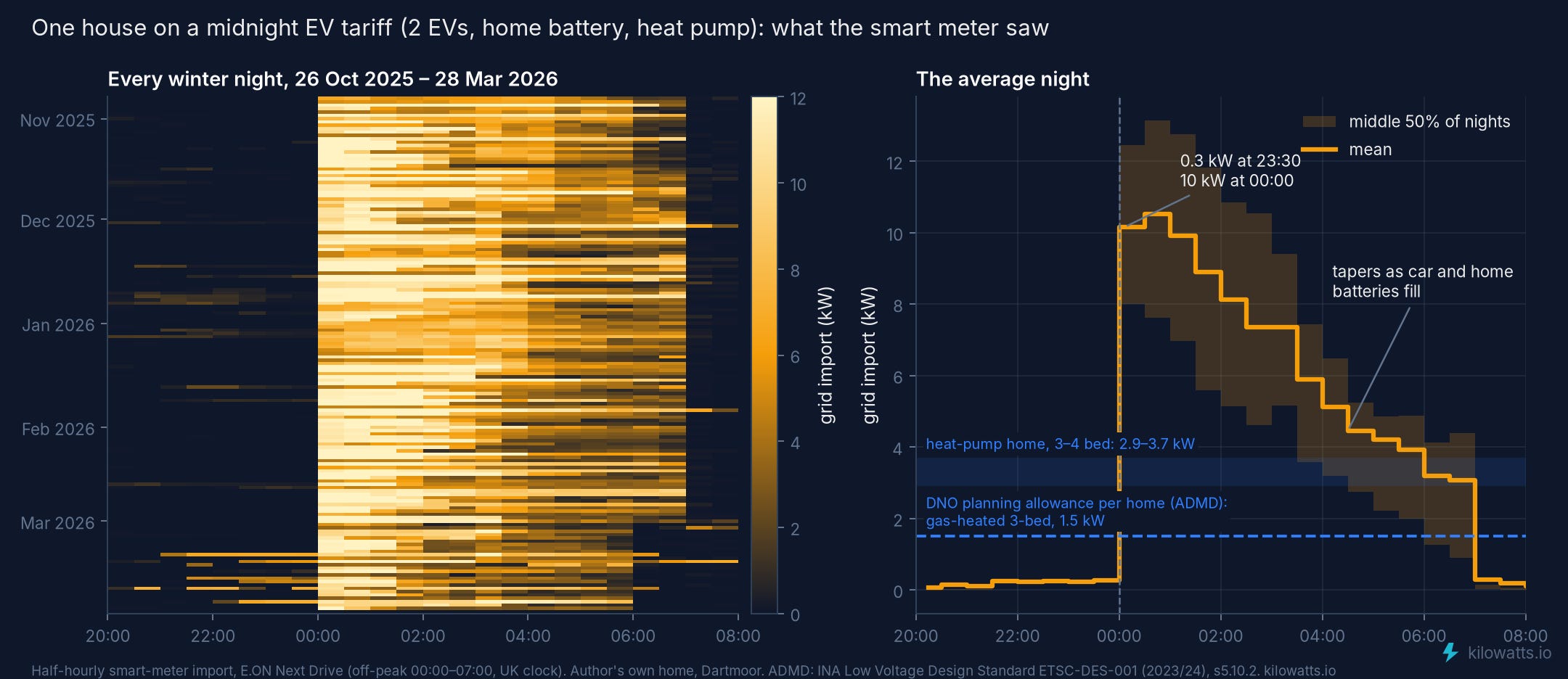
The house averaged 0.3 kW at 23:30 and 10 kW at 00:00, a nearly 40-fold jump in one half-hour. Everything starts at once: the cars, the home battery, the hot water. Then it tapers through the night as the batteries fill, down to about 3 kW by 06:30.
That shape is the whole story in miniature:
The start is a cliff; the end mostly isn't. Most cars are full long before the window closes. When Octopus moved the end of Go from 04:30 to 05:30 in July 2024, I couldn't find a clean signal in the grid data, which is what the taper predicts.
Multiply it by a few hundred thousand homes and you get a step in national demand at a known minute, every night.
The blue lines are what a network designer allows for each home when sizing the local cables and substation: its "after diversity maximum demand",