
Did the price-cap kill household energy competition?
Or is Octopus simply too good? What might happen next to the price cap?
I recently used Ofgem data to create a net approval score for household energy, where suppliers are compared on their ability to win the trust of consumers and move off the Ofgem pricecap:
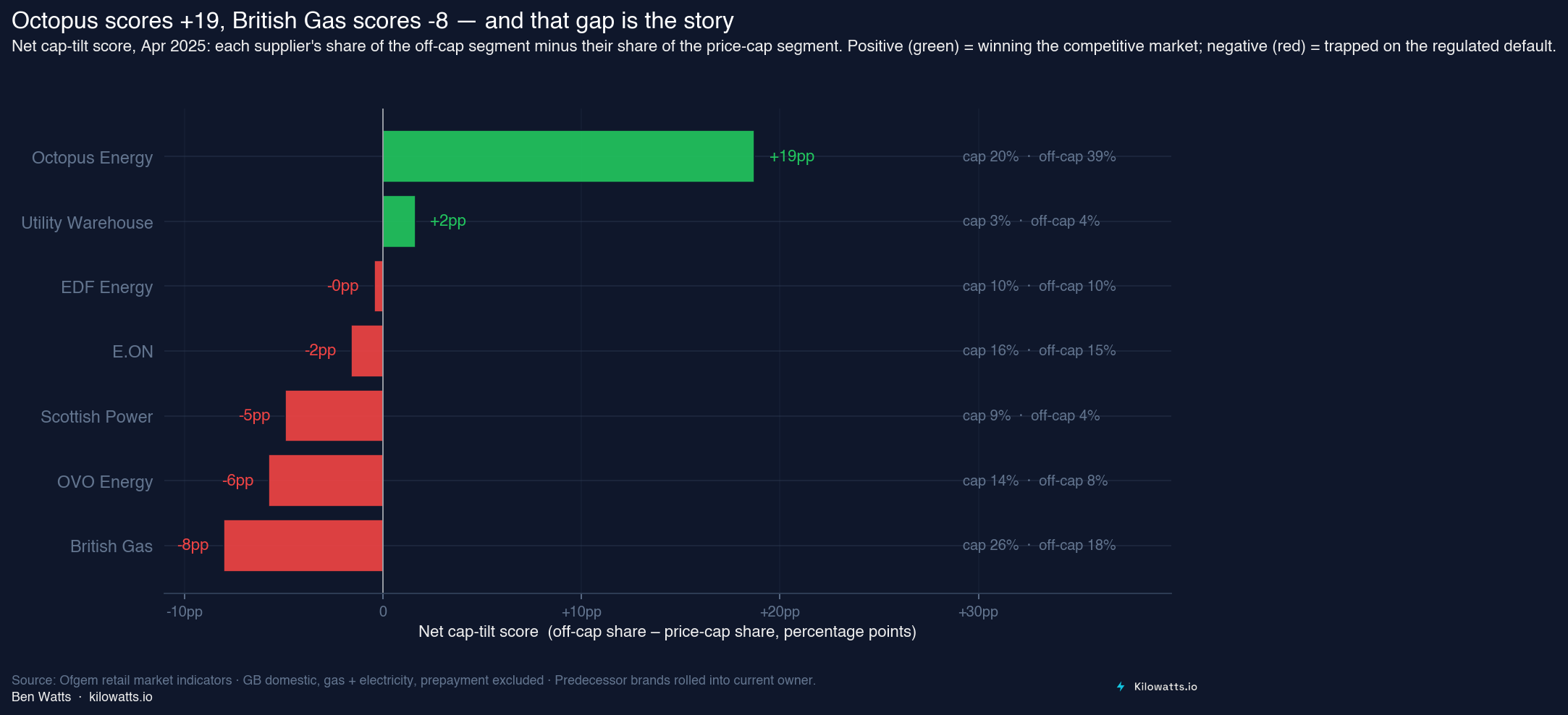
Four moments that summarise it:
2013, Ed Miliband campaigns on capping energy prices (Octopus doesn’t yet exist - except as a twinkle in Greg Jackson’s eye).
2018, after nearly “loosing” the 2017 election, Theresa May’s government legislates the cap (Octopus has under 1% of the market).
2022–23, the Treasury spends £46bn through suppliers to subsidise the cap through the wholesale crisis rather than reform it (Octopus takes over Bulb and gains momentum).
2025, the chart above. The cap preoccupied and muted Octopus’s competitors into complacency; Octopus itself rose despite it, indeed perhaps because of it.
The line between those four moments, Octopus’ rise that ran alongside, plus three plausible reforms the price cap are the back half of this piece. Spoiler, the most uncomfortable of those is the one we’ll probably end up taking.
1. Where the price cap came from
The Default Tariff Cap took effect in January 2019 but the politics started six years earlier.
September 2013 — Ed Miliband, then Labour leader, announces a 20-month energy-price freeze if Labour wins the 2015 election. “Red Ed” headlines, “the lights will go out” lobbying campaign from the Big Six.
2014–16 — the CMA opens, then concludes, its full Energy Market Investigation. The final report (June 2016) finds £1.4bn/year “detriment” to households on default tariffs. Recommends a narrow cap for prepayment customers only.
2016–17 — Theresa May campaigns on capping “rip-off energy prices”, adopting the policy the Conservatives had spent four years arguing was unworkable.
July 2018 — Domestic Gas and Electricity (Tariff Cap) Act passes.
January 2019 — Cap takes effect.
Crucially, the cap was not designed by the regulator who would administer it. It was a political response to a political problem — households on inertia tariffs paying £200+/year more than active switchers — retrofitted onto a market designed for active competition.
That mismatch is the seed of everything that follows. A market built around price competition had its main competitive lever taken away. The interesting question is which firms could still find a way to compete, and which couldn’t.
It is worth pausing on one detail that the Westminster narrative of the cap almost never includes. At the moment the Tariff Cap Act passed in July 2018, Octopus Energy had been operating for under three years and held well under 1% of the GB retail market. They had ~2% by the time the cap took effect in January 2019. The political process that produced the cap was not, in any meaningful sense, aware of the firm whose moat it was about to deepen. The eventual winner of the cap-era market was a small challenger almost nobody in the cap debate had thought about.
Hold that fact in mind. The argument later in this piece is that the cap didn’t just fail to anticipate this winner — it structurally produced this winner, by reshaping the competitive landscape into one that only a firm with a particular pre-existing investment profile could survive in. The political process didn’t pick Octopus. The market design did, six years before any of the customers showed up.
2. Seven years on, the price-cap is the left-behind market
The first thing to notice is that the cap didn’t shrink. It’s grown.
The whole idea of the price cap was that it would be a temporary measure lasting 2 years. There is even a sunset clause requiring it to be renewed every 2 years by the Secretary of State, who has to determine that there is still insufficient competition in the energy market.
As it turns out, the market was making steady progress toward becoming more competitive, and had reached 68% by July 2022. But then, rapid price rises in wholesale markets following the Ukraine conflict meant that the price-cap, with its sluggish hedging mechanism became by far and away the best choice for households. This was an open liability for suppliers who could not forward hedge against customers that weren’t obligated to remain their customers, and many ran into financial difficulty.
Instead of reforming the price-cap, the Government at the time effectively endorsed customers moving back to the price-cap and paid about £23bn to energy companies under the Energy Price Guarantee to subsidise household gas and electricity prices. It also paid £4.6bn to secure the sale of bankrupted Bulb to Octopus and a separate £18.4bn to energy companies to subsidise business energy bills. In total, about £46bn.
In contrast, a lesser £35bn was paid directly to households across a Council Tax Rebate, Cost of Living Payments and a £400 Energy Bills Support Scheme, which was done through suppliers but done on a lump sum basis rather than subsidising each unit of energy consumed. These payments were much less distortive to energy market competition, but required Government to put faith in households to spend the support provided sensibly.
Either way, the damage to energy market was done, and a little over a year later, in October 2023, only 13% of households were on a competitive tariff. The result was, in many ways turning the clock back to the initial privatisation of the 1990s, and to a much worse situation than in 2018, when the price-cap was launched. And while the market has thankfully resumed progress back towards competition, the latest Ofgem data (mid 2025) shows a recovery to around 42%. Alas, there’s another conflict driving up energy prices!
3. The market has bifurcated
Here is where it gets interesting. Because the recovery in competition since 2023 isn’t marketwide, or global across major suppliers:
The price-cap segment looks like a normal oligopoly. British Gas leads at 27%, Octopus is one of five comparable suppliers at 20%, E.ON 16%, OVO 14%, EDF 10%, Scottish Power 9%. Nobody dominates. Customers are distributed roughly the way you’d expect from a market with seven legacy or quasi-legacy participants.
The off-cap segment looks nothing like that. Octopus has 39% — more than the next two suppliers combined. British Gas is the only other firm above 15%. Scottish Power has 4%. The “Big Six” framing dies here: in the segment where customers actively choose a product, there isn’t a Big Six. There’s Octopus, and there’s everyone else.
To get a sense of how fast this happened: the firm now holding 39% of the off-cap segment had a 2% share of the GB market when the cap took effect in January 2019. This isn’t a story about a long-established player slowly extending its dominance. It is a story about a firm that essentially didn’t exist in the political imagination of the 2018 cap debate becoming, in six years, the only meaningful competitor in the segment of the market the cap left competitive.
This is what I mean by bifurcation. What was once a single market, dominated by dual fuel supplies and relatively homogenous levels of consumer loyalty is increasingly segmented. However, it’s not just the price-cap that has led to this moment. Its arrival in 2018 coincided with a bunch of other factors that squarely fitted into Octopus’ business model and strategy:
Net Zero and Electrification. UK EV sales roughly doubled year-on-year from 2018 onwards; heat-pumps have become mainstream, PV and batteries have become cost-effective without feed-in-tariffs. As I’ve posted about separately, Octopus dominates the market for newly installed solar
Smart Metering and Flex A critical mass of homes have the (working) smart meters required to enable smart tariffs outside of the traditional flat-rate and Economy 7 moulds, also enabling Flex propositions.
These trends are born out in the supplier-by-supplier timeseries of Off-cap customers. Since 2023, Octopus has outpaced all its rivals in the speed at which it has gained the trust of customers to switch back onto tariffs that are not the price-cap, a marked contrast compared with Ovo, who had prior to the crisis been close rivals:
Looking at the most recent observation a cross-sectional basis, this means that Octopus now has 9 times more customers off the price-cap than Scottish Power:
4. Rumour dispelled: Octopus managed organic growth on-top of acquisition led growth
A common response I expect to the charts above is usually some version of “well, of course Octopus is big — they swallowed Bulb, Avro, Co-op, Shell. Their share is mostly inherited.”
It isn’t. Once you strip out customers transferred via M&A and SoLR (Supplier of Last Resort) processes, the picture is clearer, not muddier.
Of the post-2019 net change in non-prepayment customer accounts:
Octopus added 12.3M total. 6.0M of those are organic — won on their own merits, with the Bulb / Avro / Co-op / Shell transfers stripped out.
OVO a challenger brand like Octopus added 3.6M total including its acquisition of SSE, but has subsequently hit harder times.
E.ON added 1.9M total, lost 0.5M organically after netting out the npower transfer, but is now challenging Octopus with its E.On Next brand and smart propositions.
EDF added 0.3M total, lost 0.4M organically after netting out Green Network Energy, but again like E.On is mounting a challenge to Octopus.
Scottish Power had no acquisitions. Their book shrank by 0.7M. That’s the cleanest organic loss in the dataset.
British Gas held its book — small organic gain of 0.5M.
In summary though, four of the Big Five/Six have shrunk organically since the cap began. And much of their post-2019 growth in their headline numbers is inorganic too.
That matters because it tells us the cap-bound suppliers haven’t just been overtaken by Octopus. They’ve been unable to compete for new customers in their own right. The customers they have are largely customers they inherited from suppliers that went bust during the 2021–22 wholesale crisis.
Sector profitability tells the same story. Ofgem’s January 2026 State of the Market report puts domestic supply profit at £0.27bn for 2025, down from £0.88bn in 2024 — a roughly 70% collapse, with Octopus identified as the only big supplier gaining share. How profitable different bits of Octopus are is a complex topic I might leave for a later date, if ever!
5. Conclusions - What should we do about the price cap?
I see three ways forward for Government, in decreasing order of probability:
A. Do Nothing.
This is the “default” (pun intended!) and most likely option, that current (and future) Governments will continue to roll over the price-cap legislation year to year. As things stand, it would be scary for a Government of any persuasion to suddenly remove the price-cap from over 50% of the market.
That said, I suspect that over time, more and more households will probably electrify, choose flex tariffs and opt out of price-cap tariffs, perhaps even bypassing traditional suppliers completely to go through dedicated flex providers. But these households are likely to be better-off, more likely to be in a position to adopt EVs, heatpumps and PV/battery setups (being more affluent and home/house owning). So the rump of households on the price-cap will increasingly represent the more vulnerable in society, which in turn will entrench any resistance to change.
There’s some hope that lower cost “plug-in” solar and battery propositions could bring some of the benefits of energy flexibility to a broader demographic, including renters and the less well off. The upfront costs are lower and could, in some circumstances be met by suppliers. However, neither of these will solve replacing the massive primary energy requirements of boilers and cars; which ultimately have to replaced by heatpumps and EVs.
B. Public Ownership.
One alternative to technical reform is a more traditional (and left wing) approach to create some form of Government owned supplier to function in particular as:
A supplier of of last resort
A subsidised social tariff to those deemed in need (low income, renters, the elderly)
This could be achieved either from scratch, or potentially by acquiring and merging some of of the legacy suppliers with a large book of existing price-cap customers. It could even be achieved by Government acquisition at low or zero cost of a legacy supplier that is struggling to find a private buyer. It’s a Northern Rock or RBS type approach
Owning a supplier could make it easier over time for any Government to achieve its policy aims of the day in the energy retail space, without the straightjacket of regulating a market with dozens of privately owned companies.
The main policy challenge would be achieving a level-playing field and reaching a compromise market division with any remaining privately owned suppliers. One suspects this division would require the Government to largely focus on relatively difficult to serve customers, allowing privately owned suppliers to cherry-pick the more affluent and easier to serve. This would in turn probably require the publicly energy company to run at a loss. This might be acceptable, and indeed preferable were it the most practicable way for the Government to offer social tariffs. However, the outcome would be a market division with separate private and public sectors, likely with a higher quality of service and modernity in the private sector. In other industries like health and education these segmentations are controversial (especially for Labour Governments!).
Of course, a more radical Government could consider a forced nationalisation of all existing energy suppliers to recreate a Government supplier monopoly. This has some benefits in economies of scale and avoiding adverse selection and skimming problems. However, though its beyond the scope of this article, the upfront cost and fractious legal dispute that hostile takeovers of both internationally owned subsidiaries like Eon, Scottish Power and EdF, post nationalisation publicly listed suppliers like SSE and British Gas, along with more recent success stories like Octopus would be quite a hurdle. That said, I suspect the outcome would be a popular proposition among many voters, and I wouldn’t be surprised if at least one party promises it at the next general election, even if it’s radically more difficult to execute than say the gradual renationalisation of rail franchises.
C. Techno Reform.
The biggest deficiency of the price-cap in an age of smart metering, flex and electrification are the flat unit rates and antiquated “3-5-12” hedging rule that suppliers have to follow. One replacement could be with a price-cap based on shorter-term day-ahead and intraday exchange prices; leaving the competitive market for longer term fixes and smart/flex propositions. The price-cap regulation could end up looking something like the Octopus Agile formula, or a bank account paying variable interest linked to the Bank of England base rate
This would make it harder to forecast bills in advance, however Government could create targeted support mechanisms for vulnerable customers to payout based on actual short-term power prices and weather conditions, an extension of the current “cold weather payment” system. This mechanism would permanently and automatically stabilise energy price shocks too, which seem to happen with increasing frequency.
However, it would require a big leap of faith in technology, the mandation of smart meters for all customers and encouraging all customers to engage more deeply with the cost and impact of their energy. So while it is probably the best approach economically, politically it’s probably a non-starter.
Sources & methodology
Customer accounts data: Ofgem Retail Market Indicators, bi-annual snapshots Jan 2019 – Jul 2025 (latest published). Non-prepayment domestic accounts only. GB-wide. Gas + electricity summed. Predecessor brands (Bulb, Shell, SSE, npower, Avro, Co-op Energy, First Utility, Green Star Energy, Green Network Energy) rolled into their current owners.
Profitability: Ofgem State of the Market: Energy Retail Highlights (January 2026). Domestic-supply profit aggregate: £0.88bn (2024) → £0.27bn (2025).
Organic vs inorganic growth: each acquisition’s “inorganic addition” is taken as the predecessor brand’s last reported non-PPM book before it disappears from the Ofgem series. This understates recent organic performance for receiving suppliers (predecessor accounts often decayed for months in administration before transfer) but is the cleanest defensible adjustment from public data.
Excluded suppliers: So Energy and Utilita — non-continuous history across the post-2019 window.


