


On 10 November I spoke at Montel's UK Energy Day in London on keeping industry in the UK. (The slides are here.) Half the talk was about which industry we are actually keeping. This piece is the other half: if you run a plant in Britain, how do you cut your electricity bill?
There are more routes than most people think, and they come in a fairly strict order. But almost all of them share one feature. They don't make the electricity system any cheaper. They move your share of its cost onto someone else.

Read the chart from the top. The first row applies to everyone: buy power when it's cheap. Then come the levies, three doors in order. Is your business in the right sector? If not, can you make your own power? If not, are you small? Then the catch, in amber: the exempt routes still pay for balancing the grid, and that is the charge that's growing fastest. The last row is the way round it, which is to go local.
Only one row is green.
Step one: buy when power is cheap
Gas still sets the British power price most of the time, but less often every year. In 2022 at least one gas plant was running in the market, rather than on a contract for the system operator, in 96% of half-hours. So far in 2026 it's 82%. That's an upper bound on gas setting the price, because a gas plant can run without being the marginal unit.
Britain isn't unusually expensive on the commodity itself. EEX's settlement prices for 2027 baseload power on 30 October put Britain at about €183/MWh, 11% above Germany and in the pack with Austria, Switzerland and Czechia. The outlier is France, with its nuclear fleet: Britain sits 42% above it. (The GB contract on EEX is an assessed mark with no trades behind it, so treat the 11% as indicative.) The gap between what a British factory pays and what a German one pays is mostly in what sits on top of the wholesale price, which is where the rest of this piece goes.
What has changed is when gas drops out. The night window opened first, as wind grew and demand fell, and it has been flat since 2024. The window that's still widening is the working day.
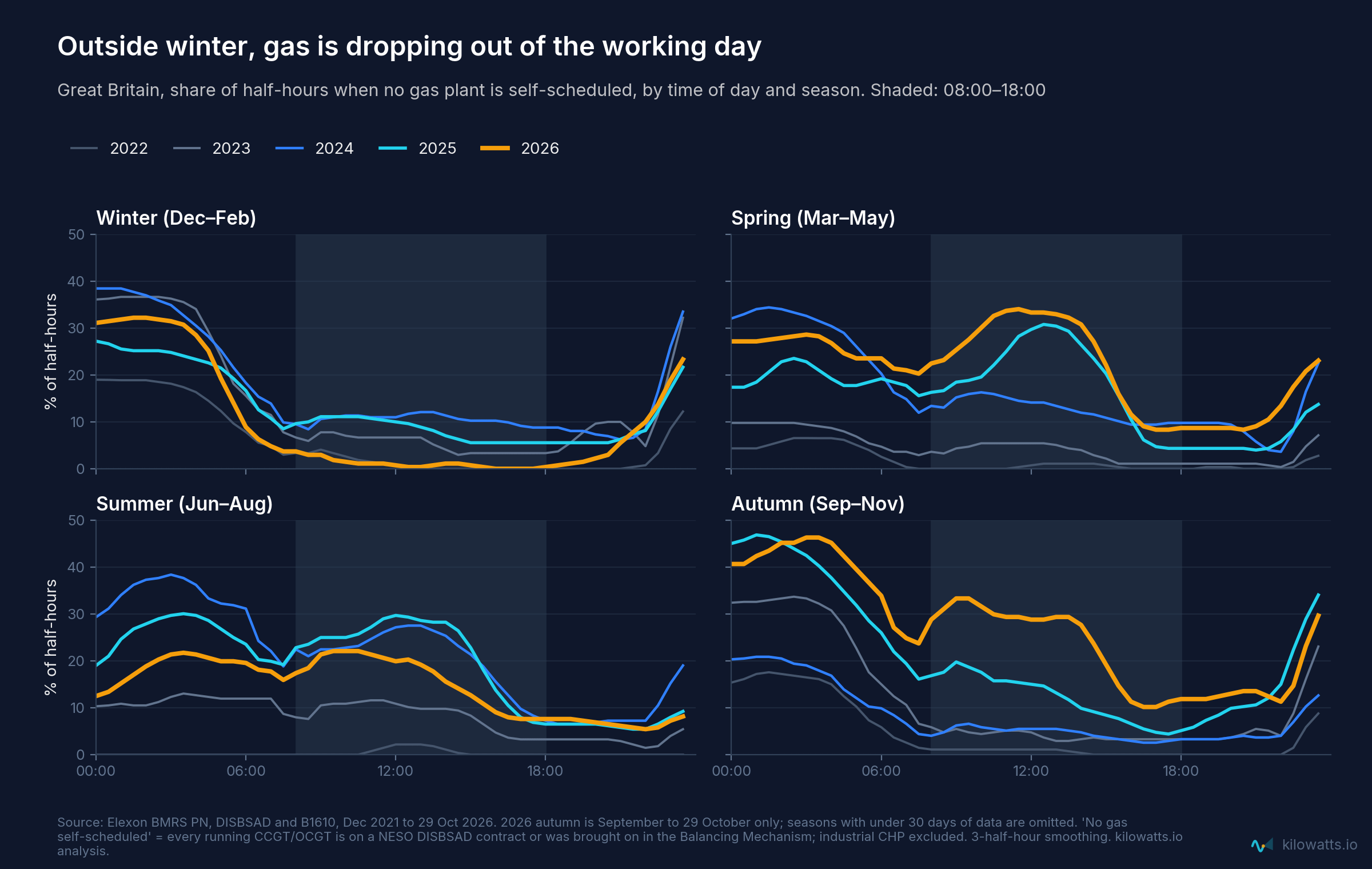
In 2022, gas was missing from the market in 1% of weekday working hours (08:00 to 18:00). In 2026 it's 12%, and about a third of spring and autumn middays. In those hours the day-ahead price has averaged £30 to £50/MWh, against £80 to £100 when gas is running (Elexon data, 2024 to 2026).
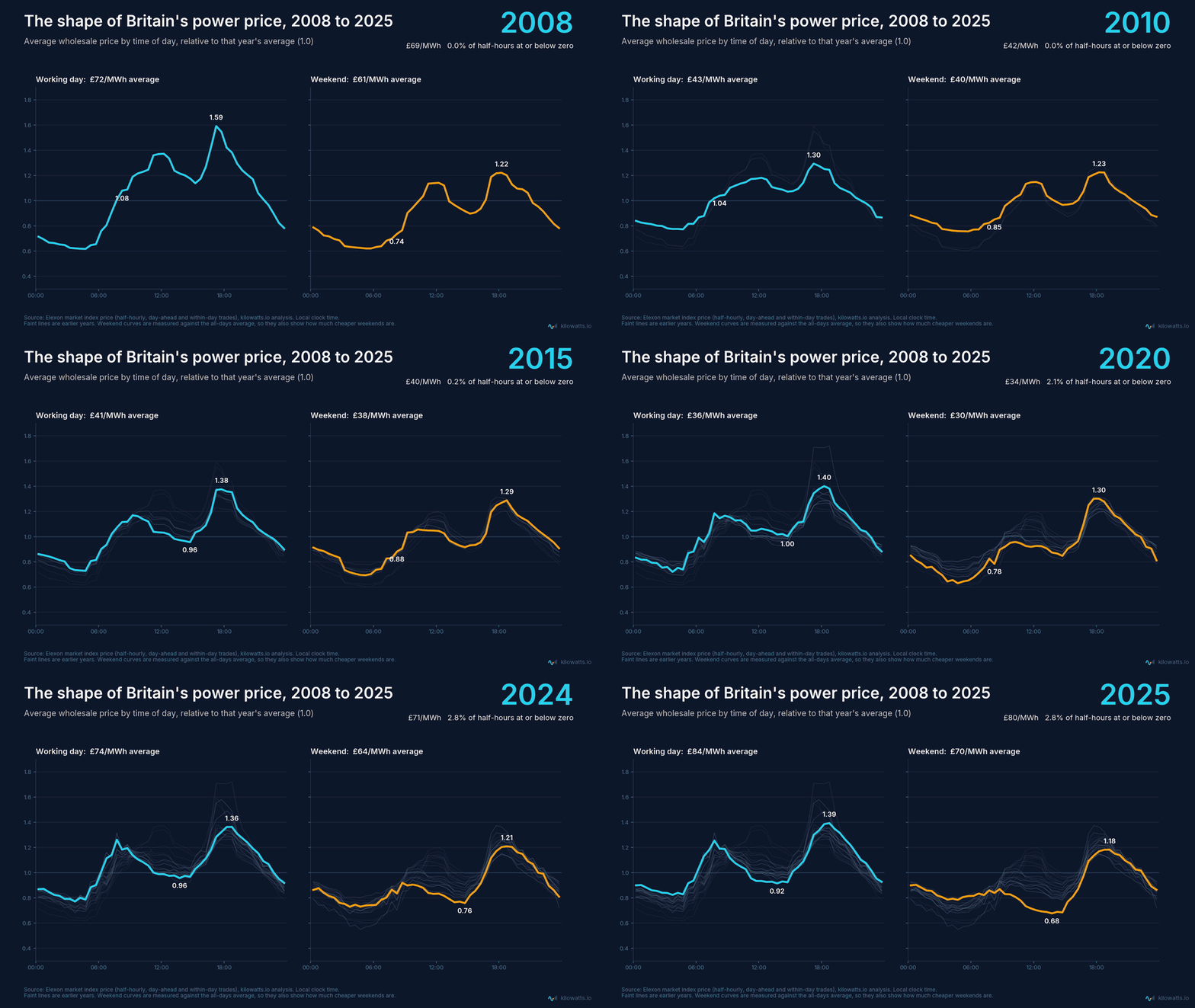
This is the green row because it cuts the cost for everyone. A cheap hour is cheap for the system too: the power is there, and using it means less is curtailed or exported at a loss. A firm that shifts its heaviest process into spring and autumn middays saves money without anyone else paying for it.
Two caveats. Winter daytime is still almost entirely gas: in December to February 2026, gas was out of the market in 0.3% of working hours. And the trend isn't one-way. Summer 2026 was a low-wind summer, and only 9% of its working hours were gas-free, against 20% in 2025.
Can you run when it's windy? Only around the edges
The obvious follow-up question: if solar gives you cheap middays, can you chase the wind too?
Wind does cut the price. In weekday working hours over the past year, the day-ahead price averaged £84/MWh when wind output was above 12 GW, and £118 when it was below 4 GW.
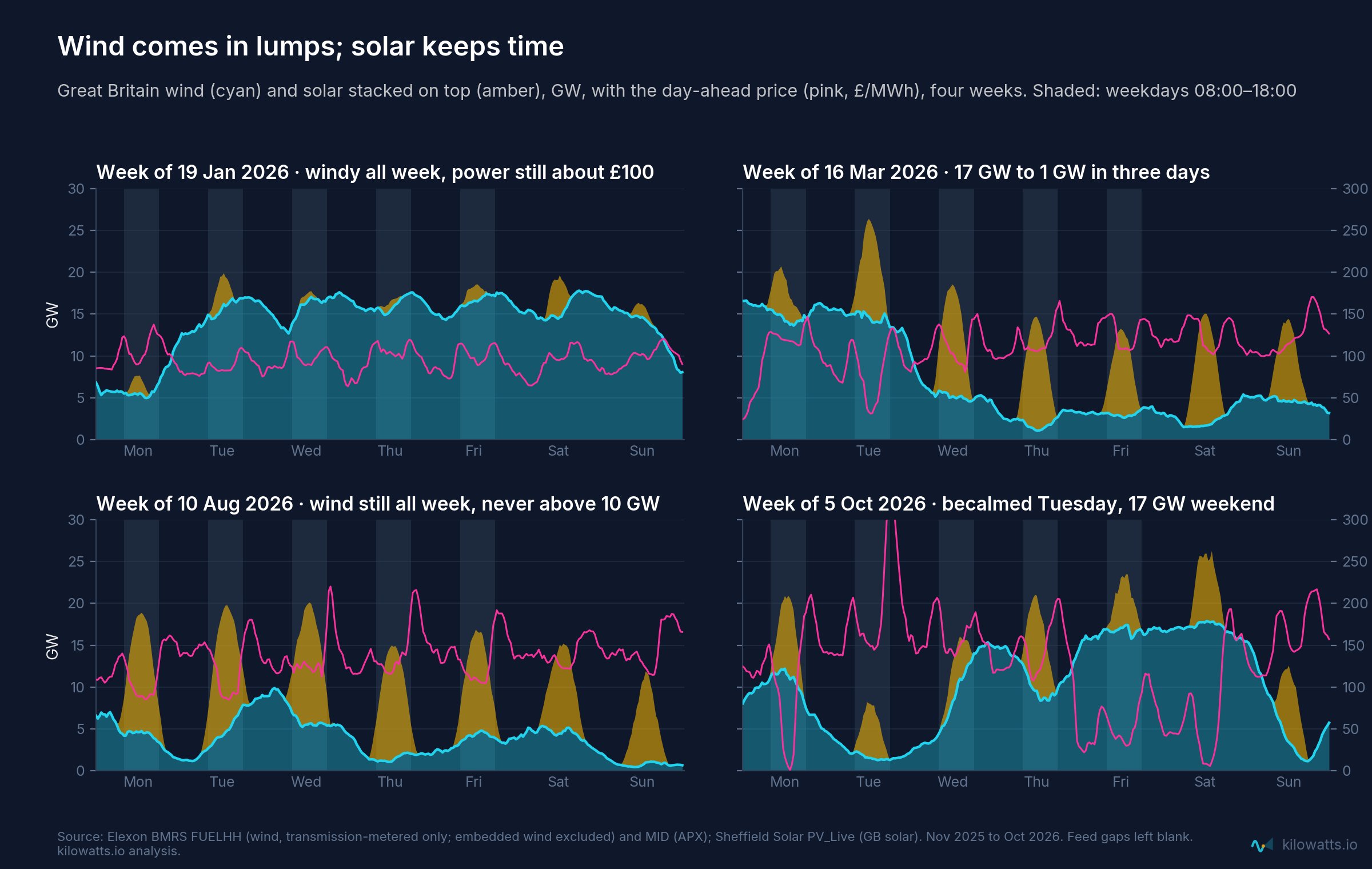
But wind comes in lumps. In the week of 16 March it fell from 17 GW to 1 GW in three days. In the week of 5 October it was becalmed on the Tuesday and roaring all weekend. And the week of 19 January was windy throughout, yet working-hour prices still ran at £83 to £126, because winter daytime demand kept gas at the margin.
The forecast is good, for about three days. I compared Elexon's published wind forecast with metered output over the past year. A day ahead it is typically within about 12% of what turns up. Three days out it's about 18%, and then it stops: the published forecast doesn't go further than that. (Those figures remove a 16% difference in fleet coverage between the forecast and the metered data. Unscaled, the error is 19 to 21%.) Beyond three days you're guessing. Daily wind output is only weakly related to what it will be three days later.
Most plants set shifts weeks ahead. So wind helps at the edges. If you have a big batch to run, pull it into a windy spell. If you have maintenance to do, book it for a calm, expensive one. But plant is expensive, it pays back by running at high load factors, and it works around people's hours. The night shift doesn't move because the wind dropped on Thursday.
And storage won't bridge a still week yet. Ofgem's first long-duration storage round, at its June 2026 minded-to stage, holds 16 projects with 137 GWh between them. That's about four and a half hours of Britain's average demand. The big pumped hydro schemes in it aren't expected to run until around 2033.
Solar is the one you can plan a shift around. Look at the amber humps in the chart: midday, almost every day, from spring to autumn.