


The Chancellor got the loudest cheer of the Budget for scrapping the gas standing charge. It is the one energy measure in the speech that costs the Treasury nothing.
That is because it isn't really a cut. It is a tax on home gas in all but name, and a carbon tax at that.
The standing charge, £108 a year, will move onto the price of each unit. Every kWh of gas a home burns will cost about 0.91p more before VAT. Burning a kWh of gas releases 0.183 kg of carbon dioxide, so that is the same as a carbon price of about £50 a tonne. Home gas has never carried one. Gas burned in a power station pays about £82 a tonne, through the UK Emissions Trading Scheme and the Carbon Price Support.
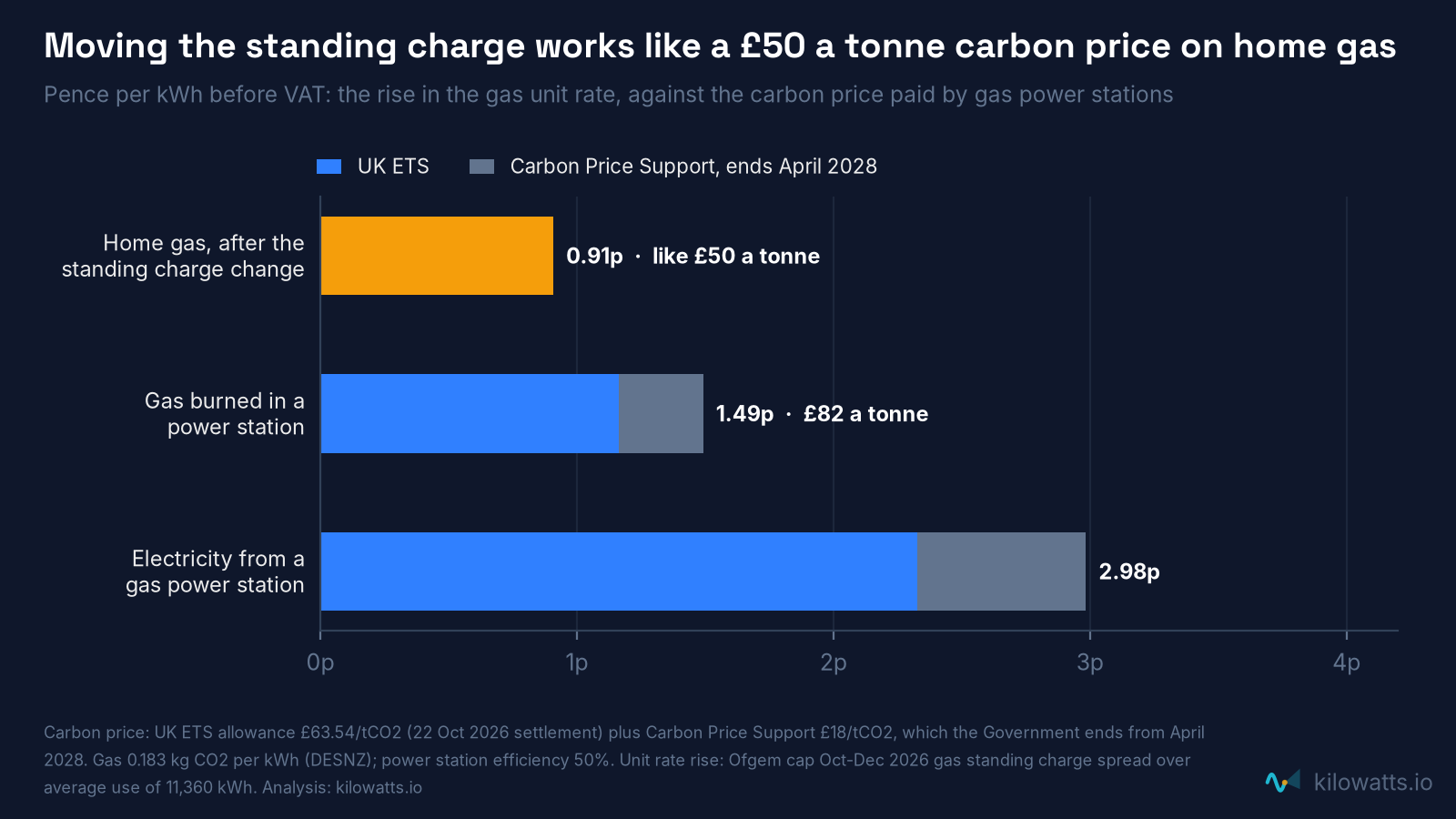
What makes it a stealth tax is where the money goes. None of it goes to the Treasury. Every gas home gets the same £108 back, as the standing charge it no longer pays. Economists call this design a carbon fee and dividend: a price on every unit, with the money handed back in equal shares, so that low users come out ahead and high users pay. Unusually for a carbon tax, that makes it mildly progressive. Britain has never had one. Now it has, without a vote on a tax or anyone calling it one.
It isn't a carbon tax by design. The 0.91p is set by suppliers' fixed costs, not by carbon, and the £50 will move with the price cap and with how much gas homes use. The average home pays no more than before. But at the margin, where decisions about boilers and heat pumps get made, it works exactly like one.
The timing lines up with the rest of carbon pricing. From April 2028 the Government scraps the £18 a tonne Carbon Price Support, taking about 0.66p off each kWh of electricity from gas power stations. That is about when the gas standing charge moves onto the unit rate: the Government has asked Ofgem to abolish it "by the end of 2027 or as soon as possible after then". Gas for power gets cheaper, and gas for heating dearer.
That is new territory for a Budget. Since privatisation, how a bill is split between a daily charge and a price per unit has been a question for Ofgem. Ofgem consulted on standing charges in 2024 as a matter of regulation. Ministers have stepped in on bills before, most obviously with the Energy Price Guarantee in 2022, but always with Treasury money attached.
A Budget is for taxing and spending, and on paper this measure does neither. The Treasury's own analysis of who gains from the Budget leaves it out, as "regulation" rather than "direct changes to the distribution of tax or public spending". In effect it is an off-budget transfer of about £650m a year, from ten million bigger homes to fourteen million smaller ones. It works like a tax and is spent like a subsidy, but it appears in neither column of the public accounts. Only the credit is on the government's books. The Resolution Foundation, which got there first, calls it part of a "shadow tax and benefit system hidden within energy bills", moving around £600 million a year; its count of losers, 9.9 million homes across Britain paying £61 more, is close to mine. Putting it in the speech is a political choice: it lets the Chancellor claim the most popular bill measure of the decade without paying for it. The last Budget moved most of the Renewables Obligation off bills and onto taxes; this one sends a new transfer the other way.
So who pays the stealth tax, and what does it buy?