


I recently attended an industry "round-table" on energy levies that was so oversubscribed that 50 people signed up. Levies are arguably the biggest financial challenge in energy, so I wanted to condense my thoughts.
Problem Statements
First, it's worth trying to summarise all the constraints around the problem.
Pushing levies into General Taxation is fanciful.
In conversations with other attendees after, I made myself a bit of an outlier for disagreeing strongly with the prevailing thought in the room, that energy levies should be put into general taxation. I have long thought this is pretty tone-deaf to the broader macroeconomic picture.
While preferences vary around the political spectrum, most voters and politicians want to spend public money on areas like the NHS, pensions or defence. Very few people want the bulk of energy costs to be subsidised. While some advocate for a more active state (e.g. public ownership) and some redistribution e.g. social tariffs, most people expect the energy industry to broadly pay its way.
Saying, "we have a problem with levies", and "we can't find a way to replace them that isn't really regressive" isn't really good enough. I get that the tax system is overall more progressive, and direct taxes on income are less inflationary. But it's incumbent on us in industry to find solutions and pay our own way in the wider economy. Plus, sensible charges are an opportunity to incentivise behaviour and reduce the overall cost of the energy system that we simply couldn't have if most of the costs were lumped into income tax or general VAT.
Standing Charges are more regressive than Council Tax
On the face of it, fixed or standing charges, especially for residential consumers have a certain economic appeal. Assuming they don't deter homes from disconnecting from the grid entirely (for gas or electricity), they don't distort the amount of energy consumed.
However, in reality I totally get why MPs (from the governing Labour party in particular) really hate standing charges:
Above Inflation But Sticky Downward
They've shot up far beyond general inflation. Even though they don't ostensibly cover wholesale energy costs, they spiked most perniciously in the aftermath of the 2022 energy crisis, at the worst possible time when the rest of the bill was also spiking due to the conflict in Ukraine. Worse still, once up they've been remarkably sticky to come back down (in contrast with tariffs per unit). TLDR, much of this is to bailout suppliers with high consumer indebtedness that hasn't recovered since 2022.
Rich vs Poor, Big vs Small
It's often said that Council Tax is pretty regressive; but at least within the same area a band H home will pay ~3 times more than a Band A property. For electricity, the occupant of a 1 bed flat in Liverpool pays the same £255/year standing charge as a castle in North Wales; a cross-subsidy nobody would advocate.
North vs South
Standing charges are set at a "regional" level, according to boundaries that were set not even when electricity was privatised in the 1990s, but how the post-war nationalised grid was grouped in the 1940s. This gives rise to very illogical arbitrary boundaries. MPs are right to feel aggrieved that standing charges in Liverpool are £255/year while more affluent Londoners pay £163/year.
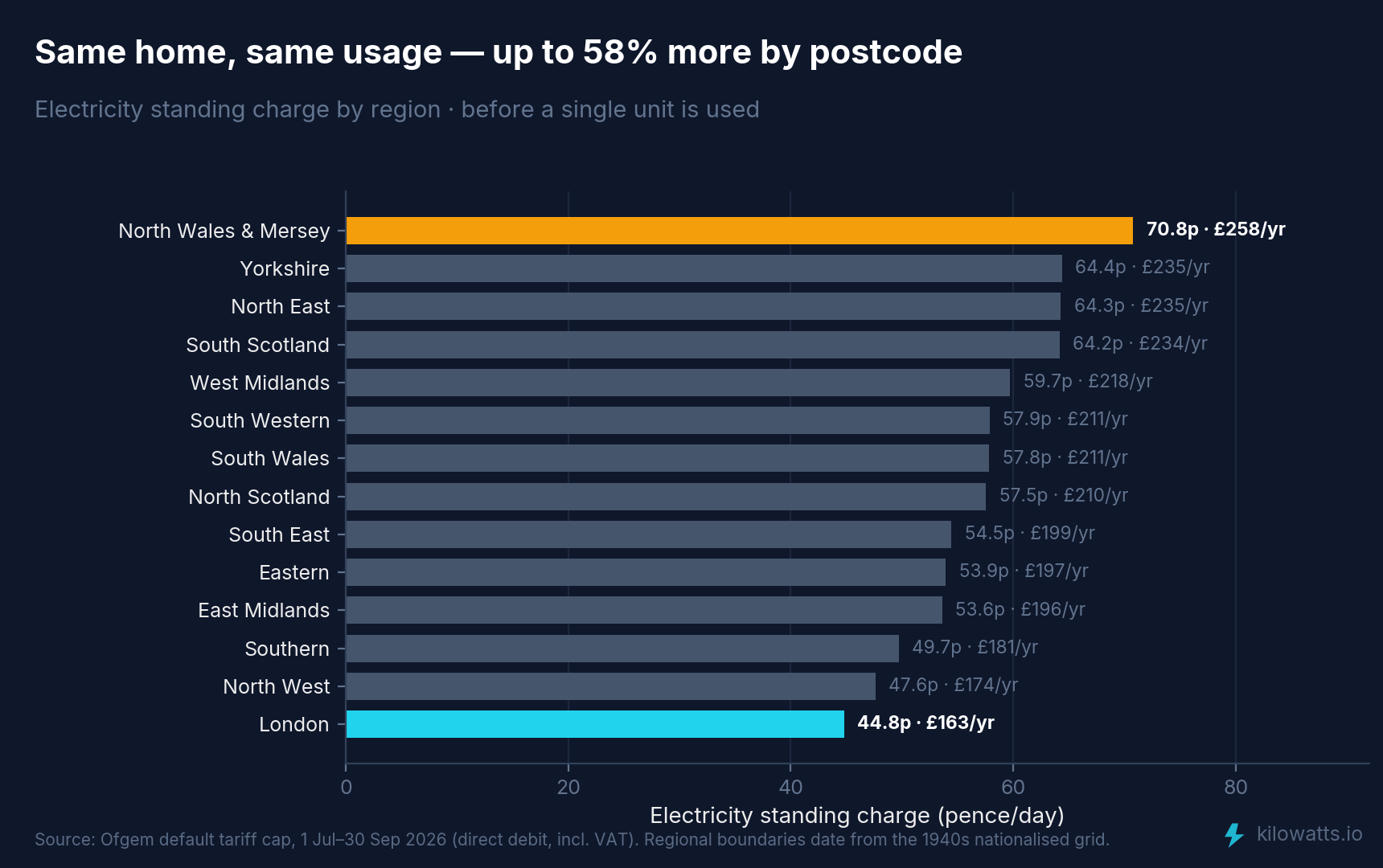
Merseyside pays ~58% more than London (£258 vs £163/yr) for the same home, before using a single unit. Source: Ofgem default tariff cap, Jul–Sep 2026.
Just tax gas screws over tenants
I confess, I used to think this was the solution. We tax gas a lot for power generation, but not in homes. Now we could tax residential gas, redress some of this imbalance, improve the "spark-gap" that deters heat pump installations.
For homeowners with resources, this carrot and stick might drive heat pump retrofit over time. But for tenants (or homeowners without spare £5,000-10,000 for a heat pump), especially privately renting ones, it's naive to think most landlords are going to rush to buy heat pumps. In theory, landlords fitting heat pumps should be able to capture higher rents over time. But that assumes tenants accurately compare the running costs of homes and negotiate proactively on rents at the start and on renewal of tenancy. I'm not sure this has ever really been the case, and it's especially doubtful after the recent renters' reforms.
Taxing gas usage ignores the principal agent issue, and would if anything, disenfranchise a more vulnerable cohort of the population, and at the margin hinder their savings rate and ability to get onto the property ladder.
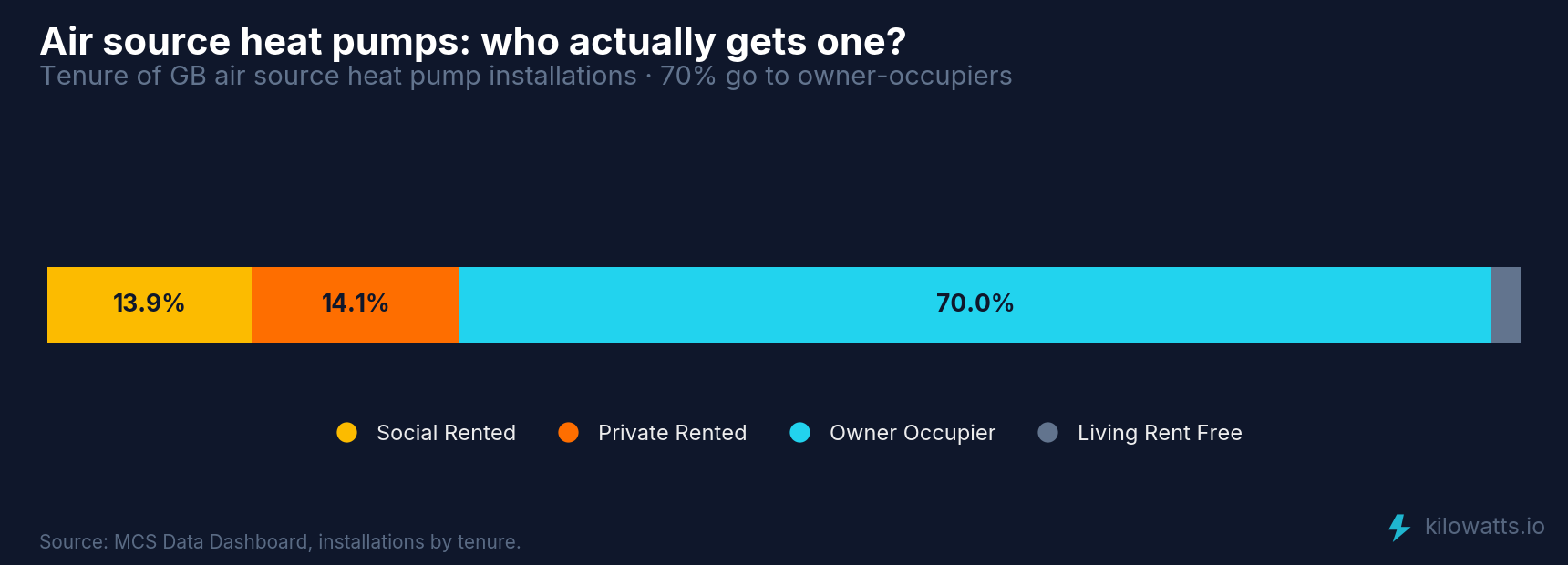
70% of GB air-source heat pump installations go to owner-occupiers; private renters are barely served. Source: MCS Data Dashboard.
Gas is a poor taxbase
There are more reasons gas is a poor choice for a levy (tax base), especially from domestic consumers. First, the demand is far more seasonal than electricity, cashflows stack up in the winter and the system almost goes dormant in the summer (serving hotwater and cooking but little else). Second, winter demand varies significantly, 10-20% year on year depending how cold a winter we have; setting tariffs in advance of the winter risks a cashflow/budgeting problem if the costs of the renewable system are largely fixed in advance, but the weather radically changes the levies raised. Third, gas has an uncertain long-term future, at least if we succeed in decarbonising. Tax regimes are notoriously hard to unwind once entrenched, and I can understand why a prudent, long-term-focused Treasury official would be reluctant to repeat the fuel-duty trap: building a major revenue stream on a commodity we're actively trying to phase out, then watching the receipts erode while finding it politically near-impossible to raise the rate or replace it.
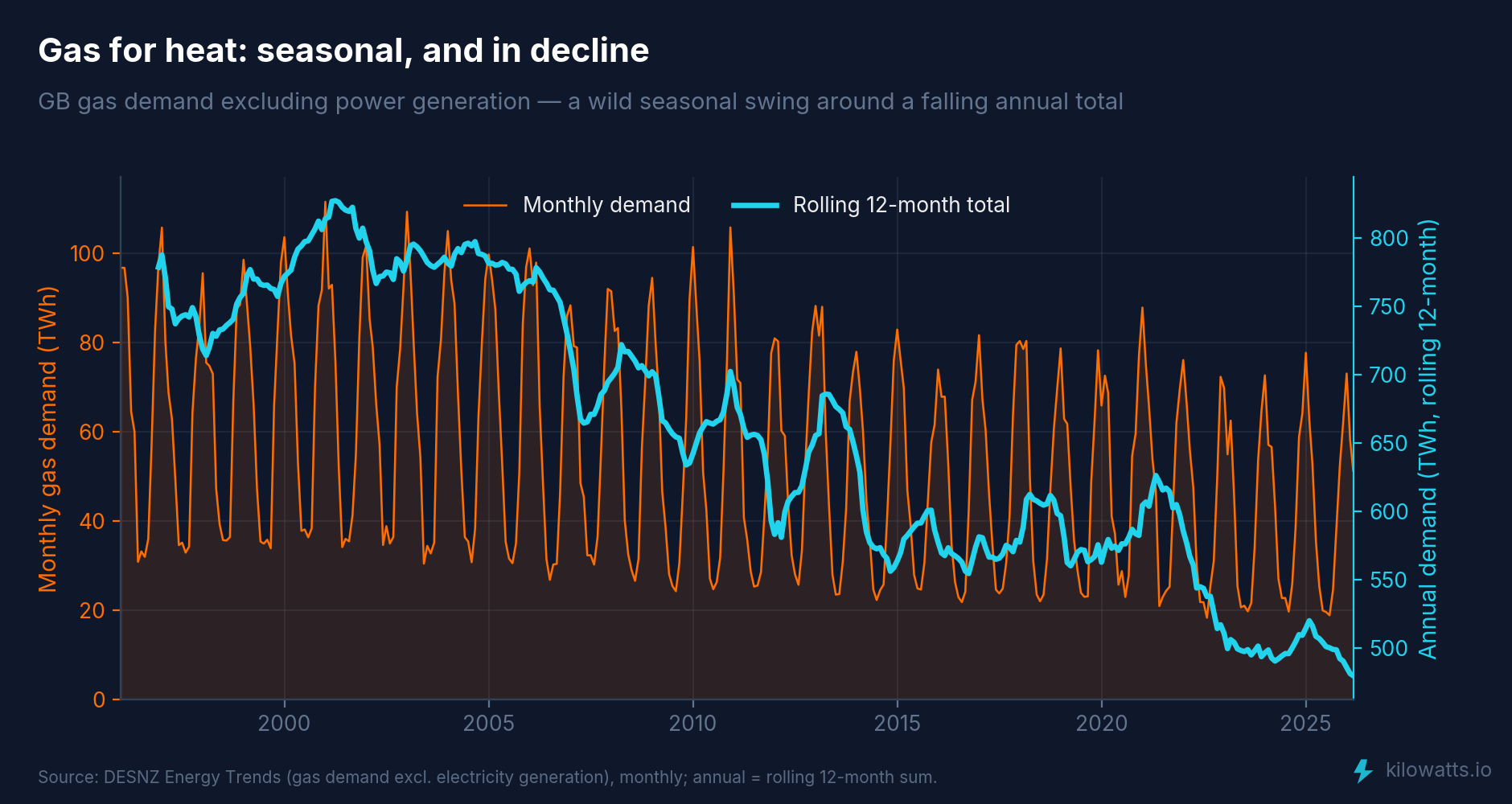
GB gas demand for heat — excluding power generation — swings sharply with the seasons while its annual total falls steadily (~800 TWh to ~490 TWh). Both are awkward properties for a tax base. Source: DESNZ Energy Trends.
Volume based grid levies are backward
Our energy system was built and privatised at a time when fuel in some shape or form accounted for the majority of bills, both for gas and electricity. As recently as 2010, raising levies per kwh was a rough and ready way to share the burden according to how much consumers used. However since then, the traditional assumptions have one by one fallen away.
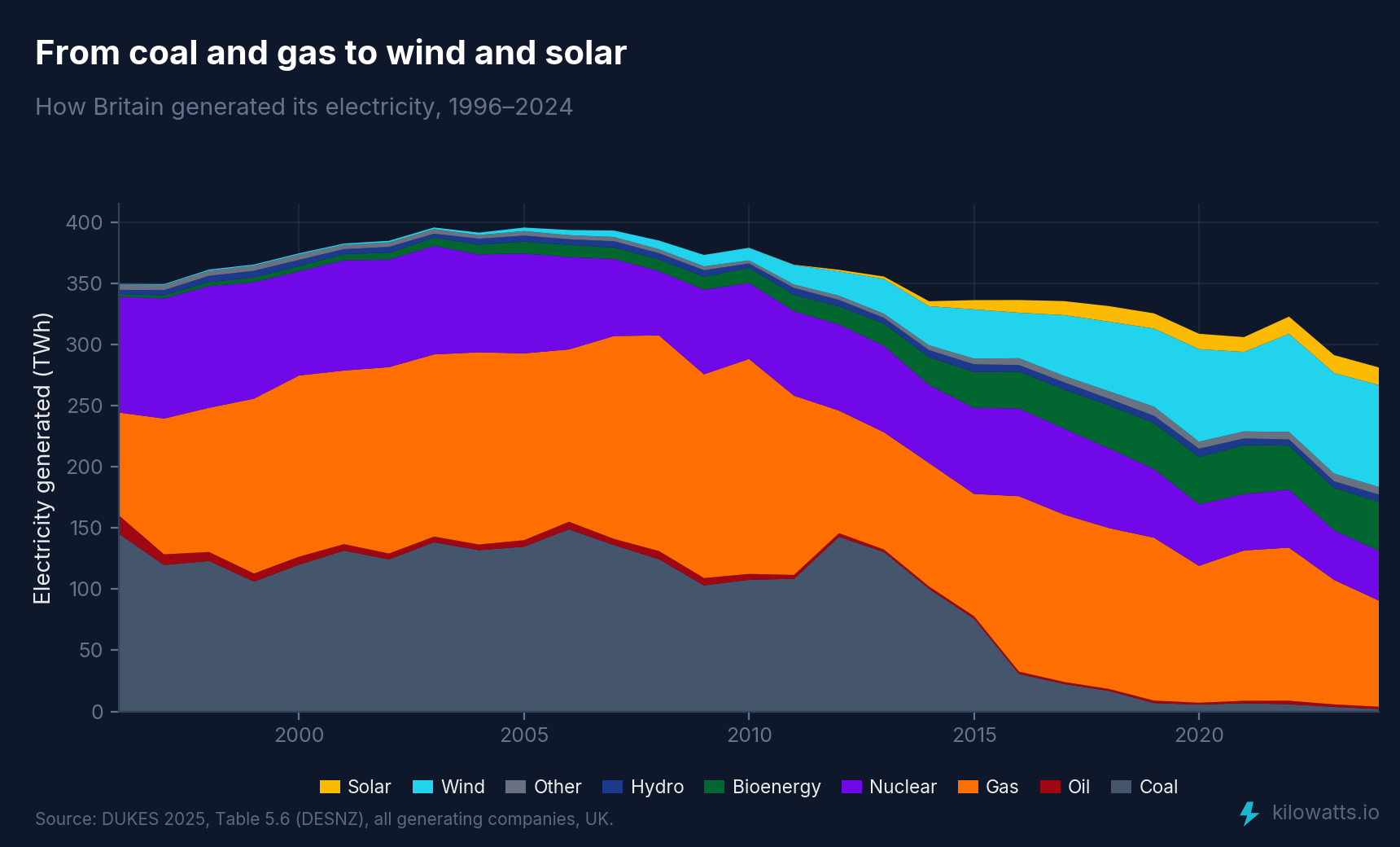
From coal and gas to wind and solar: the mix that per-unit levies were designed around has been turned inside out. Source: DUKES 2025, Table 5.6.
Tax Avoidance Behind the Meter
The collapse in PV costs means better resourced homeowners and businesses can bypass the grid entirely for much of the year; and it's not credible to implement the equivalent of a window tax or levy on self-generation. This mindset can be extended to broader "private-wire" agreements that bypass grid levies for entire industrial estates, or datacentres. Either way, such privileged users contribute less but rely on the grid more when it's most expensive to run i.e. in winter.
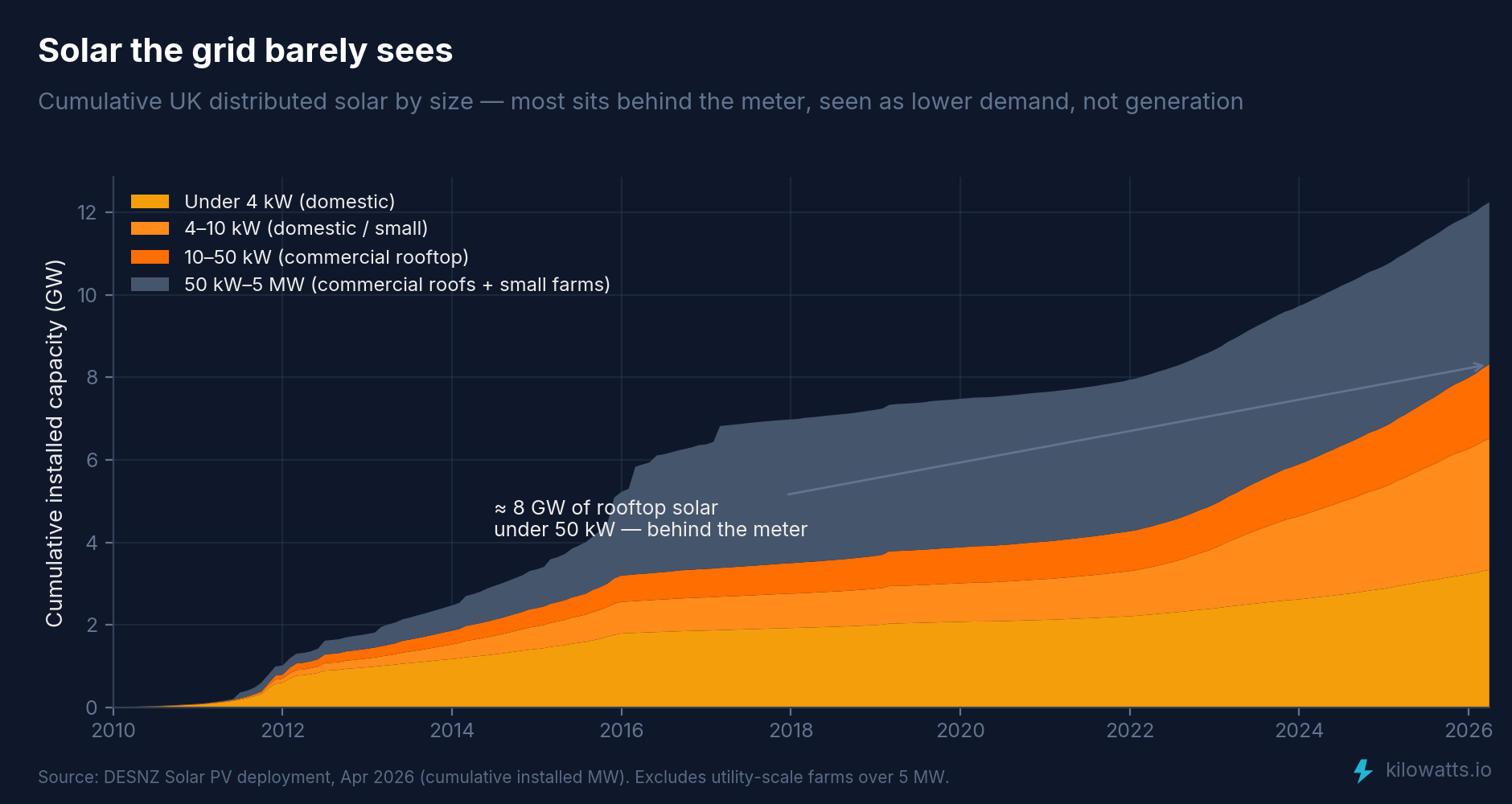
~8 GW of sub-50kW rooftop solar (domestic + commercial) now sits behind the meter — invisible to the grid records we celebrate, and largely beyond the reach of per-unit levies. Source: DESNZ Solar PV deployment.
Interest Rates have exploded
The pivotal decarbonisation decisions taken in the 2010s naively assumed interest-rates and inflation would stay low. The reality since 2022, has alongside record material inflation for steel, copper, transformers and turbines raised the cost of the electrified grid relative to earlier expectations, and relative to traditional fossil fuel options, at least outside the most extreme fuel price spikes. Even Government gilts costs are under pressure.
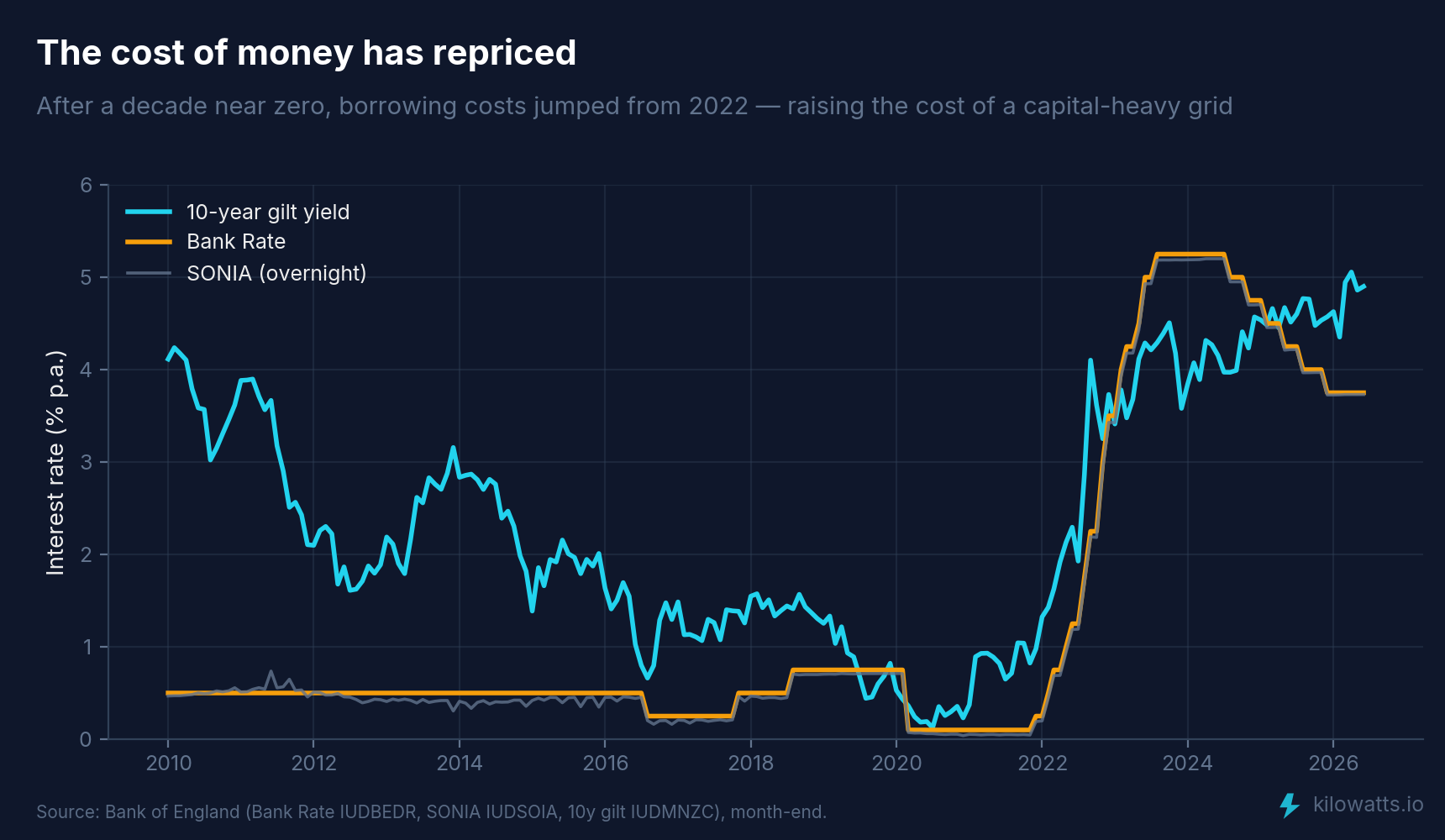
After a decade near zero, borrowing costs repriced sharply from 2022 — raising the cost of a capital-heavy grid. Source: Bank of England.
Not all energy volumes create an equal burden
When most electricity came from gas (or further back, coal) produced in Britain, it didn't massively matter when in the day/year it was consumed. With the decline of the North Sea and shift to renewables, the cost of energy, especially at the margin, is increasingly concentrated into periods with low wind and solar. This is especially true in winter as we electrify more heating demand. However, the levies we pay are generally smeared across broader seasons (or years), a situation increasingly untenable.
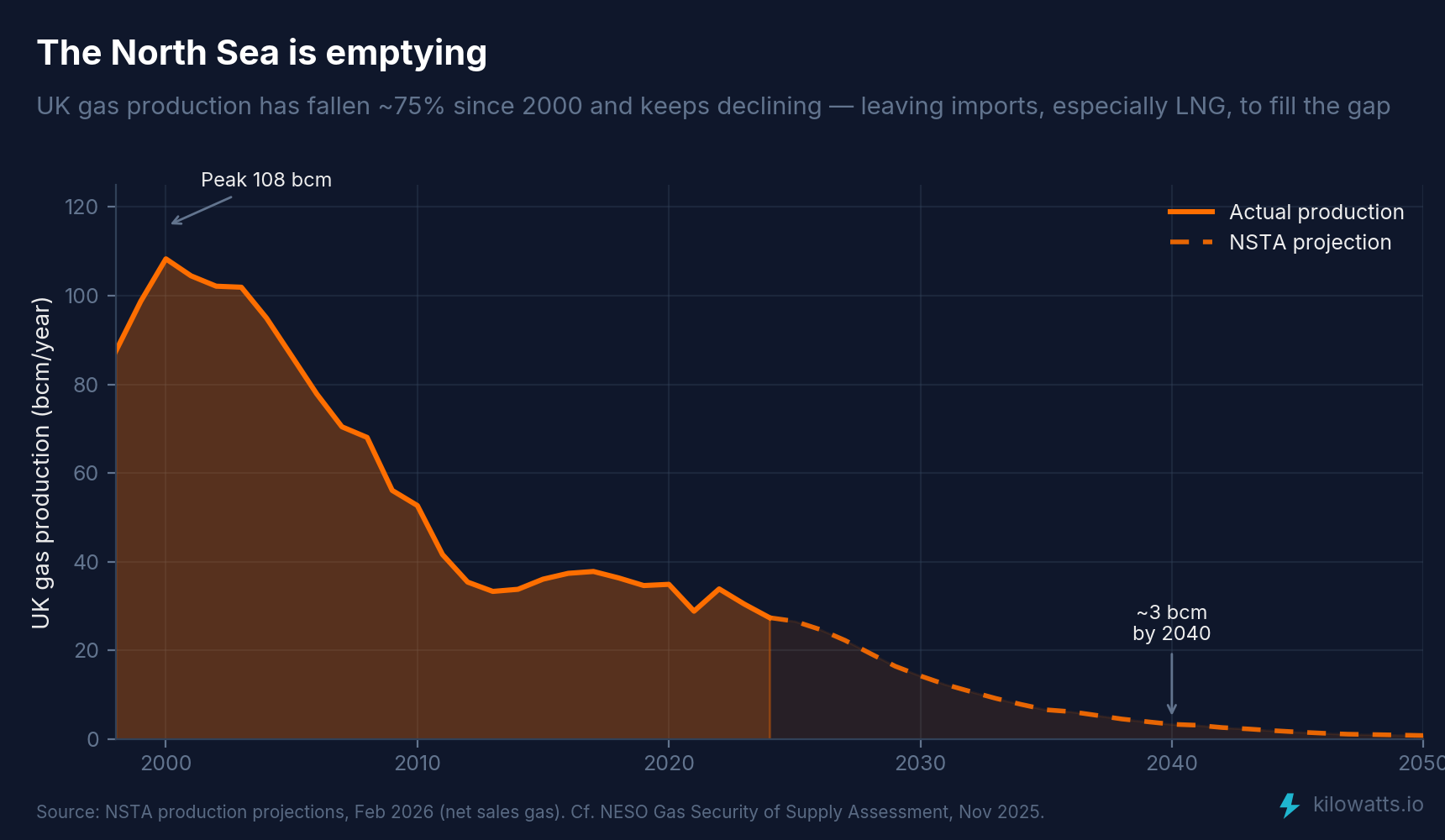
UK gas production has fallen from 108 bcm (2000) toward ~3 bcm by 2040, leaving imports — especially LNG — to fill the gap. Source: NSTA; cf. NESO Gas Security of Supply Assessment, 2025.
The Inflation Circularity and Cost of Living
Energy is a major inflation basket item, and many households on Ofgem price-cap tariffs have their bill prices set administratively. As Government's own outgoings are largely inflation-indexed (gilts, welfare, public sector payroll), radical energy levy reform has knock-on effects to other sensitive policy areas that losers will hold Government accountable for.
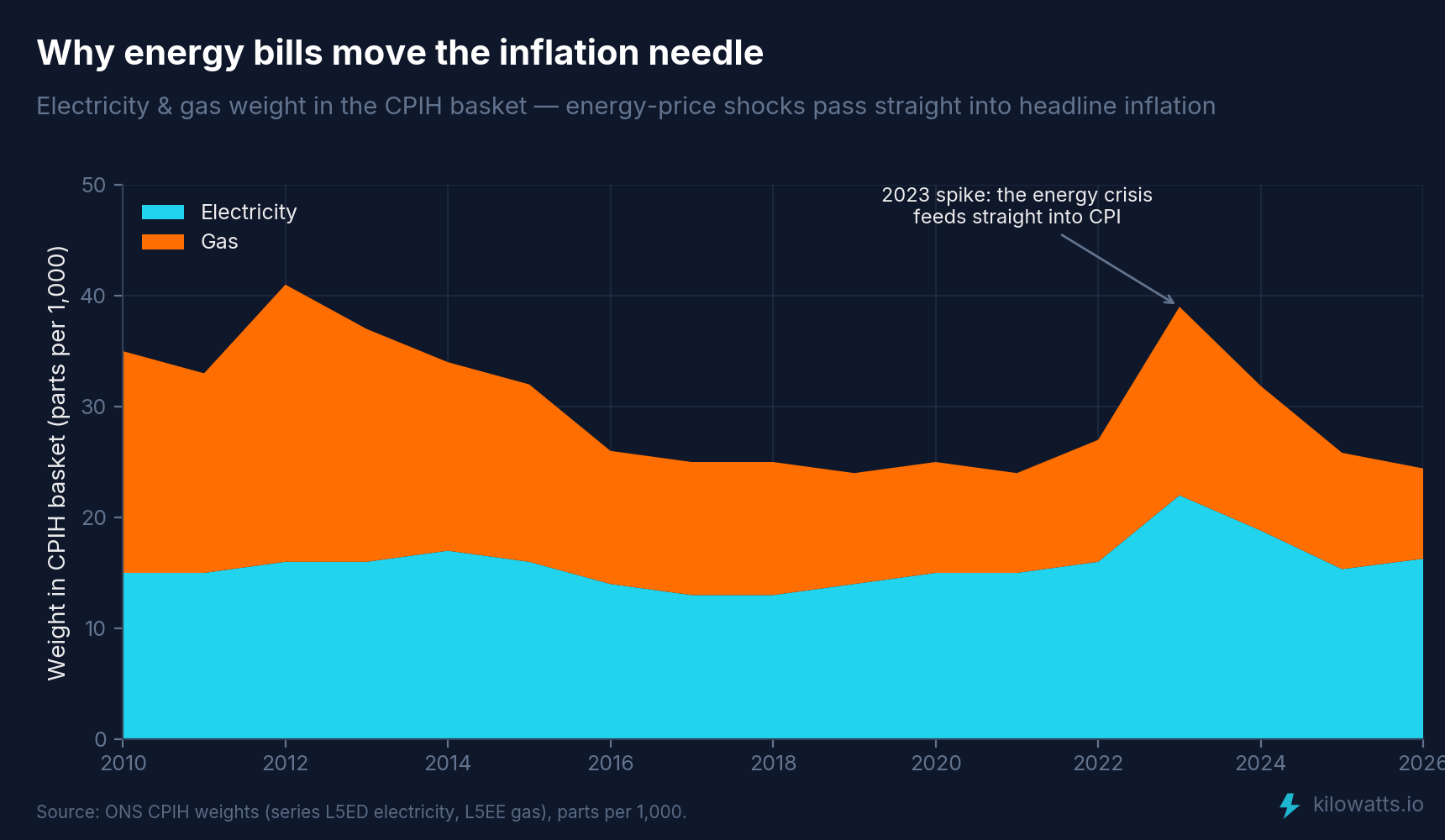
Energy's weight in the CPIH basket spiked in 2023 — energy-price shocks pass straight into headline inflation. Source: ONS CPIH weights.
Levies are Complex
Energy levies are, like the tax system more generally a byzantine patchwork of charges that have evolved incrementally. Governments have used them as an "off balance sheet" way of financing welfare programmes like the warm home discount. Residential customers (who can vote!) have gotten off light compared to businesses, and electricity consumers have been burdened more than gas customers. Worst of all, insiders with the best consultants can, like tax advisers/accountants, limit the levies without adding that much social value, leaving a bigger burden for the less well equipped/advised.
Better Alternatives
How do we raise the money needed to keep the energy system going, fairly and without deterring the energy transition or economic growth?