


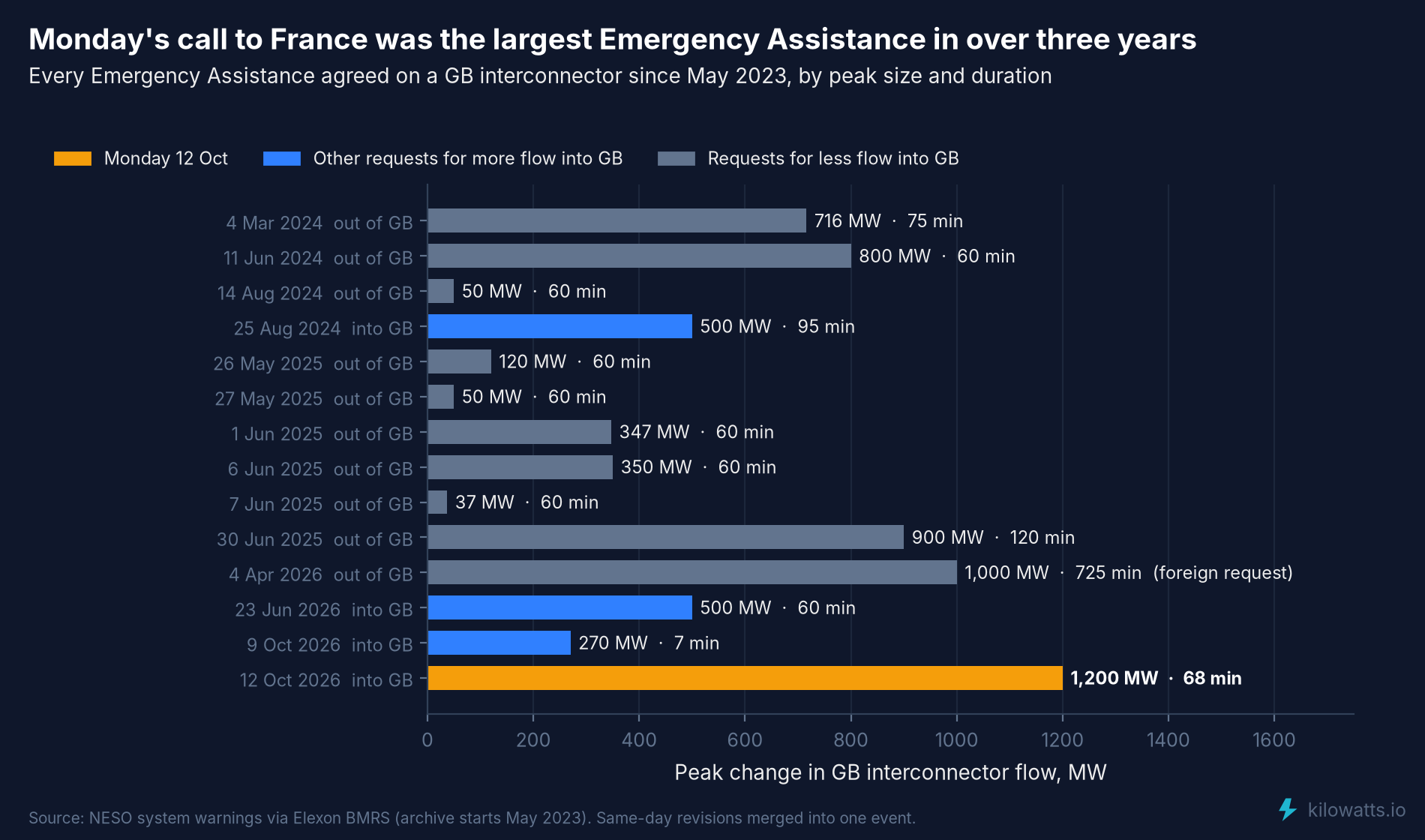
At 16:50 on Monday 12 October, NESO issued a system warning. It had asked France for Emergency Assistance, and France had agreed. Britain's imports would rise by 700 MW from 16:52 until 18:00. At 17:13 a second warning raised that to 1,200 MW.
Emergency Assistance is the instrument of last resort between neighbouring system operators. It is what you reach for when the ordinary tools have run out.
At 1,200 MW this was the largest Emergency Assistance on a British interconnector since at least May 2023, which is as far back as the published warnings go. The last time NESO asked for emergency imports on any scale was the evening of 23 June, when it took 500 MW for one hour. Monday peaked at more than twice that and delivered roughly 1,200 MWh against 500.
Here is the odd part. Britain was not short of electricity. In both half-hours of the emergency, the national system was long: there was more generation than demand. The shortage was local. It was in the South East.
System frequency says the same thing: it stayed between 49.83 and 50.18 Hz all day, inside the normal operating band, and the only wobble around the emergency was the usual swing as the interconnectors changed schedule on the hour.