


There's a new kind of curtailment. It isn't wind. It's exports.
On the evening of 23 June, at seven o'clock, Britain's system price hit £800 a megawatt-hour. We were short of power.
At that moment, Viking Link was exporting 1,140 megawatts to Denmark.
Also at that moment, the electricity system operator was paying £835 a megawatt-hour to stop BritNed exporting to the Netherlands. Grain's open-cycle gas turbine was being paid £496 a megawatt-hour to turn up. And in Scotland, Seagreen was being switched off.
Short of power. Exporting power. Paying to stop exporting power. Paying to turn on a peaker. Switching off a wind farm. All in the same hour.
Nobody in that paragraph did anything wrong. That is what makes it worth writing about.
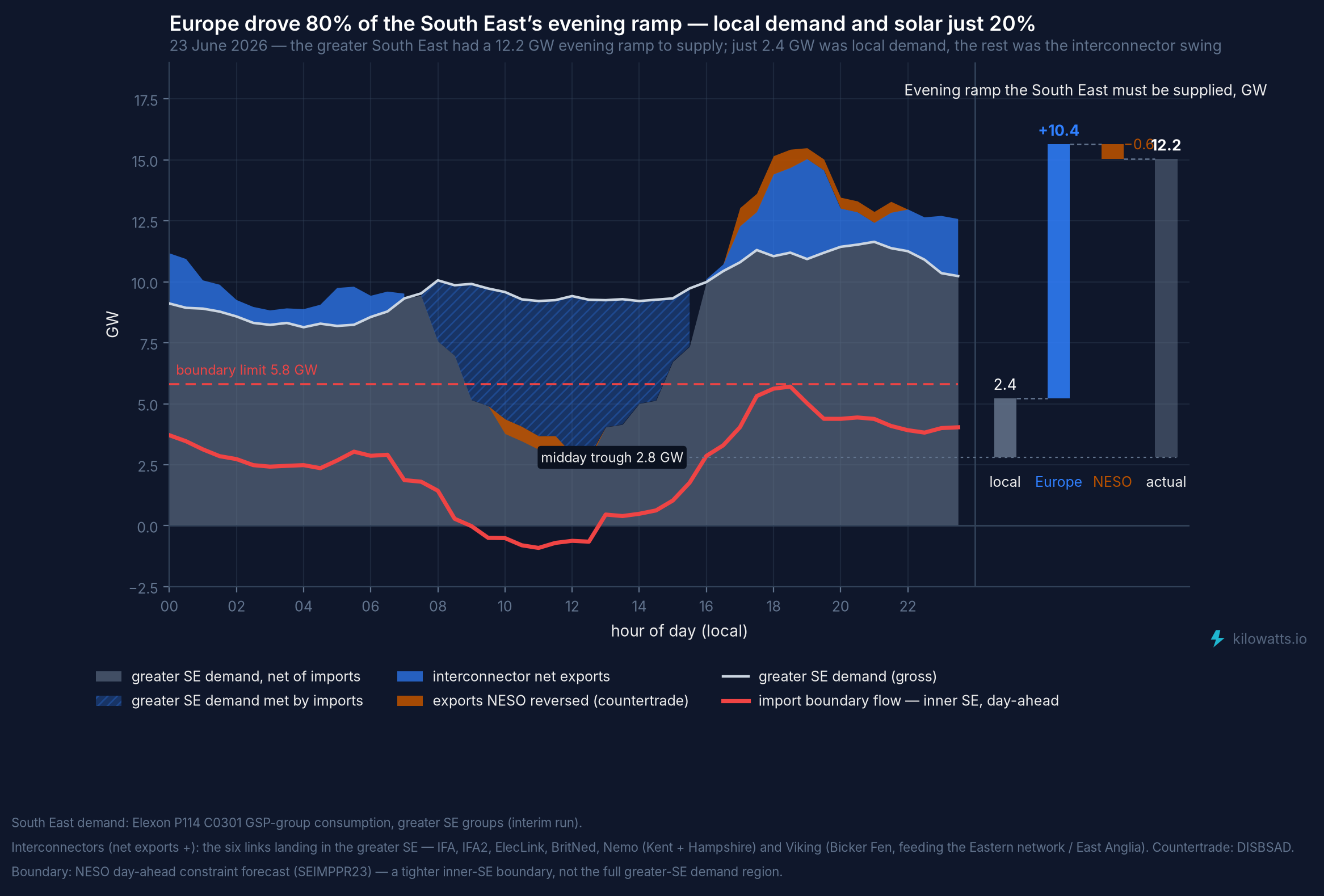
Here is that whole evening in one chart. Don't decode every band yet — just notice that the wall of the evening ramp is blue, and the blue is Europe.
The instrument nobody counts
When Britain's grid operator wants to reverse a scheduled flow on an interconnector, it cannot simply instruct it. Interconnector capacity is held by traders — the firms that bought it at auction and sold the power on. So NESO goes to whoever nominated the flow and asks them to price buying it back.
It's called countertrading. And it has never once appeared in the Balancing Mechanism, because the counterparty isn't a power station being dispatched — it's a firm unwinding a position. There are, across the whole archive, precisely zero bid-offer acceptances on any interconnector unit.
It surfaces instead in a settlement file called DISBSAD, which names the firm, the link, the volume and the cost, and leaves you to work out the price yourself. It is entirely public and almost entirely unread.
Since November 2021, NESO has spent £616 million buying back scheduled British exports. Some 2.3 terawatt-hours of them, at an average of £268 a megawatt-hour, across 47 counterparties.
If you want to know whether the numbers are real: the single most expensive trade in the file is £9,724.50 a megawatt-hour, paid on Nemo Link on 20 July 2022, the day Britain hit 40°C. That's the number that made the papers. It's in there, recoverable, alongside £35 million of interconnector spend on that day alone.
That day was the energy crisis, not the norm — take it as proof the file is real, not that £9,724 is typical. The structural story is in the quieter years since.
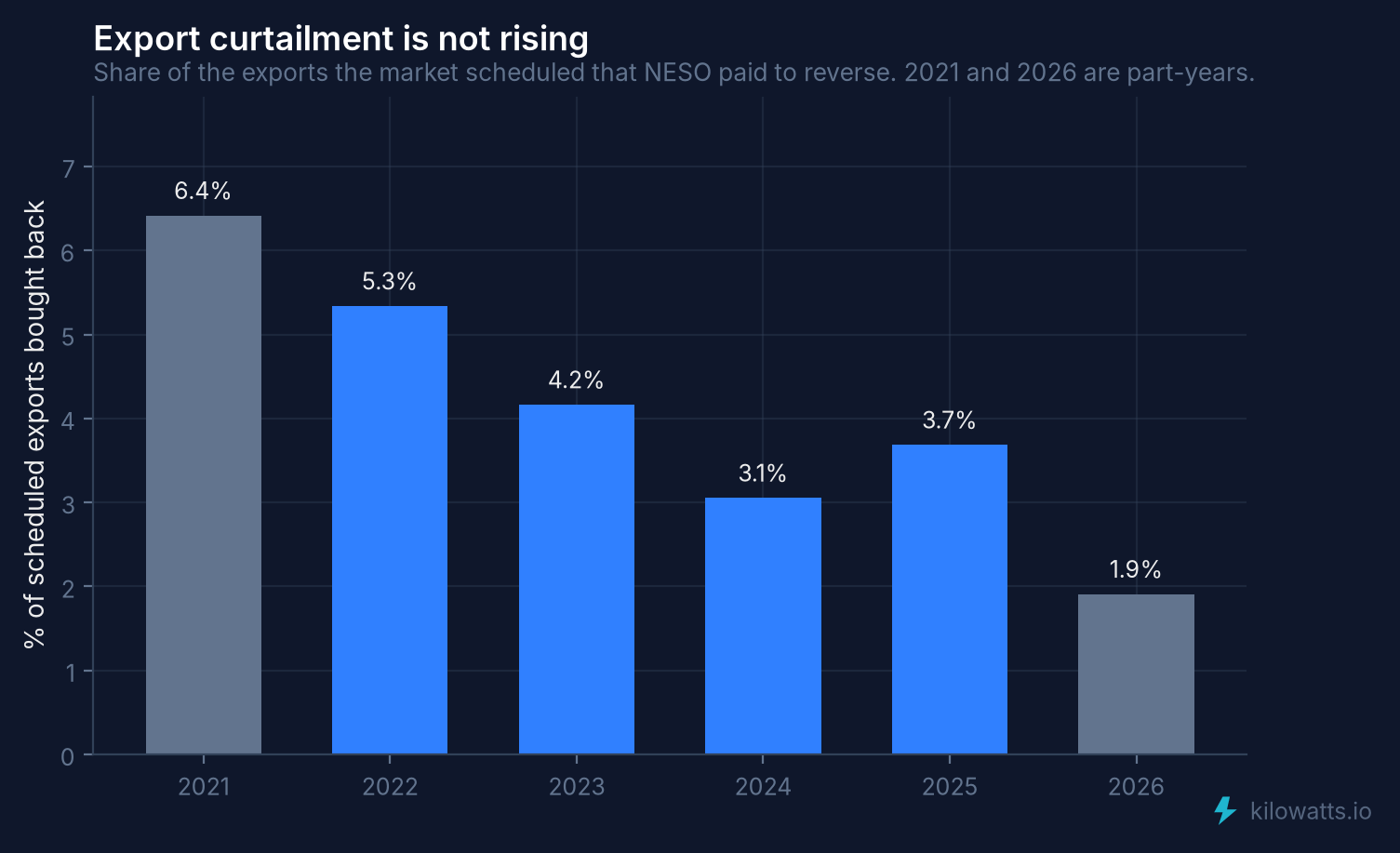
Now let me take the obvious story away from you
You would expect this to be rising. It isn't. As a share of the exports the market actually scheduled, buy-backs have fallen — 5.3% in 2022, 1.9% so far this year.
You would expect it to be summer. It isn't. May to September accounts for about 40% of the volume, which is roughly what the calendar predicts.
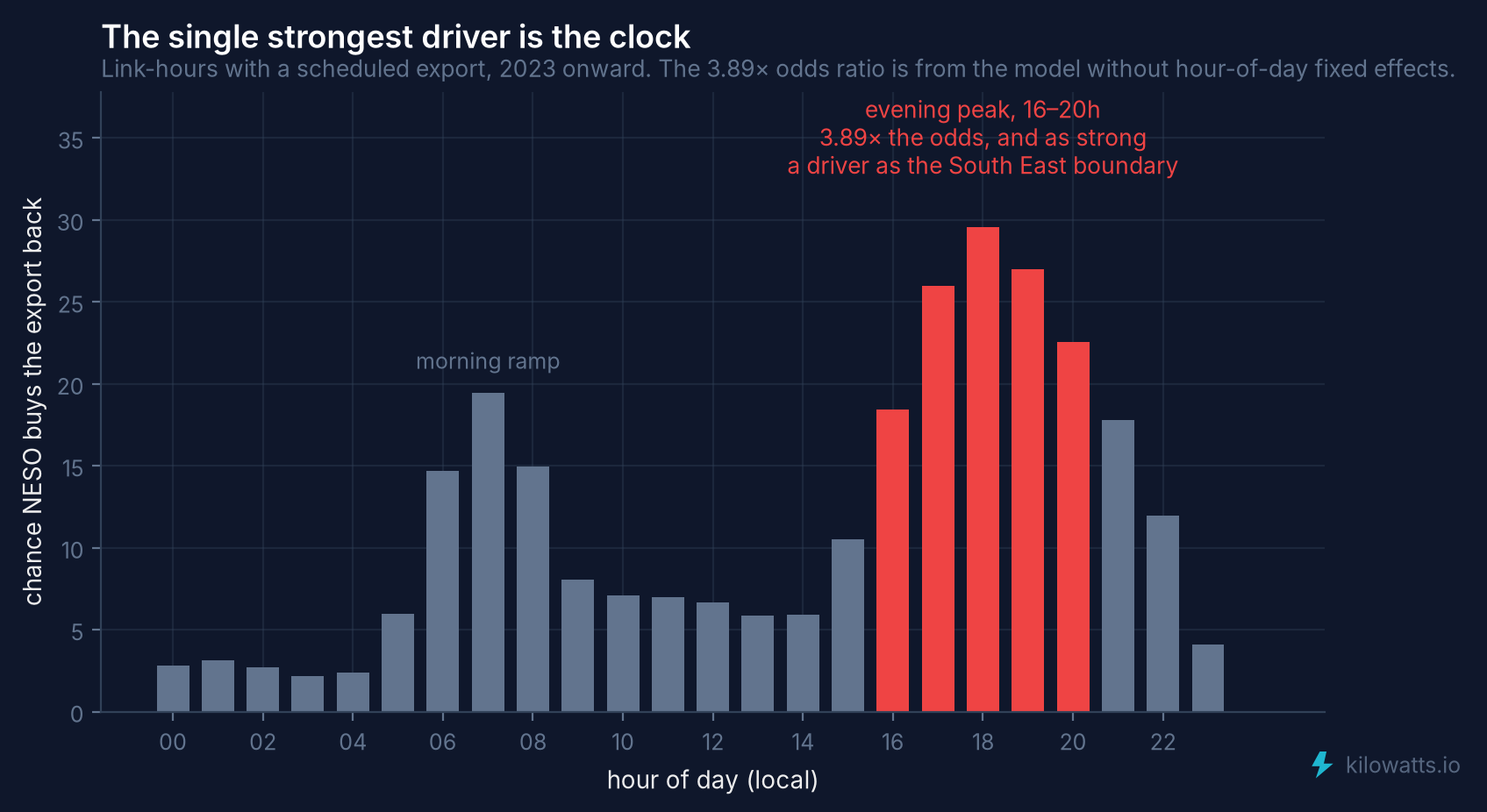
What it is, overwhelmingly, is teatime. At six in the evening, 29.6% of scheduled exports get bought back. At three in the morning, 2.8%.
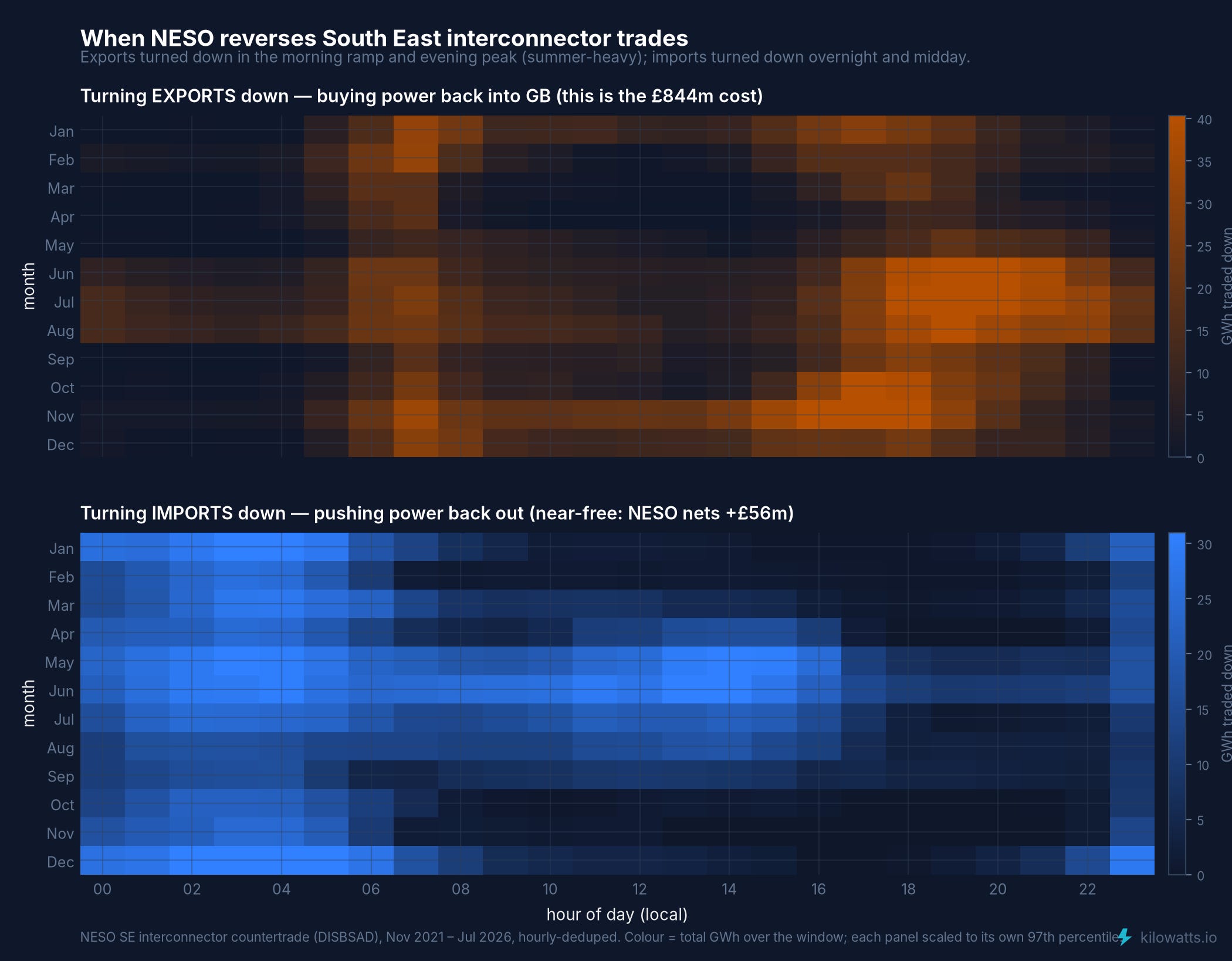
Widen the lens to the whole year and the whole day and a second pattern surfaces: NESO runs two opposite operations. It buys exports back in the morning and evening peaks — the move that costs the money — and it sells surplus back out overnight and at midday, which earns almost as much as it spends. Only one direction is expensive, and it is the teatime one.
And in about two-thirds of the hours where NESO buys an export back, Britain is short — the system needs more power, not less. This is not, at root, a story about surplus wind with nowhere to go. It is a story about the market scheduling exports at the exact hours Britain needs the electricity, and someone having to pay to undo it.
That is what leaving the EU's day-ahead market coupling bought us. Interconnector capacity is now auctioned separately from day ahead price auction (discovery). So flows can run against the spread. And if the grid operator wants to reverse this, especially if the reason for changing the flows is because of domestic transmission constraints, it can end up picking up a bill for it.
The rollercoaster behind teatime
The buy-backs land at teatime all year round. But the shape of day that makes teatime dangerous is a summer thing — and it is getting more violent.
Take a clear day in late June. At midday the South East is barely calling on its own generation at all: three gigawatts, sometimes less. Cheap continental solar is pouring in across the Channel, embedded panels are working behind the meter, the interconnectors are running flat out as imports. The region is coasting.
Then the sun goes down. Solar collapses, the imports swing to exports, demand climbs — and the call on generation that was three gigawatts at noon is twelve by eight o'clock.
That swing, trough to peak, has doubled with the seasons: two and a half gigawatts in midwinter, five and a half in June. On 27 June this year it hit 12.5 gigawatts in a single afternoon — steeper even than the 23rd. Run that same picture as a rolling average across three years and you can watch the midday floor drop away every summer and climb back every winter.
And the intuition is backwards. The evening peak isn't higher in summer — it's lower. A January teatime draws more power than a June one. What makes midsummer extreme is the floor falling out at midday: the trough drops from ten gigawatts in winter to three and a half in June, hollowed out by solar and imports. The ramp is steep because the floor collapsed, not because the ceiling rose.
Nor is it mostly a British demand story. Split the day into local demand and the interconnector swing, and in June about sixty per cent of the ramp is the interconnectors — European solar flowing in at noon and back out at dusk. Local demand does the smaller half, and barely moves with the season.
One honest note on that "demand": it is metered at the grid supply points, so it is already net of Britain's own embedded and rooftop solar. The domestic half of the ramp is therefore demand and our own solar fading out at dusk — not demand alone.
It is a flexibility problem wearing a capacity mask. Nobody is short of megawatts at midday. Britain is short of the machinery to climb from a three-gigawatt afternoon to a twelve-gigawatt evening — which is precisely the manoeuvre that jams the boundary and pulls in the buy-back. And it is exactly the manoeuvre a battery is built for: fill up on the midday glut, empty into the teatime wall. The single clearest thing Britain could do about any of this is build — and use — far more storage, sited where the ramp actually bites.