


Correct as at 21 November 2026. Which machines are running comes from NESO's availability data to 15 November and Elexon's unit notifications to 21 November; metered running to 4 November; voltage trades to 12 November.
A synchronous compensator is a power-station generator with nothing driving it: a big spinning rotor, often with a flywheel, drawing a megawatt or two to keep turning. It makes no energy. It does provide what a grid full of wind, solar and interconnectors is short of: inertia, short-circuit strength, and reactive power to hold voltage in line.
NESO has been buying them since 2020, as "an economic alternative to the balancing mechanism". That alternative is paying gas plants to run overnight, purely so their generators spin in the right place. So I asked two questions. Did NESO buy the machines in the right places? And did they turn up?
One in 16
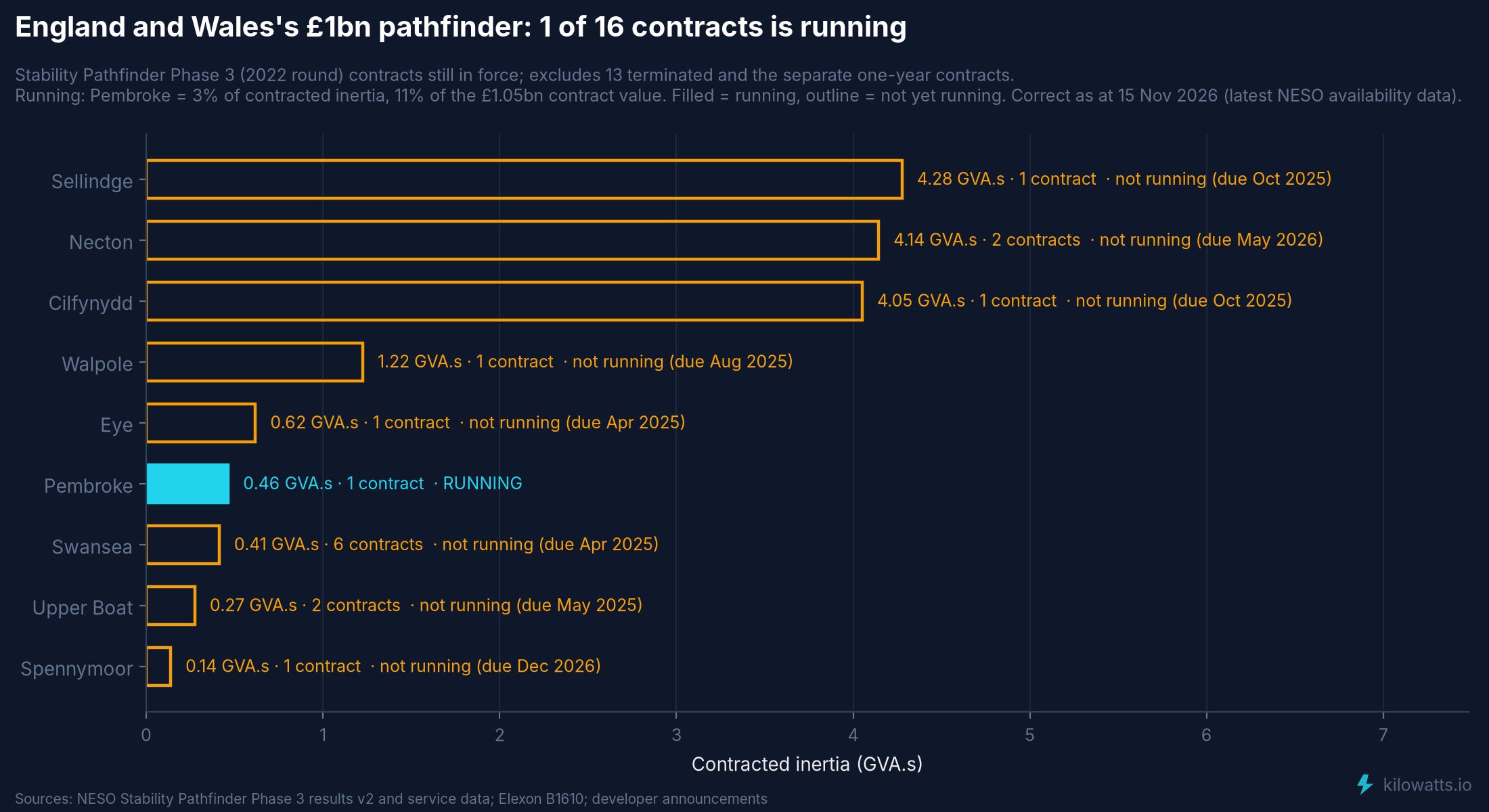
NESO's England and Wales round signed 29 contracts in 2022. Thirteen have since been ended. Of the 16 left, one is running: Pembroke. That is 3% of the contracted inertia, or 11% of the contract value, because Pembroke is a small machine. Three big machines, at Sellindge, Necton and Cilfynydd, hold 80% of the inertia, and none has started yet.
They run when they're built. Most aren't
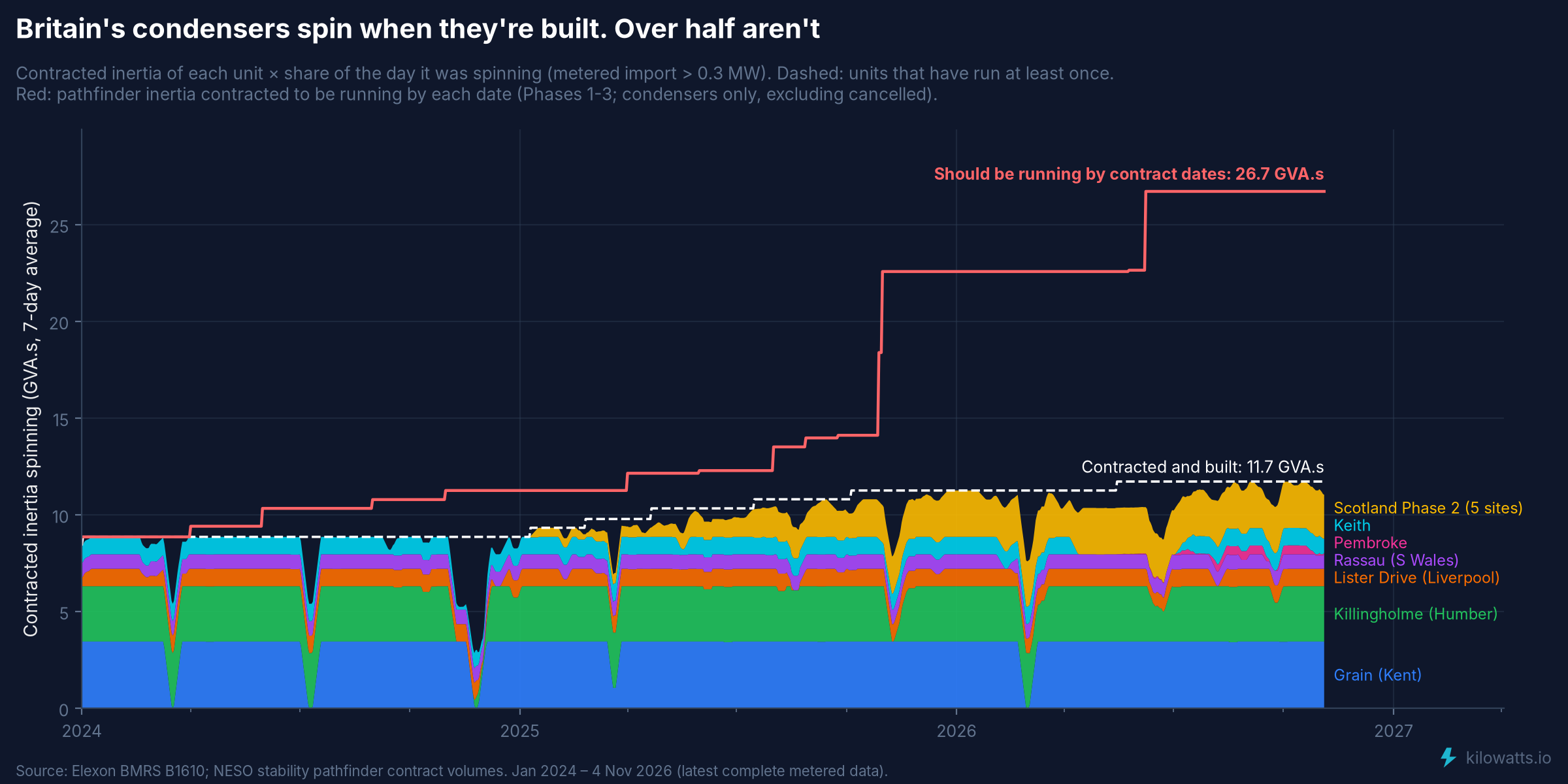
The 15 metered units spin 94–98% of the time, with no daily pattern. When they stop, it's for days or weeks at a time, for maintenance or faults. They're paid to be available, not dispatched.
The gap is the machines that never arrived. By their contract dates, 26.7 GVA.s of purpose-built condensers should now be spinning. 11.7 GVA.s is built, and it is nearly all running. The step in late 2025 is the Phase 3 machines in England and Wales falling due: Sellindge and Cilfynydd alone are 8.3 GVA.s.
Where the machines went
The first wave (Phase 1, 2020) went back to old power station sites, often reusing the old kit:
At Killingholme, generators from a 1992 PowerGen gas plant were given flywheels.
At Deeside, a whole 1994 gas plant now spins without fuel.
Grain has new machines on the footprint of the demolished oil station.
Lister Drive connects through the substation of Liverpool's old coal station.
Phase 2 (2022) went to new-build units beside Scottish substations, for short-circuit strength on a wind-heavy network. Phase 3 (November 2022) was England and Wales: 29 contracts worth £1.33bn, for service from 2025. That's where delivery has fallen furthest behind.
Where the voltage money goes
NESO's national voltage bill went from £60m in 2019/20 to a record £268m in 2023/24. This year it's at £178m by early November. Its regional breakdown stopped in May 2025.
There's a better source. NESO's published trade book gives each trade a reason code, and voltage trades are coded by the zone that needs them. Matching each trade to Elexon's records names the plant that was paid.
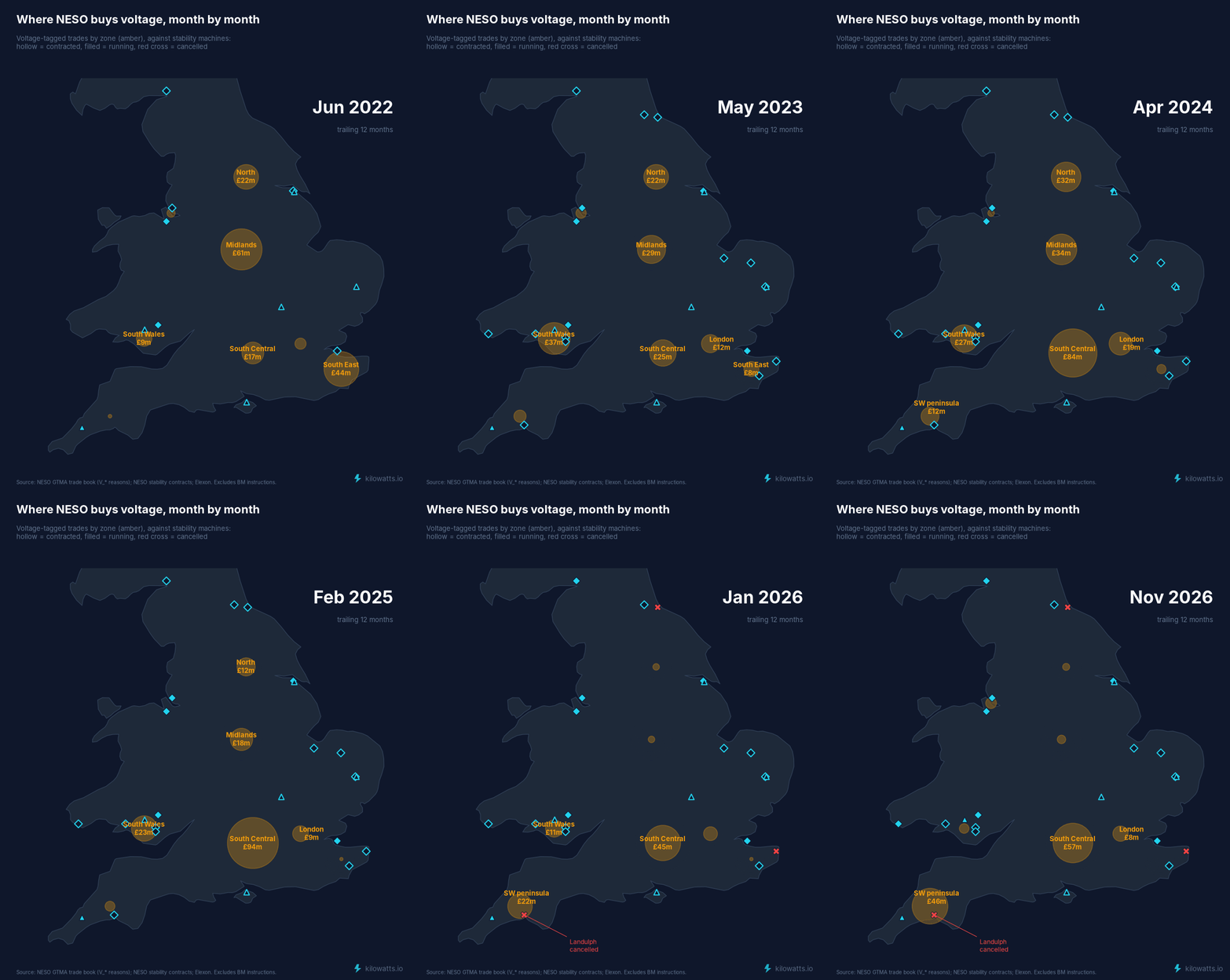
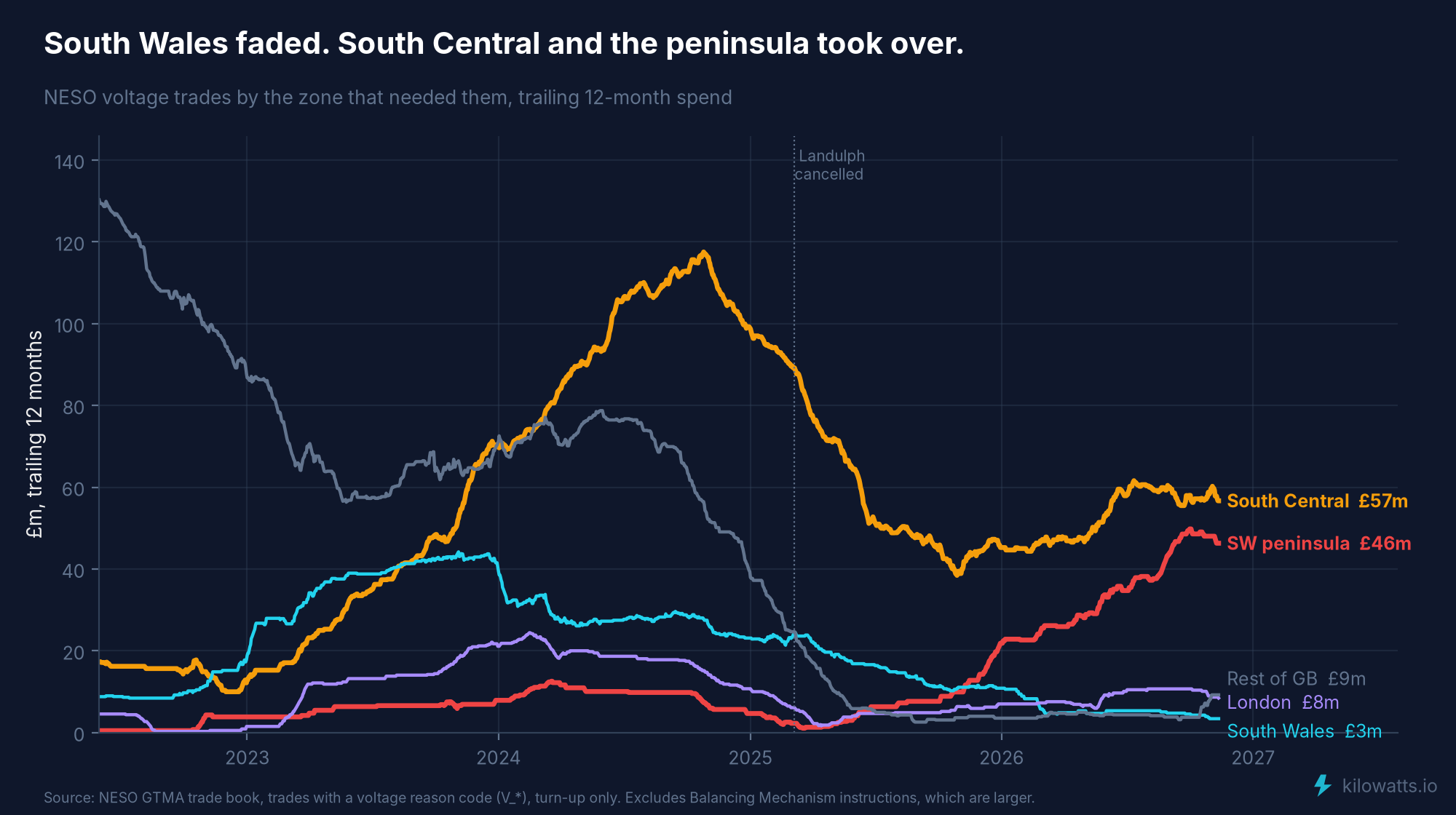
South Wales used to be the problem, and it has faded. Since spring 2025 the money has gone to two places:
South Central England (Bramley, Didcot, Fleet): £88m since April 2025.
The South West peninsula: £57m since April 2025. It was £1.3m in all of 2024/25.