


One recent weekday afternoon, a gas plant in the south of England told the grid it was switching off.
There was nothing unusual about the message. Every power station sends NESO, the system operator, a plan for each half-hour, and plants come off all the time. What made this one interesting was the timing. The evening peak was a few hours away, the market price of power was rising, and the margin of spare capacity was tight: NESO's own forecast had under 10 GW of headroom.
A gas plant like this can't simply flick back on. Once it's off, it has told NESO it must stay off for several hours. So a switch-off in mid-afternoon is a switch-off for the whole evening.
NESO didn't let it go. It paid the plant to keep running, at a reduced output, for about six hours. The price for most of that time was £600–700 per megawatt-hour. The market price over the same hours was about £250. By the end of the evening the bill was about £1 million for 1.7 GWh of electricity. In the same hours NESO was buying imports from France and Belgium at around £300.
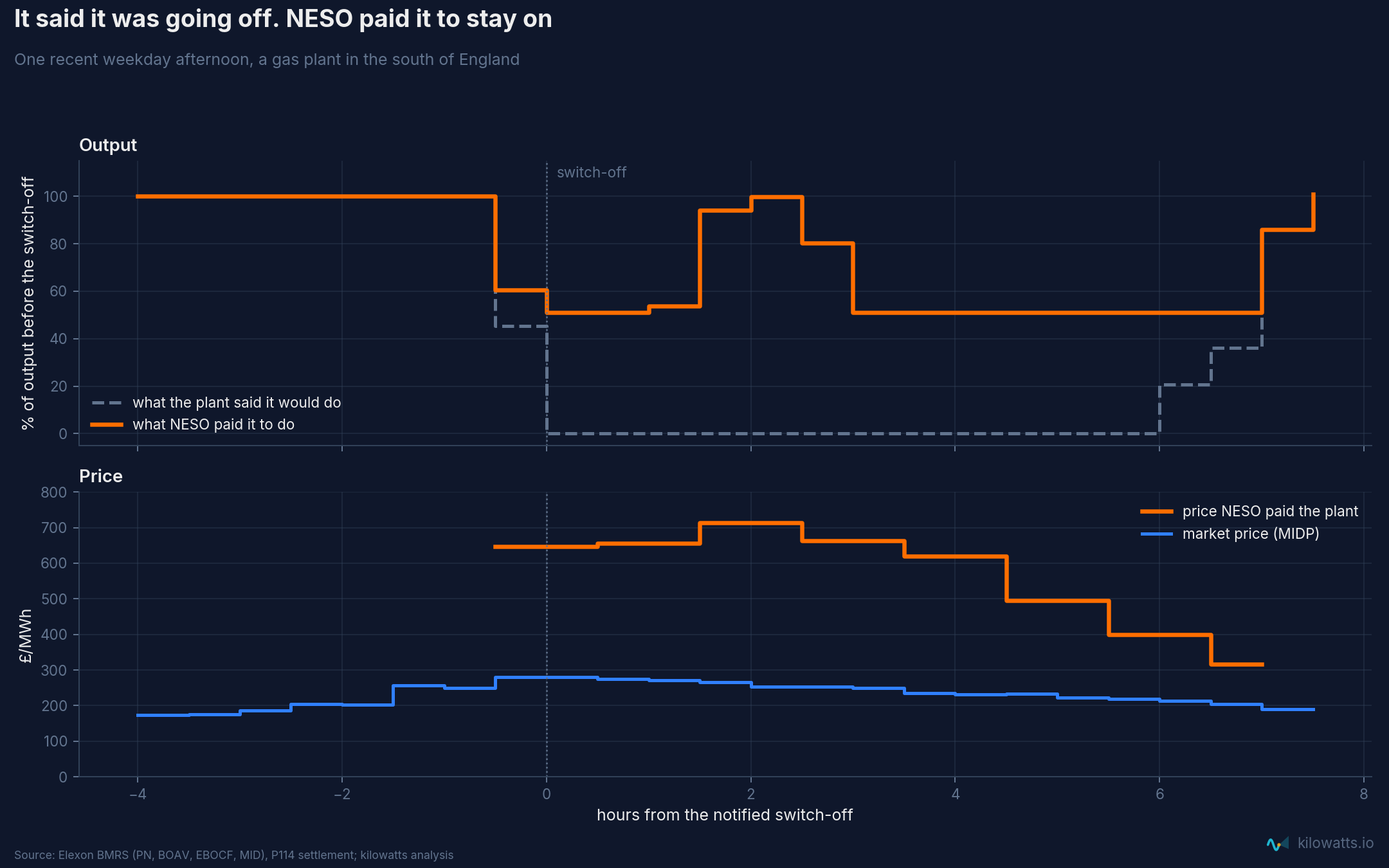
I'm not going to name the plant, and nothing in this piece should be read as an accusation. What the plant did is, as far as I can tell, within the rules. It is also not rare. I've found about 2,800 switch-offs like this by gas plants since 2016, and NESO kept about half of them on. Together they've been paid £689 million, of which £390 million was above the market price of the same power.
This is a game of chicken. The plant drives at the cliff edge of the evening peak, and NESO has to decide whether to swerve.
Why they play: gas can't pay its way in the market
The first thing to understand is that this is a business model under pressure, not a heist.
A gas plant makes its living on the spark spread: the price it sells power for, minus the gas it burns and the carbon permits it has to buy. For a typical combined-cycle plant, that spread averaged +£6 to +£12/MWh across every half-hour of the year from 2016 to 2020, and +£24 in 2022. Since 2024 it has been negative every year, between −£2 and −£6. The market now covers a gas plant's fuel in only about half of all half-hours, against nine in ten in 2016–17.
So the fleet runs less. Britain's combined-cycle gas plants ran at 47% of their capacity in 2016 and 26–28% in 2024–25. Wind and solar take the cheap hours; gas is left with the dear ones.