


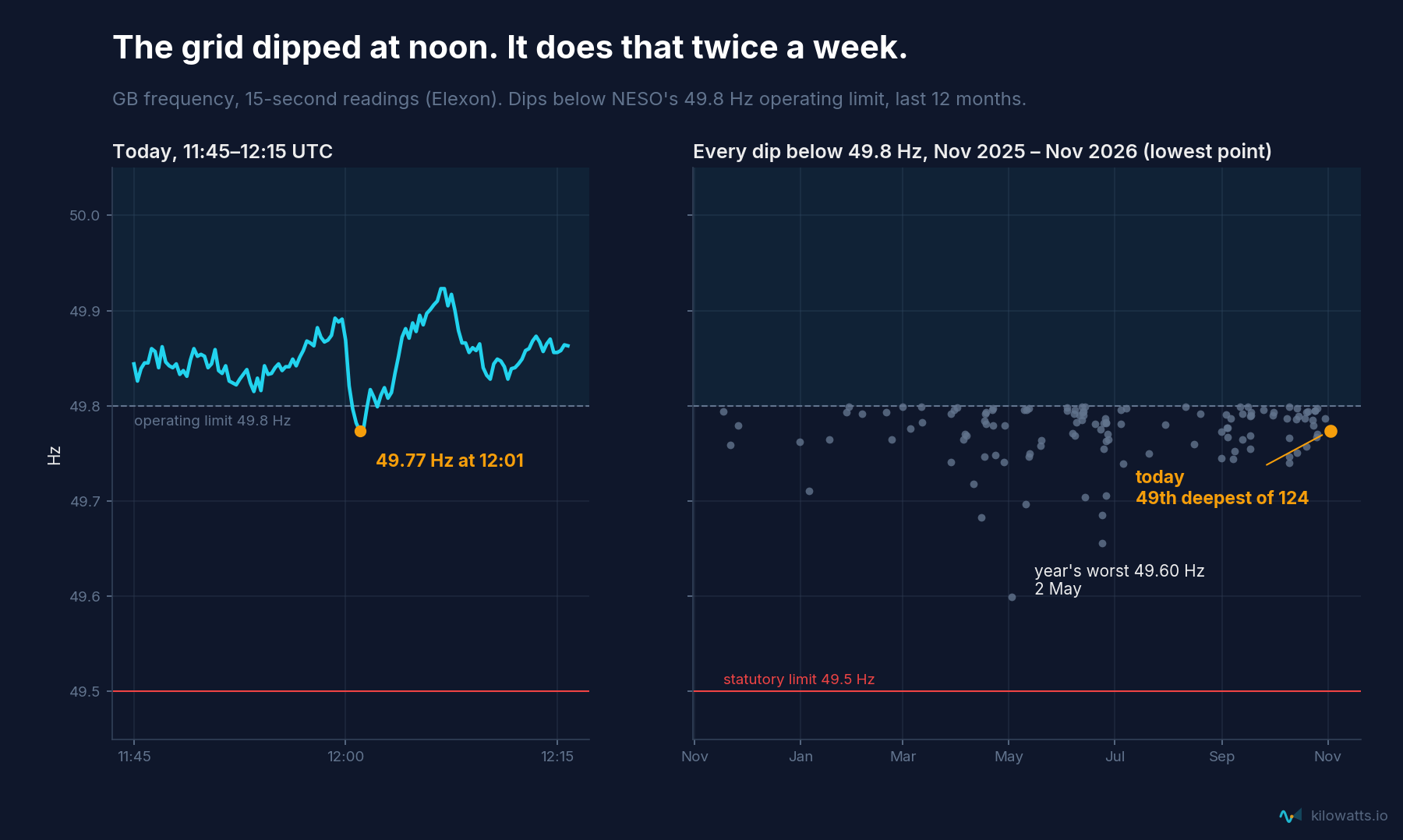
If you watch grid frequency (and some of you, I know, have it on a dashboard), you will have seen it at noon today. At 12:00 GMT, Britain's frequency slid from 49.89 Hz to 49.77 Hz in about a minute. It stayed below NESO's 49.8 Hz operating limit for 75 seconds and was back above 49.9 Hz by 12:06.
So, did it really happen, and should anyone care?
How big was it?
Not very. Using Elexon's 15-second frequency data for the last twelve months:
Frequency dropped below 49.8 Hz in 124 separate episodes, about twice a week. Today's was the 49th deepest.
In total, frequency spent 3.7 hours of the year below 49.8 Hz. That's 0.04% of the time.
The worst was 49.60 Hz on 2 May. The night everyone remembers, 23 June, when France saved the British grid, bottomed out at 49.66 Hz and stayed low for over half an hour.
The statutory limit is 49.5 Hz. Nothing came near it this year.
The fall itself was 0.117 Hz in about a minute. That's bigger than usual: about one half-hour boundary in seven this year saw a bigger drop. Today's mattered because the grid started from 49.89 Hz, so there wasn't much room before the 49.8 line.
What is worth noticing: the count
Dips cluster. Last winter was calm, with 12 dips from November to February. Then they rose through spring to a peak of 29 in 30 days around the start of July. They faded in August, and a second wave has been building since September: 41 since 1 September, and 22 in the last 30 days.
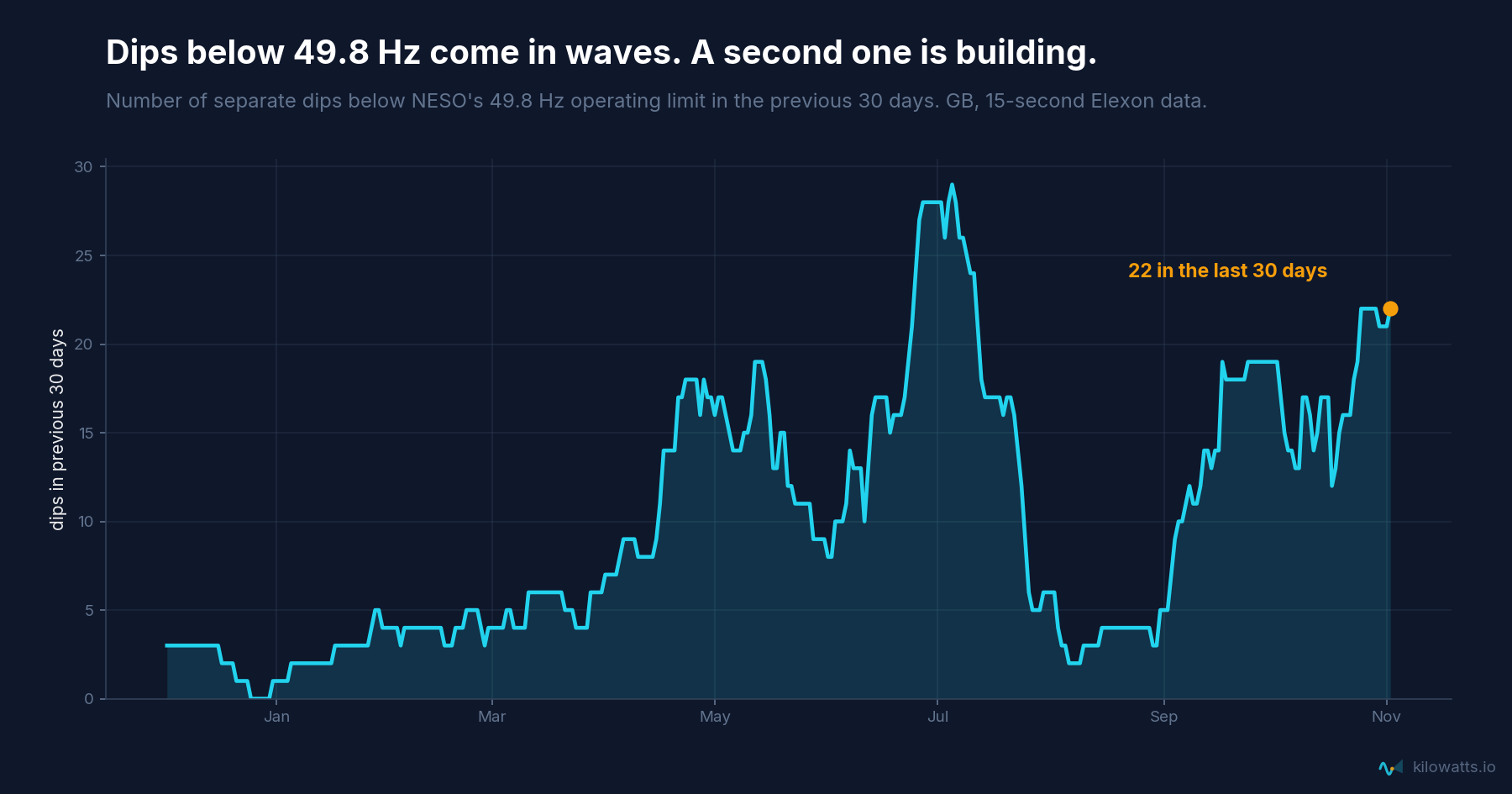
The depth hasn't got worse. The median dip bottoms out around 49.78 Hz in every quarter. There are simply more of them, and the ones that happen are falling slightly faster.
Noon on the dot
The time is the giveaway. A third of this year's dips began within two minutes of a half-hour boundary, when one settlement period hands over to the next. By chance you'd expect one in ten. The dips that start on a boundary also fall almost twice as fast as the ones that don't.
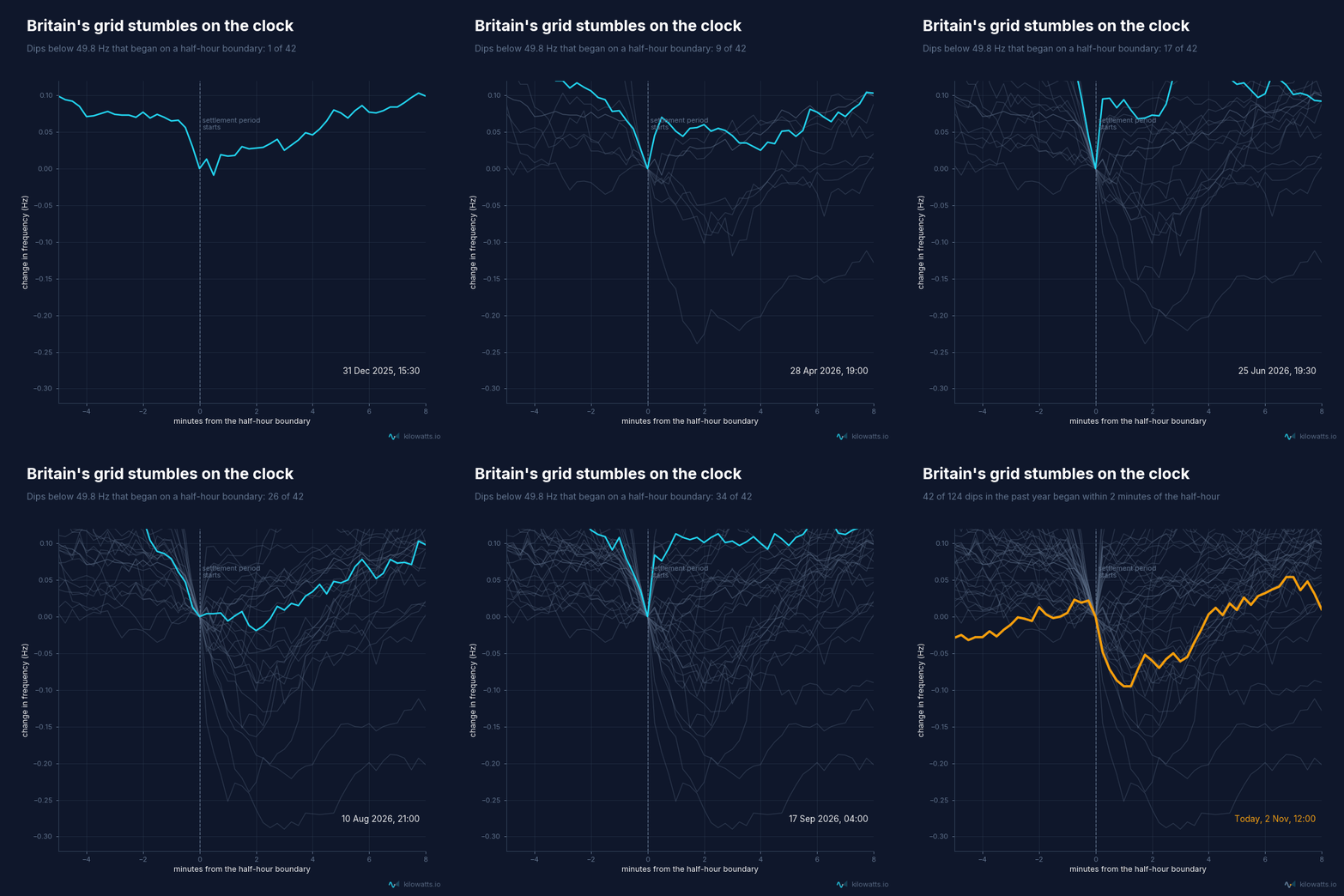
If this sounds familiar, it should. In September I showed that Britain's cheap-rate tariffs hit the grid like a World Cup whistle: every winter night, storage heaters and EV chargers switch on together at midnight and 00:30, and frequency drops on cue. Today was the same mechanism, at lunchtime, driven by grid batteries rather than cars. The public schedules show how.
Imports ramped. Interconnector traders had bought about 2,100 MW more imports for the 12:00 period, mostly by cutting exports on Viking to Denmark, plus more from France on IFA2 and ElecLink. Cables don't step. They ramp, and the import climbed from 11:50 to about 12:05. That's why frequency rose to 49.89 Hz in the minutes before noon: the extra power was arriving early.
Batteries stepped. At 12:00, 128 battery and flexible units, about 1.2 GW in total, switched to charging, mostly within a minute. That compares with roughly 820 MW net once other units' increases are counted. The units were spread from Lanarkshire to Hampshire, not concentrated in the south.
The gap. For a minute or two, the demand from batteries was in place and the imports weren't. Frequency fell. Once the cables reached their new level at about 12:05, it recovered to 49.92 Hz.
It wasn't NESO either. None of those batteries was instructed to charge. They were following their own submitted schedules. NESO's acceptances went the other way. At 11:48 it held about 140 MW of them, including Hams Hall and Thurrock, at zero for the first two minutes of the period, softening the step. At 12:01 it turned other batteries towards discharging to help recovery. The control room saw it coming and partly smoothed it. The step itself was the market's.
It wasn't a price spike. The intraday price fell from £189 to £180/MWh across the boundary, a small move. The batteries were following half-hourly schedules, and half-hourly schedules switch on the half-hour.
This is my reading of the public data, using physical notifications and 5-minute outturn. NESO hasn't commented on today.
Couldn't NESO have smoothed it?
Mostly, yes. Schedules are locked at gate closure, an hour ahead, so NESO knew at 11:00 that over a gigawatt of batteries would switch to charging on the stroke of twelve. Holding them back for two or three minutes would have cost about 50 MWh of trades, probably a few thousand pounds. It did it for 140 MW. It didn't for the rest.
But the bigger problem is the rules, not the control room. We already regulate this behaviour, just for the wrong-sized machines. Since June 2022, every home EV charger sold in Britain must by law wait a random delay of up to 600 seconds before it starts or changes rate. In the tariff-cliff piece I showed the law working: the midnight and 00:30 drops turned from a cliff into a ten-minute slide.
A 7 kW home charger must spread its start over ten minutes. A 100 MW battery can declare it moves 100 MW a minute and step on the boundary, quite legitimately. Meanwhile NESO makes interconnectors ramp gradually across the same boundary. Today the cables and the batteries met head-on.
And the timing is moving towards midday. In the same piece I found that the cheapest half-hour of a spring or summer day now falls at midday on 71% of days, up from under a fifth before 2022. Batteries chase the cheapest half-hours. The cliff that used to be a night-time, storage-heater-and-EV story is becoming a lunchtime, grid-battery one.
So what?
Today wasn't a near miss. It was avoidable, though, and it's part of a pattern: the grid is now steered by fast assets that move in blocks, and the physical system has to absorb each block change in real time. The fix is the one we already applied to home chargers. Make the fast things ramp across the boundary, or at least ramp them the same way as the cables. That's the thread through Voluntary Frequency Response, my proposal for home batteries to behave like good grid citizens rather than all jumping together, and through the World Cup half-time ramp.
For 23 June itself, see the control room story, what my own meter recorded, and the demand forecast that missed by 1.4 GW. For the October sequel, Britain's emergency call to France.
A note on clocks: the clocks went back on 25 October, so 12:00 today was noon GMT, near solar noon. Settlement periods follow the clock, not the sun, so the same pattern follows the clock all year.
Data: Elexon BMRS frequency (FREQ, 15-second), physical notifications (PN), FUELINST, market index price (MID). Code and data on request.