


When Claire Coutinho stood up and accused the people who keep Britain's lights on of quietly burying how close we came to the edge on the evening of 23 June, I did something most people can't. I went and checked.
Not because I'm clever. Because I'm the sort of person who has a grid-frequency meter in a cupboard on Dartmoor.
It's not a special meter — it's the energy monitor that came with my solar-and-battery setup, sitting on the wall next to the fuse box, quietly logging the frequency of the national grid every minute of every day. And grid frequency is the one number a person in a cupboard can hold the whole country to account with. On a synchronous AC grid, frequency is the same everywhere at once: the reading on my wall in Devon is, to a rounding error, the reading in the National Energy System Operator's control room 150-odd miles away. If NESO's official record said one thing and my meter said another, that would be a story.
So when the shadow energy secretary told Parliament that a whistleblower inside NESO had described managers keeping decisions off the books, and that the grid on 23 June had been less secure than the official version admitted, I had — unusually — the means to mark their homework. Both of them.
I went looking for a cover-up. I found something more interesting, and in the end more damning: the establishment's data was honest, the grid held — and the reason it held is the scandal nobody is shouting about.
What the meter saw
Here is 23 June on my meter, set against every other evening that month.
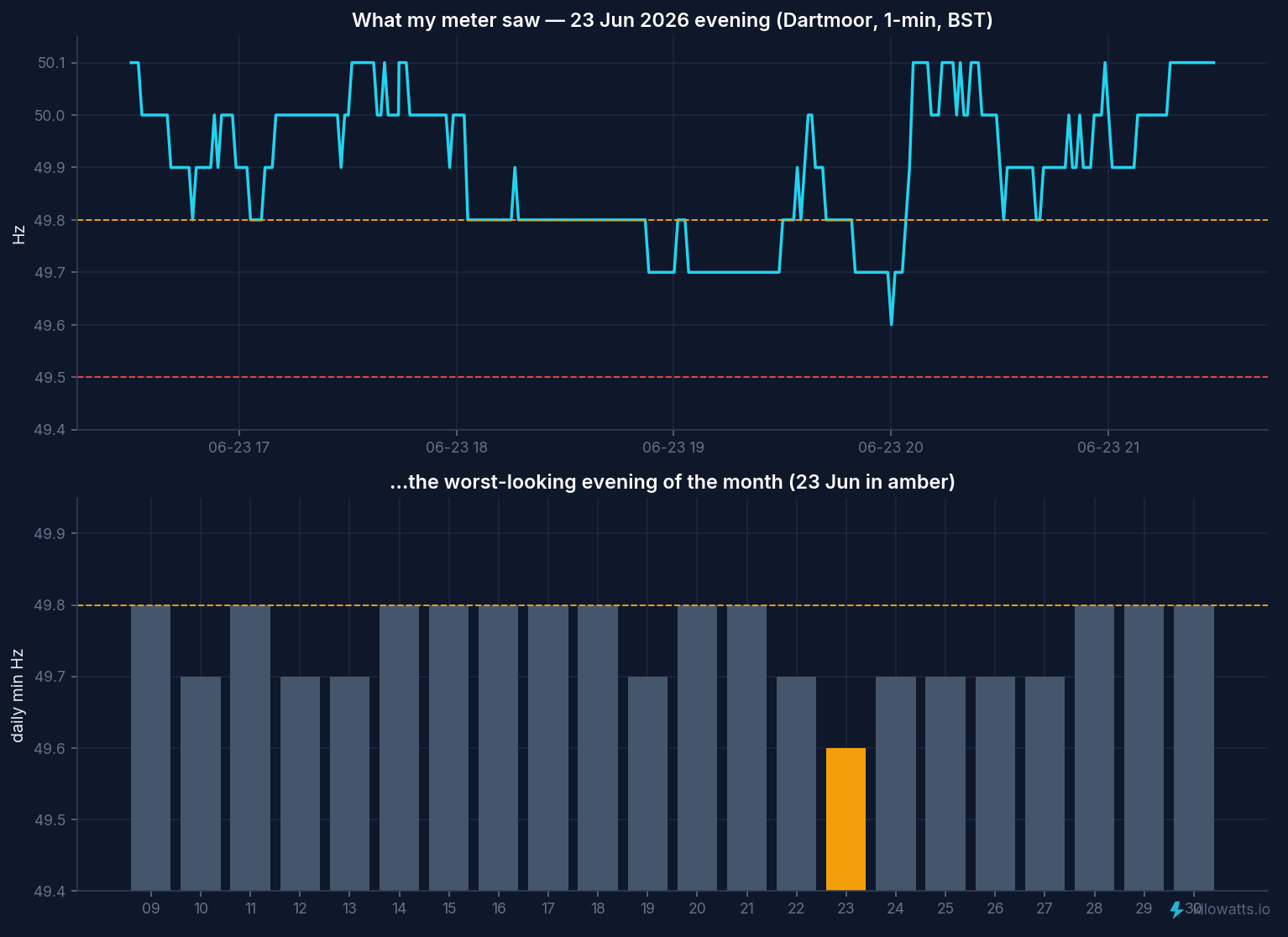
It's the worst-looking evening of the lot. From about ten to seven the frequency sags and stays sagged, wandering below the 49.8 Hz line that NESO treats as its operational floor, and around eight o'clock it touches what my meter reads as 49.6 — the lowest point of the entire month. If you wanted a picture to accompany the words "the grid was in trouble and they didn't tell you," this is it.
For about a day, I thought I had one.
The twist
The honest thing to do with a suspicious-looking home measurement is to check it against the professionals'. NESO's second-by-second data doesn't publish until a month after the event, but Elexon — the market's referee — carries the same official frequency at 15-second resolution, and it is available. (It's also, as it happens, exactly the source the energy analyst Kathryn Porter used for her own well-aired critique of that evening. Hold that thought.)
So I overlaid the two.
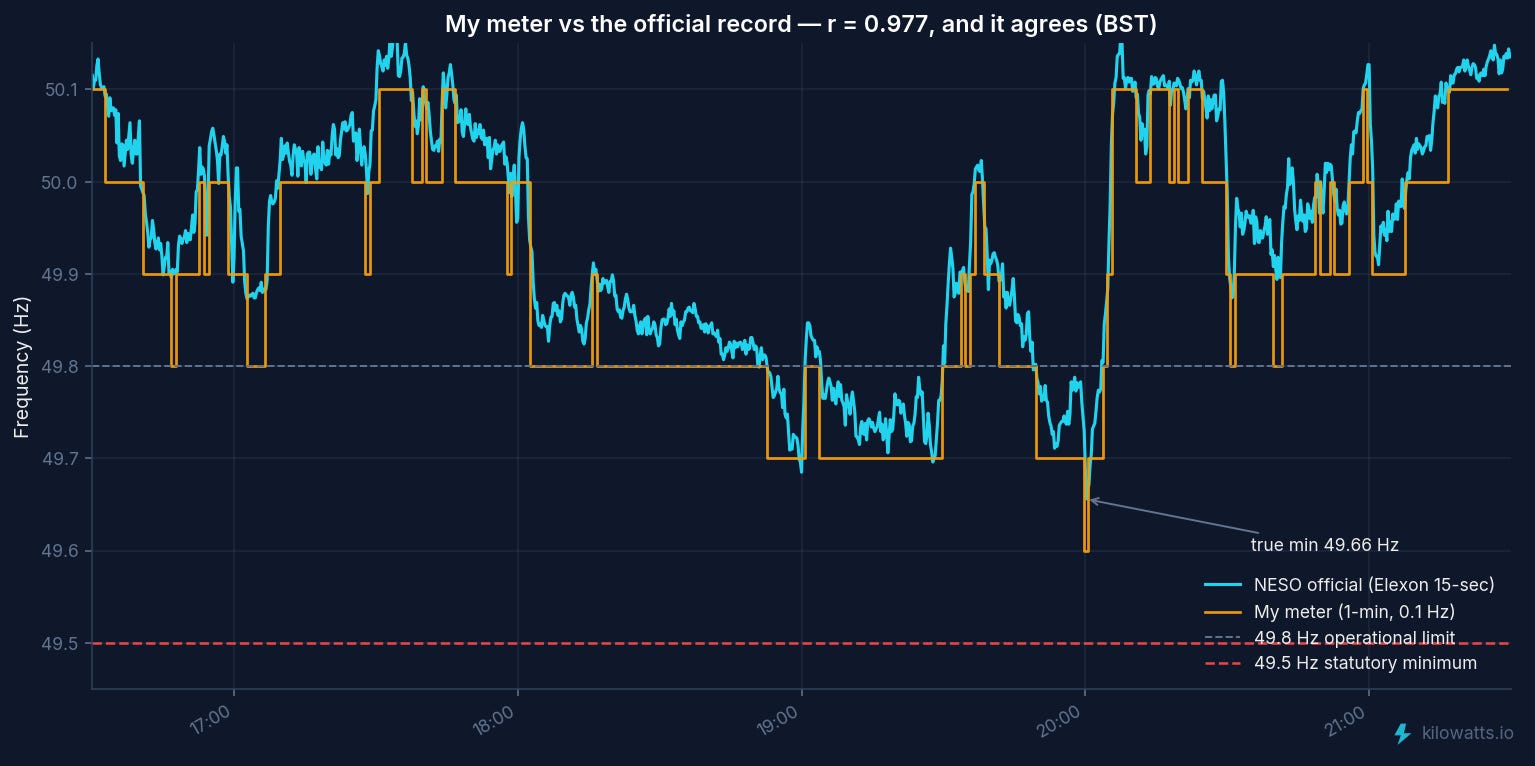
They agree. Not roughly — a correlation of 0.977, the same shape, both bottoming at the same minute around eight o'clock. My cupboard genuinely tracked the national grid. But the official curve is a little kinder than mine: the true minimum wasn't 49.6, it was 49.656 Hz — a real dip, but one that stayed clear of the 49.5 Hz statutory floor and miles from the 49.2 Hz at which the grid automatically starts shedding load. My meter reads about 0.05 Hz low, and because it reports in coarse tenths, it over-states how long frequency spent under each threshold. My eye-catching impression that it sat under 49.7 Hz for the best part of an hour? Below that line the true figure is nearer two minutes.
Which is a small humiliation with a large lesson. A £100 meter in a cupboard can tell you, remarkably well, when the grid wobbled and what shape the wobble was. It cannot tell you it breached a limit it didn't breach. The frequency is not the scandal. If anything, my amateur kit made the evening look worse than the professionals' did — the opposite of a cover-up.
So which side do you take?
You can't answer that until you're precise about what Coutinho actually alleged, because most of the coverage wasn't. She made two specific claims. First, that NESO managers told staff to work in "live documents with no version history," creating no permanent audit trail — to keep records from being preserved for Freedom of Information requests. Second, that NESO's corporate affairs team interfered in control-room decisions to protect the organisation's reputation. She's referred it to the Information Commissioner in a 7 July letter. NESO denies it; the energy minister, Michael Shanks, called it "scaremongering."
Here's the thing readers need and the shouting obscures: those are claims about NESO's internal records and motives, not its published data. So my meter — and every public dataset — can settle some of this cleanly and is simply blind to the rest.